





Spotlights
Plumber, Pipefitter, Steamfitter, Journeyman Plumber, Service Plumber, Industrial Pipefitter, HVAC Pipefitter, Sprinkler Fitter, Gas Fitter, Backflow Technician, Residential Plumber, Commercial Pipefitter
Turn on a faucet, flush a toilet, or walk into a warm building on a freezing day, and you are relying on a network of pipe that someone had to design, install, and test without a single leak. Plumbers, Pipefitters, and Steamfitters build and maintain the hidden systems that carry water, gas, steam, and other fluids through homes, hospitals, schools, and factories, work that almost nobody notices until it stops working, and that everybody notices immediately when it does.
While the three specialties share a foundation in reading pipe system blueprints, cutting and joining pipe, and troubleshooting pressurized systems, each has its own focus. Plumbers install and repair the water supply, drainage, and gas piping in homes and buildings, working closely with homeowners, general contractors, and electricians. Pipefitters install high-pressure and process piping in industrial settings like power plants, refineries, and manufacturing facilities, working alongside engineers and industrial mechanics. Steamfitters specialize in the pipe systems that move steam and hot water for heating and industrial processes, often in large commercial and institutional buildings. All three trades demand precision, since a bad joint in a pressurized system is not just an inconvenience, it can be dangerous.
Using tools like pipe wrenches, pipe threaders, welding rigs, press-fitting tools, and increasingly, computer-aided pipe design software, these tradespeople combine physical skill with a deep understanding of fluid dynamics, pressure, and materials. Their work keeps drinking water clean, keeps hospitals sterile, keeps factories running, and keeps buildings heated safely through winter. Few trades have as direct an impact on public health and safety as the people who build and maintain the pipes we depend on every single day.
- Solving hands-on puzzles every day, since no two pipe systems or problems are identical
- Knowing your work directly protects public health and safety
- High demand and strong union wages with a clear, well-paid career path
- Freedom to specialize across residential, commercial, or industrial settings
Working Schedule
Most Plumbers, Pipefitters, and Steamfitters work full-time, around 40 hours a week, though service plumbers and those on emergency call rotations may work evenings, weekends, or overnight to handle burst pipes, gas leaks, or heating failures. Industrial pipefitters often work scheduled shifts at a plant or refinery, sometimes including planned shutdown periods that require extended hours. The work happens in a mix of settings: crawl spaces, basements, mechanical rooms, industrial plants, and active construction sites, and it can involve tight, uncomfortable spaces as well as physically demanding lifting and positioning of pipe. Most tradespeople in this field are employed by plumbing, mechanical, or industrial contractors, or dispatched through a union hiring hall.
Typical Duties
- Reading blueprints and piping schematics to plan installations
- Measuring, cutting, threading, and joining pipe made of copper, PVC, steel, and other materials
- Installing water supply lines, drains, and venting systems in buildings
- Installing and repairing fixtures such as sinks, toilets, water heaters, and boilers
- Welding, soldering, and press-fitting pipe joints to prevent leaks
- Installing and maintaining high-pressure process piping in industrial facilities
- Installing steam and hot water heating systems in commercial buildings
- Testing pipe systems for leaks, pressure, and code compliance
- Diagnosing and repairing clogs, leaks, and malfunctioning fixtures
- Installing gas lines and connecting gas-powered appliances safely
- Reading and interpreting mechanical and plumbing codes
- Coordinating pipe routing with electricians, HVAC technicians, and other trades
Additional Responsibilities
- Maintaining and calibrating pipe-cutting, threading, and welding equipment
- Estimating materials and labor costs for jobs
- Responding to emergency service calls for leaks or system failures
- Training apprentices on pipefitting, soldering, and safety procedures
- Keeping detailed records of installations, inspections, and repairs
- Ensuring compliance with local plumbing and mechanical codes
- Communicating with clients or facility managers about system issues
- Staying current on new pipe materials and green plumbing technologies
A Plumber, Pipefitter, or Steamfitter's day often starts with a review of the work order or service calls scheduled for the day, gathering the right pipe, fittings, and tools before heading to the job site. A residential plumber might spend the morning diagnosing a leak under a sink or replacing a water heater, while an industrial pipefitter might be reviewing isometric drawings before installing high-pressure process piping at a plant.
Midday work is often the most physically demanding part of the day: cutting and threading pipe, welding or soldering joints, and fitting sections of pipe into place in tight or awkward spaces. Precision matters enormously here, since a single bad joint can mean a leak that shows up weeks later. Steamfitters working on a commercial heating system might spend hours running pipe through mechanical rooms and connecting it to boilers and radiators.
Afternoons often bring testing and troubleshooting: pressurizing a new system to check for leaks, running water through a newly installed line, or diagnosing why a fixture is not working properly. Service plumbers may fit in several house calls in an afternoon, each with a different problem to solve. At the end of the day, the crew cleans up the work area, documents completed work, and preps materials for tomorrow's jobs.
Soft Skills
- Strong problem-solving and diagnostic thinking
- Attention to detail and precision under pressure
- Physical stamina for lifting, kneeling, and working in tight spaces
- Clear communication with clients, crew, and other trades
- Patience when troubleshooting hidden or hard-to-access problems
- Customer service skills, especially for residential service work
- Reliability and punctuality, particularly for emergency calls
- Comfort working in confined or uncomfortable spaces
- Safety awareness around pressurized systems and gas lines
- Adaptability across different building types and systems
- Basic business sense for estimating and billing
- Willingness to keep learning as codes and materials evolve
Technical Skills
- Reading blueprints, piping schematics, and isometric drawings
- Pipe cutting, threading, soldering, welding, and press-fitting
- Knowledge of copper, PVC, PEX, cast iron, and steel piping systems
- Understanding of water supply, drainage, and venting systems
- High-pressure and process piping installation for industrial settings
- Steam and hydronic heating system installation and repair
- Use of pressure testing and leak detection equipment
- Knowledge of local and national plumbing and mechanical codes
- Gas line installation and safety procedures
- Basic knowledge of electrical and HVAC systems for coordinated work
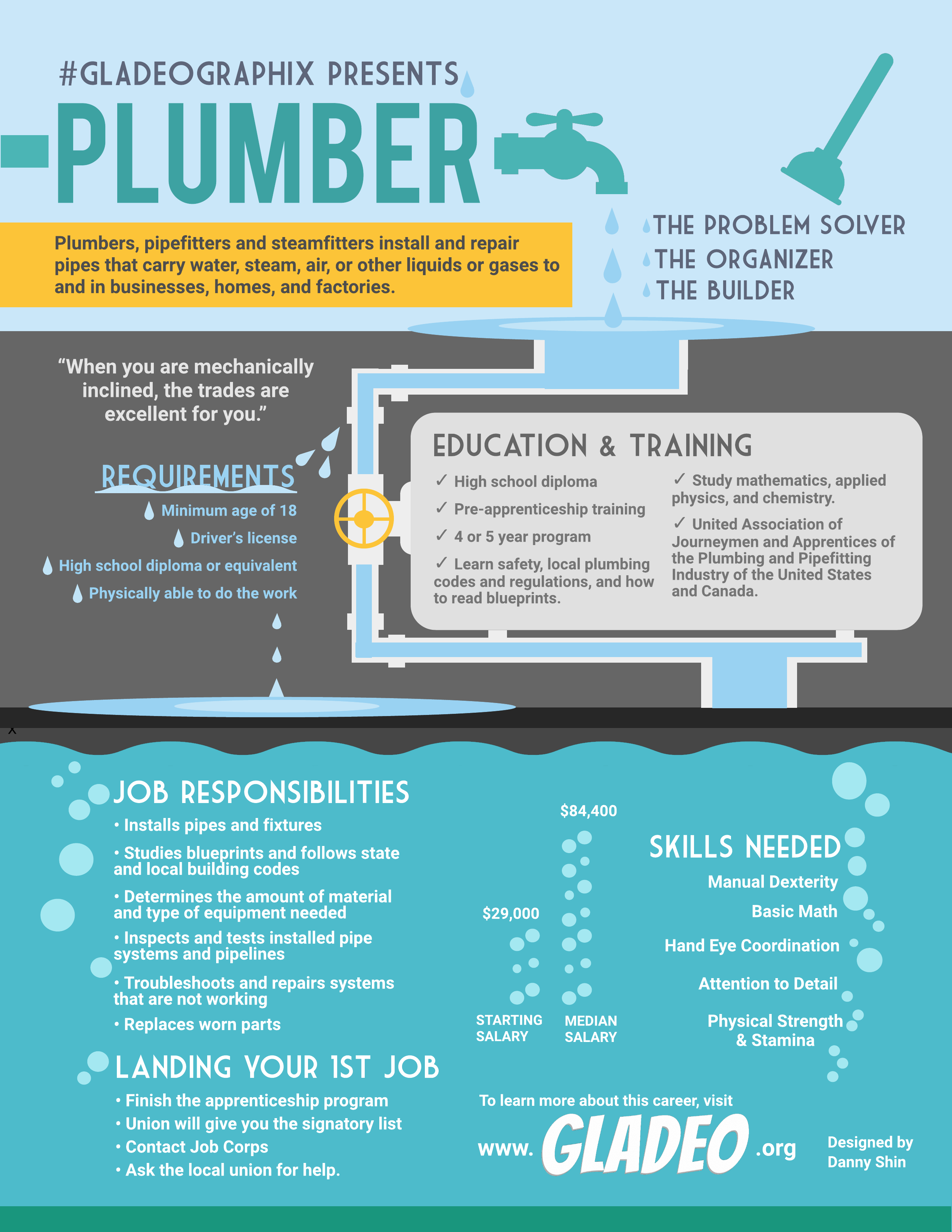
- Residential Plumber: Installs and repairs water, drain, and gas systems in homes
- Commercial Plumber: Works on larger-scale plumbing systems in office and retail buildings
- Service Plumber: Specializes in diagnosing and repairing existing systems and emergency calls
- Industrial Pipefitter: Installs high-pressure process piping in plants and refineries
- Steamfitter: Focuses on steam and hot water heating systems in large buildings
- Sprinkler Fitter: Installs and maintains fire suppression sprinkler systems
- Gas Fitter: Specializes in installing and servicing gas piping and appliances
- Backflow and Cross-Connection Technician: Tests and maintains devices that protect drinking water
- Residential plumbing contractors
- Commercial and industrial mechanical contractors
- Power plants, refineries, and manufacturing facilities
- Union hiring halls and apprenticeship programs
- HVAC and mechanical systems companies
- Fire protection and sprinkler system contractors
- Hospitals, schools, and institutional facilities departments
- Municipal water and wastewater utilities
- General contractors on new construction projects
- Property management companies
- Government infrastructure agencies
- Independent and self-employed plumbing businesses
This trade demands precision under real stakes: a poorly sealed joint in a gas line or a high-pressure steam system is not a minor error, it is a safety hazard. Plumbers, pipefitters, and steamfitters are expected to follow code exactly and take the time to test their work thoroughly, even when a schedule is tight, because cutting corners can put people at risk.
The physical demands add up over a career. The work involves kneeling, crawling into tight spaces, lifting heavy pipe and fixtures, and sometimes working in extreme heat near boilers or in the cold in unheated crawl spaces. Service plumbers and those on emergency rotations may be called out at inconvenient hours, since pipes do not wait for business hours to burst.
In return, this is one of the most in-demand and well-compensated trades, with strong union wages, comprehensive benefits, and a clear path from apprentice to journeyman to master plumber or pipefitter. Many eventually move into supervisory roles, start their own contracting businesses, or specialize in high-paying industrial and mechanical work.
- Growth in green plumbing technologies like tankless and heat pump water heaters
- Increased use of PEX piping for faster, more flexible residential installations
- Rising demand for water conservation and greywater recycling systems
- Expansion of industrial and data center construction driving pipefitting demand
- Use of pipe modeling software and prefabrication to speed installation
- Greater emphasis on backflow prevention and drinking water protection
- Adoption of trenchless technology for underground pipe repair and replacement
- Growth in geothermal and hydronic heating system installation
- Rising demand for skilled tradespeople as the existing workforce ages into retirement
- Integration of smart leak-detection sensors and connected plumbing systems
Many Plumbers, Pipefitters, and Steamfitters grew up as natural problem solvers, the kind of kid who wanted to know why something was leaking or how a system of pipes actually worked. Taking things apart, fixing bikes, or helping a parent with home repairs were common early interests, along with puzzles and building projects that rewarded patience and logic.
Others were drawn to science classes involving pressure, fluids, or physical systems, and they enjoyed the satisfaction of diagnosing a problem and solving it with their hands. A practical, methodical mindset paired with comfort in tight or messy spaces often pointed these students toward one of these closely related trades.
“Some of us we have more Neanderthal DNA than others. You’ve got to be able to express that in the best way possible. We all have a sense of creativity that can be shown and it’s finding that way to show that creativity. Some people they can do that behind a computer, other people it’s great to be able to build a building. It all comes into that sense of being of whatever makes you feel alive.” Robert Williams III, Business Rep, International Union of Painters and Allied Trades District Council 16, Northern California
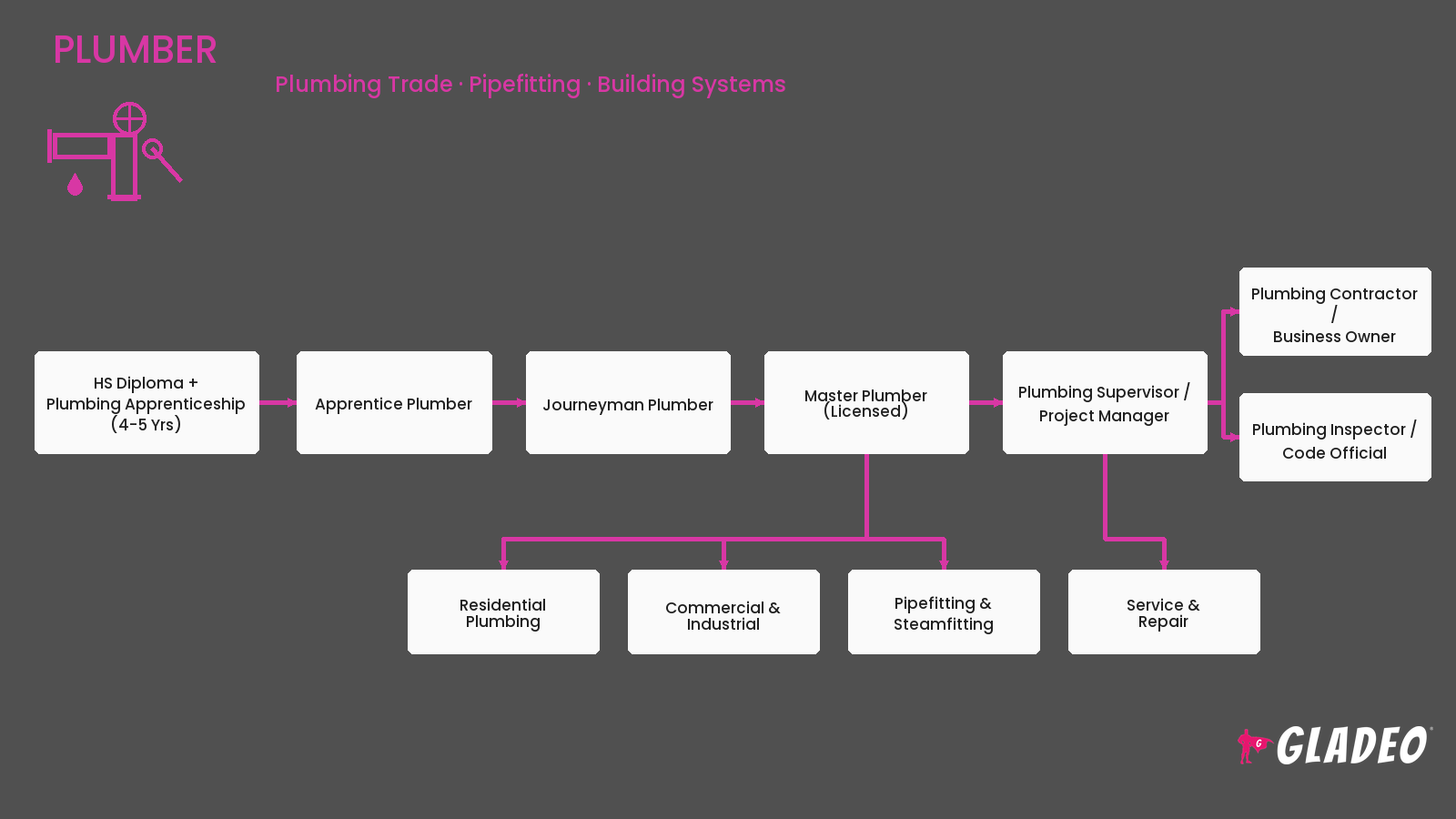
Most Plumbers, Pipefitters, and Steamfitters enter the field through a registered apprenticeship, commonly sponsored by the United Association of Journeymen and Apprentices of the Plumbing and Pipe Fitting Industry (UA) or by mechanical contractor associations. These programs typically last four to five years and combine paid on-the-job training with classroom instruction in blueprint reading, code, welding, and safety. A high school diploma or equivalent is generally required, and most states require passing a licensing exam to work as a journeyman or master plumber.
Students can take courses in relevant subjects such as:
- Blueprint Reading and Piping Schematics
- Construction Math and Applied Physics
- Introduction to Plumbing and Pipefitting
- Welding and Pipe Joining Techniques
- Plumbing and Mechanical Code
- Occupational Safety (OSHA 10 or 30)
- Basic Hydraulics and Fluid Dynamics
- Shop Class and Tool Safety
- Gas Systems and Appliance Basics
- Blueprint and Isometric Drawing Interpretation
Apprentices earn wages from day one while training under journeymen on real installations and repairs, with pay increasing at each level completed. Many UA-affiliated programs include time at a dedicated training center with pipefitting, welding, and pressure-testing stations. After becoming a journeyman, additional certifications, such as medical gas piping or backflow prevention, can open doors to specialized, higher-paying work, and passing a master plumber exam allows some to run their own licensed businesses.
- Take algebra, geometry, and physical science, which apply directly to pipe sizing and pressure
- Enroll in shop, welding, or construction technology classes if your school offers them
- Contact a local UA plumbers or pipefitters union about apprenticeship opportunities
- Practice fixing things at home, from leaky faucets to running toilets, to test your interest
- Attend a SkillsUSA competition or trade career fair to meet contractors and unions
- Job shadow a plumber or pipefitter or tour a mechanical contracting shop
- Earn an OSHA 10 safety certification before applying to programs
- Get comfortable with basic welding or soldering through a shop class if possible
- Talk to a working plumber, pipefitter, or steamfitter about the differences between the specialties
- Take on part-time or summer work involving manual labor or basic repairs
- Research apprenticeship application deadlines and any required entrance exams
- Build physical stamina, since the work involves kneeling, lifting, and tight spaces
- A registered apprenticeship recognized by the U.S. Department of Labor
- Sponsorship by the United Association (UA) or a reputable mechanical contractor
- A curriculum that prepares you for your state's journeyman licensing exam
- Hands-on training center time for pipefitting, welding, and pressure testing
- Instructors with real field experience in plumbing or pipefitting
- A clear wage progression schedule tied to completed apprenticeship levels
- Strong safety training covering gas lines, confined spaces, and pressurized systems
- Job placement support with local signatory contractors
- Opportunities to specialize in residential, commercial, or industrial work
- Support for licensing exam preparation
- Manageable class sizes with real bench and tool time
- Flexible scheduling if you plan to work while completing training
- Apply to a local UA apprenticeship program or plumbing and mechanical contractor
- Complete any required aptitude test and interview with genuine enthusiasm for the trade
- Earn an OSHA 10 certification before applying to strengthen your application
- Highlight any experience with tools, repairs, or mechanical problem-solving
- Attend union open houses or contractor hiring events in your area
- Consider entry-level helper or laborer roles to get a foot in the door
- Ask about pre-apprenticeship programs at local technical or trade schools
- Build a reliable work history, since dependability is critical for service calls
- Network with working plumbers or pipefitters and their union locals
- Be ready to discuss your comfort with tight spaces and physical labor honestly
- Keep a valid driver's license, since service and job sites vary across a region
- Follow up consistently with the hiring hall while waiting for apprenticeship placement
- Complete every level of apprenticeship training and pass your journeyman licensing exam
- Volunteer for complex jobs like industrial piping or advanced heating systems
- Pursue a master plumber license to unlock supervisory and business ownership options
- Earn specialty certifications such as backflow prevention or medical gas piping
- Build a reputation for clean, code-compliant, leak-free work
- Move from journeyman into foreman, estimator, or project manager roles
- Mentor apprentices in pipefitting, code knowledge, and safety practices
- Consider starting an independent plumbing or mechanical contracting business
Websites:
- United Association of Journeymen and Apprentices of the Plumbing and Pipe Fitting Industry - ua.org
- Plumbing-Heating-Cooling Contractors Association - phccweb.org
- Mechanical Contractors Association of America - mcaa.org
- International Association of Plumbing and Mechanical Officials - iapmo.org
- American Society of Plumbing Engineers - aspe.org
- National Center for Construction Education and Research (NCCER) - nccer.org
- SkillsUSA - skillsusa.org
- Occupational Safety and Health Administration - osha.gov
- PM Engineer Magazine - pmengineer.com
- Plumbing & Mechanical Magazine - pmmag.com
- Home Builders Institute - hbi.org
Books:
- Modern Plumbing by E. Keith Blankenbaker and Steven Blankenbaker
- Pipefitter's Blue Book by W.V. Graves
- Plumber's and Pipe Fitter's Calculations Manual by Jules Oravetz
- Audel Plumbers and Pipe Fitters Library by Rex Miller and Mark Richard Miller
- The Steam Fitter's Handbook by John A. Denison
If you find that being a Plumber, Pipefitter, or Steamfitter isn't the right fit, your mechanical aptitude and systems thinking transfer well into related trades.
- HVAC Technician
- Welder
- Industrial Mechanic
- Construction Estimator
- Boiler Operator
- Sprinkler Fitter
- Gas Utility Technician
- Water Treatment Plant Operator
- Building Inspector
- Mechanical Contractor
Newsfeed

Featured Jobs
Online Courses and Tools