







Spotlights
Framing Carpenter, Finish Carpenter, Cabinetmaker, Trim Carpenter, Formwork Carpenter, Rough Carpenter, Residential Carpenter, Commercial Carpenter, Union Carpenter, Woodworker, Construction Carpenter, Scenic Carpenter
Nearly every structure you walk into, your house, your school, a store, a stage set, started as a stack of lumber and a set of plans until a Carpenter turned it into walls, floors, staircases, and cabinets you can actually use. Carpentry is one of the oldest and most versatile trades in the world, and it still shapes almost everything built today, from the wood frame hidden behind drywall to the custom kitchen cabinets people show off to guests.
Carpenters build and repair structures and fixtures made of wood, steel studs, and other materials, working from blueprints and construction plans to frame walls and roofs, install doors and windows, build staircases, and craft finish work like trim, molding, and custom cabinetry. On a job site, carpenters collaborate with general contractors, electricians, plumbers, and architects, since framing has to be precise enough for every other trade to build on top of it. Some carpenters specialize in the fast-paced rough framing that gives a building its shape, while others focus on the slow, exacting finish work that gives a space its final look and feel.
Using tools ranging from hammers, levels, and chisels to circular saws, nail guns, table saws, and laser levels, Carpenters combine physical skill with careful measurement, because in this trade the saying "measure twice, cut once" is not just advice, it is survival. Their work forms the literal backbone of homes, offices, schools, and public buildings, and skilled finish carpentry can transform an ordinary room into something people are proud to live or work in.
- Turning raw lumber into finished structures people will use for generations
- Working with your hands at a trade that blends strength, precision, and creativity
- Wide variety of specialty paths, from rough framing to fine custom cabinetry
- Strong demand and solid wages through union and non-union paths alike
“You are able to look at the world differently. You know how to do things, design things, make things…When I bought my house, I redesigned my own bathroom. You feel empowered. You can create and build on a regular basis.” Silvia Y. Ledezma, Journeyman Carpenter, Scaffold (Staging) Builder, Contra Costa County
Working Schedule
Carpenters typically work full-time, around 40 hours a week, mostly during daytime hours on active construction sites. Overtime is common when projects are behind schedule or racing toward a deadline, and some finish carpenters or cabinetmakers keep more flexible hours if they run their own shop. The work is physically active and often outdoors during framing stages, moving indoors for finish work as a project nears completion. Most carpenters work for general contractors, framing companies, or carpentry contractors, though experienced carpenters sometimes go independent or start their own remodeling businesses.
Typical Duties
- Reading blueprints and construction plans to determine layout and dimensions
- Measuring, cutting, and shaping wood, plastic, and other materials
- Framing walls, floors, and roof structures for new construction
- Installing doors, windows, and hardware
- Building and installing staircases, railings, and structural supports
- Installing insulation, drywall backing, and subflooring
- Crafting and installing finish trim, molding, and baseboards
- Building custom cabinetry, shelving, and built-in furniture
- Repairing and renovating existing wood structures and fixtures
- Setting up and stripping concrete formwork for foundations and walls
- Operating power tools including saws, nail guns, and routers safely
- Inspecting completed work for level, plumb, and square accuracy
Additional Responsibilities
- Estimating material quantities and costs for projects
- Maintaining and sharpening hand tools and power equipment
- Coordinating scheduling with other trades on a job site
- Training and supervising apprentices and helpers
- Following building codes and obtaining necessary permits
- Cleaning and organizing job sites for safety and efficiency
- Communicating with clients or project managers about progress and changes
- Staying current on new materials, fasteners, and building techniques
A Carpenter's day often starts with a review of the day's plans, checking blueprints against what has already been built and confirming which materials arrived on site. Mornings during a framing job are fast-paced: measuring and cutting studs, nailing wall sections together, and raising them into place with the crew, all while keeping everything square and level.
Midday work shifts depending on the stage of the project. On a framing job, the crew might be sheathing walls or setting roof trusses, working efficiently as a team to keep the schedule on track. On a finish carpentry job, the pace slows down considerably, with careful measuring, cutting, and fitting of trim, cabinets, or custom millwork where a sixteenth of an inch can make the difference between a seamless joint and a visible gap.
Afternoons often bring a mix of installation, adjustment, and cleanup, along with coordination with other trades moving into the space behind the carpenters. A carpenter might walk a homeowner or project manager through completed work, note any changes needed, and prep materials for the next day. At the end of the day, tools are cleaned and stored, and any leftover material is organized for the next phase of work.
Soft Skills
- Precision and strong attention to detail
- Physical stamina and hand-eye coordination
- Problem-solving when materials or spaces do not match the plan exactly
- Clear communication with crew members and clients
- Patience, especially during detailed finish work
- Time management across multiple project phases
- Teamwork and reliability on a job site
- Adaptability to different project types and materials
- Pride in visible, lasting craftsmanship
- Basic math fluency for measurements and angles
- Safety awareness around power tools and heights
- Willingness to keep learning new techniques and materials
Technical Skills
- Blueprint and construction plan reading
- Framing techniques for walls, floors, and roofs
- Operation of power tools including saws, nail guns, and routers
- Precise measuring and layout using levels, squares, and laser tools
- Finish carpentry techniques including trim, molding, and joinery
- Cabinetmaking and custom millwork
- Concrete formwork construction
- Knowledge of lumber grades, fasteners, and adhesives
- Basic knowledge of electrical, plumbing, and HVAC rough-in coordination
- Building code compliance for structural and finish work
- Framing Carpenter: Builds the structural skeleton of walls, floors, and roofs
- Finish Carpenter: Installs trim, molding, doors, and detailed interior woodwork
- Cabinetmaker: Designs and builds custom cabinetry and built-in furniture
- Formwork Carpenter: Builds molds for pouring concrete foundations and structures
- Scenic Carpenter: Builds sets and structures for theater, film, and television
- Residential Carpenter: Focuses on homebuilding and residential renovation
- Commercial Carpenter: Works on larger-scale office, retail, and institutional buildings
- Restoration Carpenter: Specializes in repairing and preserving historic woodwork
- General contracting and homebuilding companies
- Commercial construction firms
- Cabinetmaking and custom millwork shops
- Union carpentry locals and apprenticeship programs
- Remodeling and renovation contractors
- Historic preservation and restoration firms
- Theater, film, and television production companies
- Concrete and formwork specialty contractors
- Property management and maintenance companies
- Furniture and woodworking studios
- Government and institutional facilities departments
- Independent and self-employed carpentry businesses
“I have been artist since I was 17 years old and I have always liked working with my hands – cutting, matting.” Silvia Y. Ledezma, Journeyman Carpenter, Scaffold (Staging) Builder, Contra Costa County
Carpentry demands both physical endurance and mental precision, often at the same time. Framing work requires lifting heavy lumber, working on ladders and scaffolding, and moving quickly to keep a project on schedule, while finish work requires the opposite: slow, meticulous attention where a small error is impossible to hide in a client's finished home. Balancing speed with accuracy is a skill that takes years to develop.
The schedule can be demanding, especially when weather delays push work into evenings or weekends to make up lost time. Carpenters spend much of their career on their feet, lifting materials and using power tools that require constant focus to use safely. Job sites are not always climate-controlled, so extreme heat, cold, and dust are part of the deal.
The payoff is real versatility and independence. Carpenters can specialize in whatever part of the trade appeals to them most, from fast-paced framing crews to quiet custom cabinet shops, and many eventually run their own businesses, set their own schedules, and take on the kinds of detailed, creative projects that first drew them to woodworking.
- Growth in engineered lumber and mass timber construction for larger buildings
- Increased use of prefabricated wall panels and modular framing components
- Rising demand for energy-efficient framing techniques and advanced building envelopes
- Expansion of custom and semi-custom cabinetry driven by home renovation demand
- Use of laser levels, layout tools, and construction apps for precision and scheduling
- Growth in historic restoration work as older housing stock ages
- Adoption of cordless and battery-powered tools reducing job site cord clutter
- Rising interest in sustainable and reclaimed wood materials
- Expansion of accessory dwelling unit (ADU) construction creating new framing demand
- Cross-training in adjacent trades as carpenters take on broader scopes of work
Many Carpenters grew up building things, forts, treehouses, birdhouses, model furniture, and loved the process of turning raw materials into something functional. Building block sets, woodworking kits, and shop class projects were often early favorites, along with helping a parent or relative with home repairs and renovations.
Others were drawn to design and problem-solving, sketching floor plans or furniture ideas before they ever picked up a saw, or they enjoyed the satisfaction of fixing something broken around the house. A combination of patience, hands-on curiosity, and pride in a finished product often signaled an early fit for carpentry as a career.
Most Carpenters learn the trade through a registered apprenticeship, often sponsored by the United Brotherhood of Carpenters and Joiners of America (UBC) or by independent contractors, typically lasting three to four years and combining paid on-the-job training with classroom instruction. Some carpenters start with a certificate or associate degree in carpentry or construction technology from a technical college before entering an apprenticeship, which can shorten the required training time. A high school diploma or equivalent is generally required.
Students can take courses in relevant subjects such as:
- Blueprint Reading and Construction Drawing
- Construction Math and Geometry
- Introduction to Framing and Rough Carpentry
- Finish Carpentry and Cabinetmaking
- Shop Class and Tool Safety
- Occupational Safety (OSHA 10 or 30)
- Building Codes and Permitting Basics
- Concrete and Formwork Fundamentals
- Woodworking and Joinery Techniques
- Estimating and Construction Business Basics
Apprentices earn wages from day one while training on real job sites under experienced journeymen, with pay increasing at each completed level. Many programs rotate apprentices through framing, finish work, and formwork so they graduate with broad, versatile skills. Building a portfolio of completed projects, especially finish and cabinetry work, helps carpenters demonstrate craftsmanship to future employers or clients. Continuing education in new materials and techniques keeps carpenters competitive throughout their careers.
- Take shop class, woodworking, and construction technology courses if available
- Study geometry and algebra, which are used constantly for measurements and angles
- Contact a local carpenters union or contractor about apprenticeship opportunities
- Build projects at home, from birdhouses to furniture, to practice measuring and cutting
- Join a SkillsUSA chapter or enter a woodworking or construction competition
- Job shadow a carpenter or tour an active construction site
- Earn an OSHA 10 safety certification before applying to programs
- Practice reading blueprints and construction plans in a drafting or CAD class
- Volunteer with a community organization that builds homes, such as a local Habitat for Humanity affiliate
- Talk to a working carpenter about the different specialty paths within the trade
- Take on part-time or summer work involving construction or manual labor
- Start building a photo portfolio of any woodworking or building projects you complete
- Take courses in high school such as shop, math, algebra, geometry, physics, and mechanical drawing
- Get in the habit of practicing good safety and wearing proper personal protective equipment
- If needed, start an exercise program or take P.E. to ensure you have the necessary strength and stamina to perform carpentry work full-time
- Obtain your driver’s license so you can make it to job sites when needed
- Apply to entry-level construction laborer jobs to gain real-world experience
- Volunteer with local Habitat for Humanity construction projects to learn about materials, methods, and tools. Consider overseas opportunities for extra excitement!
- Review criteria for landing a Carpenter apprenticeship in your area
- Study books, articles, and video tutorials related to the trade
- Ask a seasoned Carpenter if they can mentor you
- Keep a working draft of your resume, noting any skills you’ve picked up, projects completed, and other details
- Get certified in a specialized area to bolster your credentials
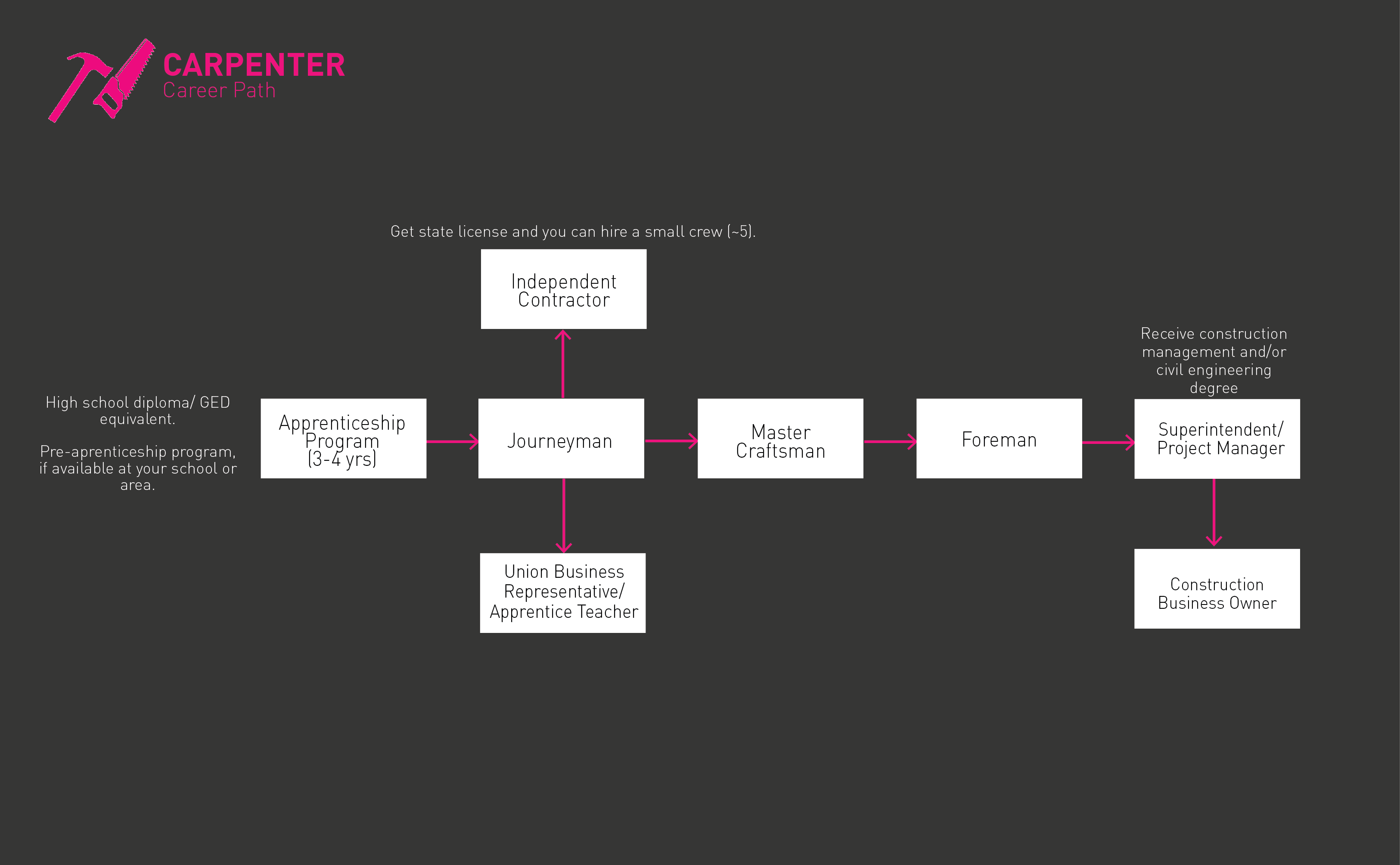
- Apply to a local carpenters union apprenticeship or a carpentry contractor directly
- Complete any required aptitude test and interview with clear examples of hands-on work
- Earn an OSHA 10 certification before applying to strengthen your application
- Build a small portfolio of projects, even informal ones, to show initiative
- Attend union open houses, trade school job fairs, or contractor hiring events
- Consider entry-level laborer or helper roles to get a foot in the door
- Ask about pre-apprenticeship programs at local technical or trade schools
- Build a reliable work history, since dependability matters as much as skill early on
- Network with working carpenters, instructors, or family friends in the trade
- Be honest about your physical readiness and willingness to learn on the job
- Keep a valid driver's license, since job sites vary across a region
- Follow up regularly with the hiring hall while waiting for apprenticeship placement
- Complete every level of apprenticeship training and pass required exams
- Seek out varied experience across framing, finish work, and formwork
- Earn certifications in specialty areas like cabinetmaking or historic restoration
- Build a reputation for precision, reliability, and clean, code-compliant work
- Move from journeyman into foreman or superintendent roles by demonstrating leadership
- Learn estimating and project management to open doors to running jobs
- Mentor apprentices in framing and finish techniques
- Consider starting an independent carpentry or remodeling business after gaining experience
Websites:
- United Brotherhood of Carpenters and Joiners of America - carpenters.org
- Associated General Contractors of America - agc.org
- Associated Builders and Contractors - abc.org
- National Center for Construction Education and Research (NCCER) - nccer.org
- Home Builders Institute - hbi.org
- SkillsUSA - skillsusa.org
- Fine Homebuilding - finehomebuilding.com
- This Old House - thisoldhouse.com
- National Kitchen and Bath Association - nkba.org
- Occupational Safety and Health Administration - osha.gov
- Habitat for Humanity - habitat.org
- Journal of Light Construction - jlconline.com
Books:
- Framing Carpentry by Editors of Fine Homebuilding
- Finish Carpentry: Efficient Techniques for Custom Interiors by Gary Striegler
- The Complete Book of Woodworking by Tom Carpenter
- Carpentry by Floyd Vogt
- Roof Framing by Marshall Gross
If you find that being a Carpenter isn't the right fit, your measuring, building, and problem-solving skills open doors to many related trades.
- Cabinetmaker
- Construction Estimator
- General Contractor
- Drywall Installer
- Flooring Installer
- Construction Superintendent
- Furniture Maker
- Home Inspector
- Millwright
- Set Builder
Newsfeed

Featured Jobs
Online Courses and Tools