







Spotlights
User Researcher, User Experience Researcher, Design Researcher, Usability Analyst, Usability Researcher, Human Factors Researcher, Customer Insights Researcher, Product Researcher, Qualitative Researcher, Quantitative UX Researcher, Research Operations Specialist, Human-Computer Interaction Researcher
Have you ever tried to use an app or website and thought, "Why on earth is this so confusing?" Maybe a button was hidden, a form kept rejecting your answer, or you could not find the one setting you needed. UX Researchers are the people who make sure those moments become rare. They are the detectives of the digital world, spending their days finding out what real people actually need, want, struggle with, and love when they use a product. Their discoveries shape the apps, games, websites, and gadgets that billions of people use, and they often stop a team from building something nobody wants.
UX Researchers study people. They sit down with users in interviews, watch them try out early versions of a product in usability tests, send surveys to thousands of customers, and dig through usage data to see where people get stuck or give up. They work shoulder to shoulder with designers, product managers, engineers, and marketers, asking the questions that help a team decide what to build, how it should work, and how to know whether it is succeeding. A great UX Researcher does not just collect information. They tell the story of the user in a way that makes the whole team care, turning interview notes and charts into clear findings and practical recommendations that change real decisions.
Their toolkit blends psychology, data, and storytelling. They use methods such as user interviews, field studies, card sorting, A/B tests, diary studies, surveys, and analytics. They record sessions, tag patterns in the notes, and build tools like personas and journey maps that help teams see the world through users' eyes. Their work matters because products fail not because teams lack talent, but because they guessed wrong about people, and a few good questions asked early can save months of building the wrong thing. When UX research is done well, products become easier, fairer, more accessible, and more delightful for everyone.
- Getting to talk with fascinating people from all walks of life and learning how they think, work, and live
- Seeing the product change in real ways because of something a user said or a pattern you uncovered
- Standing up for users, including people with disabilities, older adults, or kids, whose needs are often overlooked
- Blending curiosity about human behavior with creative problem solving and technology, in a field that keeps evolving
“I get to spend most of my time doing what I love—learning about people and solving problems! I’ve been able to travel the world and learn about so many different things” - Georgie Bottomley, Senior UX Researcher, Atlassian
Working Schedule
Most UX Researchers work full-time, usually about 40 hours a week during normal business hours, in an office, from home, or in a hybrid arrangement. Research tends to move in cycles. A project might begin with planning and recruiting participants, followed by a burst of interviews or testing sessions that can fill a week or two, and then a stretch of analysis and reporting. Because participants live in different time zones and have different schedules, some sessions are held early in the morning, in the evening, or occasionally on weekends. Many UX Researchers work on a product team at a company, while others work at agencies or consultancies on projects for many different clients, or as independent freelancers. A few travel to visit users in their homes, workplaces, or schools, which is known as field research.
Typical Duties
- Working with product teams to figure out which questions research should answer
- Planning studies, choosing the right methods, and writing research plans and interview guides
- Recruiting participants who represent the people who will actually use the product
- Conducting one-on-one interviews and observing people as they use products in their natural settings
- Running usability tests to see where people get confused or stuck in a prototype or a live product
- Designing and analyzing surveys to measure attitudes and behaviors at a large scale
- Analyzing quantitative data such as clicks, drop-off rates, and A/B test results
- Finding patterns in notes, recordings, and transcripts through coding and thematic analysis
- Creating personas, journey maps, and other tools that bring user needs to life
- Writing reports, building presentations, and sharing clear findings and recommendations
- Presenting results to designers, engineers, product managers, and executives
- Making sure research is ethical, with informed consent, privacy protection, and respect for participants
Additional Responsibilities
- Training teammates to run simple research on their own and to listen to users effectively
- Building and maintaining a research repository so findings can be found and reused later
- Managing research operations, such as recruiting panels, incentives, scheduling, and consent forms
- Collaborating with accessibility experts to include people with disabilities in studies
- Keeping up with new research methods, tools, and academic findings in psychology and human-computer interaction
- Advising on how to measure success, including setting up metrics that show whether changes help users
- Mentoring junior researchers and interns
- Using AI tools to help transcribe, summarize, and organize data, while carefully checking the results for accuracy and bias
A UX Researcher's morning might begin by checking in with the product team about a new feature in development, such as a redesigned checkout flow for an online store. Perhaps the designers have a question: do shoppers understand the new layout, or do they get lost? The researcher reviews the plan for the study, double-checks the interview guide, and gets the prototype and recording tools ready. A few minutes before the first session, they greet the participant on a video call or in a lab, explain how the session will work, and remind them that they are testing the product, not being tested.
Midday is when the sessions happen. The researcher asks the participant to complete a task, such as finding and buying a pair of shoes, and asks them to think out loud while they do it. The researcher watches closely for hesitation, wrong turns, and confusion, and asks open-ended follow-up questions like "What were you expecting to happen there?" Teammates watch silently in a separate room or on a live stream, taking notes. Between sessions, the researcher jots down observations, resets the prototype, and takes a moment to review what stood out.
Afternoons are for making sense of what happened. The researcher goes through notes and recordings, clustering similar observations on a digital whiteboard to see patterns: perhaps five out of six participants missed the new coupon field. They compare it with data from the product's analytics, which shows a high drop-off at the same step. They draft a short summary with video clips of the key moments and quick, practical recommendations. Before the day wraps up, they join a team meeting to share early findings, answer questions, and agree on what to try next, and then start planning the next study.
"If I’m running research, I am out and about meeting people, typically at their place of work to learn about what they do. If I’ve done my field research, I’m back in the office sorting through the information, trying to understand patterns of behaviour and what we learned. I also spend a lot of my time talking to people across the company, sharing what we know to help them make decisions.” - Georgie Bottomley, Senior UX Researcher, Atlassian
Soft Skills
- Curiosity about why people do what they do
- Empathy and the ability to put yourself in someone else's shoes
- Active listening and the patience to let people finish their thoughts
- Clear and engaging storytelling, in writing and in presentations
- Communication and persuasion, since good research only matters if it is acted on
- Collaboration with designers, engineers, and product managers who see problems differently
- Critical thinking and the ability to question assumptions, including your own
- Objectivity and awareness of your own bias, so that you hear what users say instead of what you hope to hear
- Organization and project management across several studies at once
- Flexibility and adaptability when plans, participants, or prototypes change at the last minute
- Cultural sensitivity and respect for people from different backgrounds and abilities
- Comfort with ambiguity, since real human behavior is messy and rarely gives a perfect answer
Technical Skills
- Qualitative methods such as interviews, observation, field studies, diary studies, and usability testing
- Quantitative methods such as surveys, A/B testing, and statistics, including how to avoid common mistakes in interpreting data
- Study design, sampling, and recruitment, including how to ask good questions without leading participants
- Research tools such as UserTesting, Maze, Lookback, Qualtrics, SurveyMonkey, Dovetail, and Optimal Workshop
- Prototyping and design tools such as Figma, used to test early ideas
- Analytics tools such as Google Analytics, Amplitude, Mixpanel, or Pendo
- Data analysis with Excel or Google Sheets, and often R, Python, or SQL for deeper analysis
- Synthesis tools and methods such as affinity mapping, thematic coding, personas, and journey maps
- Knowledge of accessibility standards and inclusive design practices
- Using AI tools responsibly for transcription, summarization, and analysis, while verifying results and protecting participant privacy
- Qualitative UX Researcher: Focuses on interviews, observation, and in-depth understanding of why people behave as they do
- Quantitative UX Researcher: Uses surveys, statistics, and large datasets to measure behavior and test ideas at scale
- Generative Researcher: Explores unmet needs early on to help teams decide what to build in the first place
- Evaluative Researcher: Tests designs and products to find usability problems and measure how well they work
- Market and Customer Insights Researcher: Studies customers, markets, and competitors to inform product strategy and business decisions
- Human Factors Researcher: Studies how people interact with complex systems, such as medical devices, cars, and aircraft cockpits
- Research Operations Specialist: Builds the systems for recruiting, scheduling, tools, and data so research runs smoothly across a company
- Accessibility Researcher: Works with people with disabilities to make products usable for everyone
- Large technology companies and social media platforms
- Software and app startups
- E-commerce and retail companies
- Banks, fintech, and insurance companies
- Healthcare technology, hospitals, and medical device makers
- Video game studios and entertainment and streaming companies
- Education technology companies and universities
- Government agencies and civic technology teams
- Automotive and aerospace companies
- Design and research agencies and consultancies
- Non-profits and public health organizations
- Freelance and independent research practices
UX Researchers need to be comfortable with ambiguity and with having their ideas challenged. Real human behavior is messy, and the answer is rarely a neat yes or no. Researchers often deliver findings that teammates do not want to hear, such as a feature that took months to build confusing people, and they need to share them with honesty and tact. The job is as much about influencing decisions as it is about uncovering facts, and it can take persistence to get busy teams to act on what you have learned.
Research also moves at the pace of the business. Teams often want answers quickly, and researchers must balance rigor with speed, deciding what level of evidence is enough for the decision at hand. In some companies, researchers are part of a very small team or even the only researcher, which means juggling many requests and explaining the value of research again and again. Changes in company budgets can also affect research teams, so adaptable researchers who can show their impact are in the best position.
The work requires emotional energy, since researchers spend days listening closely to other people, sometimes hearing frustrations, stories of struggle, or sensitive topics, and they must handle this with care and privacy. Most of the work is done at a computer, with long stretches of analysis and writing, but also bursts of high-energy sessions and presentations. Researchers must also hold themselves to high ethical standards, protecting participants' privacy, never pressuring them, and being honest about how data will be used.
- AI tools that transcribe interviews, tag themes, and draft summaries, freeing researchers to focus on strategy and judgment, while raising new questions about accuracy and bias
- Research that studies AI-powered products, such as chatbots and assistants, and how much people trust them
- Remote research, including video interviews and unmoderated tests that reach participants anywhere in the world
- Democratization of research, in which designers, product managers, and engineers run simple studies, supported by trained researchers
- Growth of research operations, with dedicated teams and tools that make recruiting and sharing findings easier
- Mixed-methods research that combines in-depth interviews with large-scale data to tell a fuller story
- Greater attention to accessibility and inclusive design, bringing people of different abilities, ages, and backgrounds into research
- Increased focus on privacy, data ethics, and responsible research practices
- Research for voice, augmented reality, virtual reality, wearables, and other new interfaces
- Continuous discovery, where teams talk to users every week instead of running a few big studies a year
- Emphasis on measuring the impact of research and connecting it directly to business and user outcomes
Many UX Researchers were the curious kids who asked a lot of questions and loved figuring out why people behave the way they do. They enjoyed people-watching, interviewing family members for school projects, conducting surveys of classmates, or running mini experiments to see how friends would react. They often loved psychology, sociology, anthropology, or communications classes, and enjoyed writing, debate, or journalism. Some were the friend everyone confided in, or the family member who noticed when something was bothering someone.
Others came from design, art, technology, or business interests and found their way into research later. They liked games, apps, and gadgets and were quick to notice when something was annoying or confusing, and could not help wondering how it could be better. Some got their start as teachers, customer service workers, librarians, or marketers and discovered that their love of listening to people could be a profession. What they had in common was empathy, a strong curiosity, and a desire to make things work better for people.
UX Researchers come from many backgrounds, and there is no single required path. Common degrees include psychology, cognitive science, human-computer interaction (HCI), human factors, anthropology, sociology, communications, information science, and design. A bachelor's degree is the usual starting point, and many UX Researchers go on to earn a master's degree in HCI, human factors, user experience research, or a related field, especially at larger companies and in more specialized roles. A few earn a PhD, which can be helpful for advanced research positions in technology companies and labs.
Along with a degree, employers look for hands-on research skills. Students can build experience through research assistant positions, class projects, internships, volunteer work with local organizations, and personal projects such as redesigning an app and testing it with real users. Short courses, certificates, and bootcamps in UX research can help people transition from other careers or fill in gaps in knowledge. A portfolio with case studies showing how you planned a study, ran it, and influenced a decision is the best way to demonstrate your skills.
Students can take courses in relevant subjects such as:
- Introduction to Psychology and Cognitive Psychology
- Research Methods and Statistics
- Human-Computer Interaction
- Human Factors and Usability Engineering
- Qualitative Research and Ethnography
- Survey Design and Data Analysis
- Information Architecture and Interaction Design
- Data Visualization and Communication
- Accessibility and Inclusive Design
- Writing and Public Speaking
Most UX Researchers learn a great deal on the job, picking up the specific tools and processes of their company. Mentorship from senior researchers, joining professional communities, and attending workshops and conferences help them grow. Because the field changes quickly, especially with new technologies like AI, continuous learning is part of the job.
- Take psychology, sociology, statistics, English, and speech or debate courses to build your understanding of people and communication
- Practice asking good questions by interviewing friends and family about their experiences with an app, a store, or a school program
- Run small surveys at school using free tools, and practice making charts and sharing what you found
- Pick an app, website, or school system that frustrates you, and sketch a better version, then ask others to try it
- Learn free design tools such as Figma and explore how prototypes are made
- Join clubs that involve people and problem solving, such as student government, debate, journalism, or a tech or design club
- Read about UX through free resources such as articles, podcasts, and videos from Nielsen Norman Group and the Interaction Design Foundation
- Volunteer for a local non-profit and offer to improve their website, forms, or signup process by talking with the people who use them
- In college, look for research assistant positions in psychology, HCI, or information science labs
- Complete UX internships, and ask about research-focused roles at tech companies, agencies, or university design labs
- Take an introductory statistics and data analysis course, plus basic Excel, SQL, or Python skills
- Start a portfolio with two or three case studies that show your process, your findings, and what changed because of your work
- Strong coverage of both qualitative and quantitative research methods
- Courses in human-computer interaction, human factors, or user experience taught by faculty who have done real research
- Opportunities to work in research labs or on real projects with companies and community partners
- A capstone or portfolio course where you plan and carry out a full study
- Access to usability labs, eye tracking, and modern research tools
- Strong internship and career services connections to technology companies and design agencies
- Interdisciplinary options that let you combine psychology, design, computer science, and communication
- Training in research ethics, privacy, and working with participants responsibly
- Active student groups such as UXPA chapters, HCI clubs, or design organizations
- Alumni working in UX research who can mentor you and share job leads
- Instruction on using AI tools in research thoughtfully, including their limits
- Affordable tuition, financial aid, and flexible options such as certificates or part-time study
- Seek out internships, apprenticeships, and research assistant roles, which are among the best doors into the field
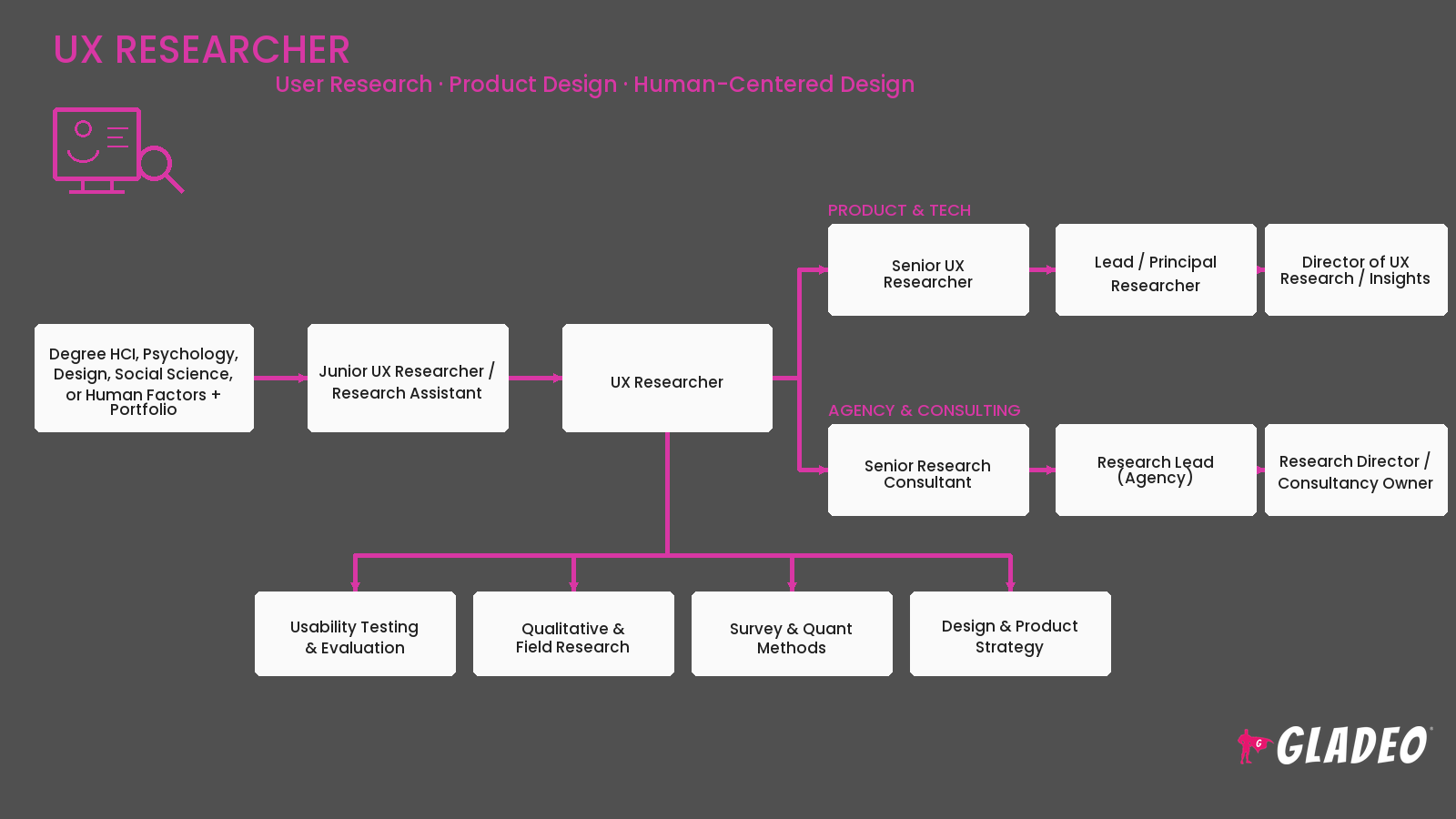
- Search for entry-level titles such as Junior UX Researcher, Associate UX Researcher, User Research Assistant, Research Coordinator, Usability Analyst, UX Research Intern, or Research Operations Coordinator
- Consider adjacent roles such as UX designer, customer insights analyst, or market research analyst, which can lead into research
- Build a portfolio of two to four case studies that explain the problem, your methods, what you learned, and the impact
- Make your case studies clear and visual, with sketches, quotes, charts, and a short story that anyone can follow
- Use job boards such as LinkedIn, Indeed, and company career pages, and check sites that focus on design and tech jobs
- Join communities such as UXPA, the ResearchOps Community, and local UX meetups to meet people and learn about openings
- Reach out to researchers for short informational conversations, and ask what they look for in new hires
- Practice talking through a research project in an interview, including what went wrong and what you would do differently
- Show that you can work with data, by including simple analyses, survey results, or A/B test examples in your portfolio
- Volunteer or freelance for small businesses, non-profits, or student projects to gain real examples
- Stay patient and persistent, because entry-level research roles can be competitive, and many people begin in related jobs and move into research
“I worked really hard, spent a lot of time learning about the industry and attended events and meetups to learn what was going on. I met a recruiter who was able to land me an entry level position, but having the passion and knowledge about a sector I was interested in meant the employer knew I would work hard and was willing to learn.” - Georgie Bottomley, Senior UX Researcher, Atlassian
- Deepen your skills in both qualitative and quantitative methods so you can choose the right approach for each question
- Take on bigger, more strategic projects that shape what a company builds, not just how it looks
- Build influence by communicating clearly, partnering with leaders, and showing how research changes decisions and results
- Mentor junior researchers and teach teammates how to ask better questions
- Specialize in an in-demand area such as AI products, accessibility, healthcare, or quantitative research
- Develop leadership skills, such as setting research strategy, managing budgets, and building research teams
- Move into roles such as Senior UX Researcher, Staff Researcher, Research Manager, Head of Research, or Director of User Experience
- Share your knowledge by speaking at conferences, writing articles, and contributing to the research community
Websites:
- Nielsen Norman Group - nngroup.com
- Interaction Design Foundation - ixdf.org
- User Experience Professionals Association (UXPA) - uxpa.org
- ResearchOps Community - researchops.community
- ACM SIGCHI (Special Interest Group on Computer-Human Interaction) - sigchi.org
- Human Factors and Ergonomics Society (HFES) - hfes.org
- Dscout People Nerds - dscout.com/people-nerds
- User Interviews (UX Research Field Guide) - userinterviews.com
- MeasuringU - measuringu.com
- UX Collective - uxdesign.cc
- Google PAIR Guidebook for human-centered AI - pair.withgoogle.com
- Figma Community and Learn - figma.com
- Maze - maze.co
- W3C Web Accessibility Initiative - w3.org/WAI
Books:
- Don't Make Me Think by Steve Krug
- Just Enough Research by Erika Hall
- The Mom Test by Rob Fitzpatrick
- Interviewing Users by Steve Portigal
- The Design of Everyday Things by Don Norman
If you find that being a UX Researcher isn't the right fit, your skills in understanding people, analyzing information, and communicating insights transfer to many related careers.
- UX/UI Designer
- Product Manager
- Market Research Analyst
- Data Analyst
- Content Designer
- Human Factors Specialist
- Customer Success Manager
- Business Analyst
- Accessibility Specialist
- Instructional Designer
Newsfeed

Featured Jobs
Online Courses and Tools