





Spotlights
Green Building Consultant, Sustainable Construction Specialist, Environmental Building Advisor, Energy Efficiency Analyst, LEED Consultant, Green Building Inspector, Sustainable Design Coordinator, Eco-Building Specialist, Energy Auditor, Sustainable Development Officer, Green Infrastructure Specialist, Building Sustainability Analyst
Every time you enter a modern office, school, or home designed to be kind to the planet, you’re experiencing the work of a Sustainable Building Specialist. These professionals ensure that buildings not only stand strong but also reduce environmental impact, save energy, and promote healthier living spaces for everyone.
Sustainable Building Specialists carefully evaluate building plans, materials, and construction methods to make sure they align with green standards and sustainability goals. They collaborate with architects, engineers, construction teams, and environmental experts to balance functionality, cost, and ecological responsibility. Their day-to-day involves site inspections, energy audits, materials research, and guiding projects toward certifications like LEED or WELL.
Using advanced tools like energy modeling software, environmental impact calculators, and sustainability rating systems, these specialists make critical decisions that shape how buildings interact with the environment. Their role is essential because they bridge the gap between design and real-world sustainability, ensuring buildings conserve resources, reduce waste, and provide long-term benefits to communities and the planet.
- Playing a key role in protecting the environment through smarter building practices.
- Seeing a tangible impact when a project earns green certifications or reduces energy use.
- Collaborating with diverse teams passionate about innovation and sustainability.
- Contributing to healthier indoor environments that improve people’s daily lives.
Working Schedule
Sustainable Building Specialists often work full-time, splitting their time between office settings, construction sites, and sometimes client meetings. Their schedule can be influenced by project deadlines and site availability, sometimes requiring flexibility to attend evening or weekend meetings. Many work as consultants or for firms specializing in green building, balancing steady hours with occasional bursts of intense activity during inspections or audits.
Typical Duties
- Review building plans and blueprints for sustainability compliance.
- Conduct site inspections to assess energy efficiency and environmental impact.
- Perform energy and resource usage audits on buildings.
- Advise architects and construction teams on sustainable materials and methods.
- Ensure projects meet certification standards like LEED, WELL, or Green Globes.
- Analyze data from energy modeling software to recommend improvements.
- Develop reports on sustainability performance and compliance.
- Collaborate with engineers and environmental scientists to solve design challenges.
- Stay updated on environmental regulations and green building trends.
- Educate clients and contractors on best practices for sustainable construction.
- Monitor construction processes to minimize waste and pollution.
- Assist in budgeting sustainable building projects to meet cost and environmental goals.
Additional Responsibilities
- Participate in community outreach to promote green building awareness.
- Research new eco-friendly building materials and technologies.
- Provide training sessions for construction teams on sustainability standards.
- Help develop company policies for sustainable practices.
- Support grant writing or funding proposals for green projects.
- Review post-construction performance data to ensure ongoing compliance.
- Coordinate with local government agencies on environmental permits.
- Assist in lifecycle assessments of building projects.
In the morning, a Sustainable Building Specialist might start by reviewing the day’s site inspection schedule, checking building plans, and preparing tools and reports for the team. They might also respond to emails from architects or project managers about upcoming sustainability reviews.
Midday is often spent on-site at construction projects, examining materials, verifying compliance with sustainability guidelines, and consulting with contractors about energy-saving opportunities. They might gather data using specialized equipment or conduct interviews to understand project challenges.
Later in the afternoon, the specialist returns to the office to analyze collected data using software tools and prepare detailed reports. They often meet with clients or team members to discuss findings, suggest improvements, and plan next steps to keep projects on track toward green certification goals.
Soft Skills
- Strong communication skills to explain complex sustainability concepts clearly.
- Attention to detail for inspecting materials and construction practices.
- Critical thinking to solve environmental challenges creatively.
- Collaboration and teamwork to work effectively with diverse professionals.
- Problem-solving mindset for adapting plans to real-world conditions.
- Time management to handle multiple projects and deadlines.
- Adaptability to stay current with rapidly evolving green technologies.
- Patience and persistence during lengthy certification processes.
- Ethical commitment to environmental responsibility.
- Organizational skills to manage documentation and compliance records.
- Curiosity and willingness to learn about new sustainability methods.
- Customer service orientation when advising clients and contractors.
Technical Skills
- Proficiency with energy modeling and simulation software (e.g., EnergyPlus, eQUEST).
- Knowledge of green building certification systems (LEED, WELL, Green Globes).
- Ability to conduct building performance and energy audits.
- Familiarity with sustainable materials and construction techniques.
- Understanding of environmental regulations and compliance requirements.
- Experience using data analysis tools and environmental impact calculators.
- Competence with building information modeling (BIM) software.
- Skill in preparing technical reports and documentation.
- Knowledge of HVAC systems and their environmental impacts.
- Use of handheld devices for site inspections and measurements.
- Residential Specialist: Focuses on making homes energy-efficient and eco-friendly.
- Commercial Specialist: Works on office buildings, malls, and other commercial properties.
- Industrial Specialist: Concentrates on factories and warehouses for sustainable operations.
- Energy Efficiency Auditor: Specializes in analyzing and improving energy use.
- Materials Consultant: Advises on selecting sustainable and recycled construction materials.
- Certification Specialist: Guides projects through green building certification processes.
- Sustainable Design Coordinator: Integrates ecological principles into architectural design.
- Environmental Compliance Officer: Ensures projects meet local and federal environmental laws.
- Green building consulting firms
- Architecture and design studios
- Construction companies with sustainability focus
- Government environmental agencies
- Energy auditing firms
- Nonprofit environmental organizations
- Universities and research institutions
- Real estate development companies
- Manufacturers of sustainable building materials
- Certification and standards organizations
- Property management firms
- Engineering consulting firms
The role of a Sustainable Building Specialist can be high-pressure because projects often operate under strict budgets and tight deadlines, while also needing to meet rigorous environmental standards. Balancing these demands requires careful planning and sometimes quick decision-making.
Work hours are typically full-time with occasional overtime, especially when approaching certification deadlines or during active construction phases. Site visits may require travel and working outdoors in various weather conditions.
Professionals in this career must be ready to manage complex regulations and evolving technologies, which means continuous learning and adapting. The job can involve revising plans multiple times to satisfy all stakeholders and environmental requirements, demanding patience and perseverance.
- Increasing use of renewable energy sources in building designs.
- Growth of net-zero energy buildings aiming for zero carbon emissions.
- Advancements in smart building technologies for energy management.
- Greater integration of sustainable materials like recycled or bio-based products.
- Rising importance of water conservation and management in construction.
- Expansion of green certification programs and stricter standards.
- Use of digital twins and BIM for better sustainability planning.
- Focus on occupant health and indoor environmental quality.
- More government incentives for green building projects.
- Emphasis on climate resilience and adaptation in design.
Many Sustainable Building Specialists were fascinated by nature and how things work from a young age, often enjoying building projects, science experiments, or environmental clubs in school. They showed curiosity about how to make things better for the planet and enjoyed hands-on activities like gardening or recycling programs.
They likely loved subjects like science, math, and geography, and spent time exploring topics like energy conservation or climate change. Early experience with design, construction, or even video games simulating building and planning also hinted at their future path.
Becoming a Sustainable Building Specialist usually starts with a bachelor’s degree in fields like environmental science, architecture, civil engineering, or construction management with a focus on sustainability. Some professionals also pursue specialized certifications or graduate degrees to deepen their expertise.
Students can take courses in relevant subjects such as:
- Environmental Science
- Sustainable Design
- Green Building Technologies
- Energy Management
- Construction Materials and Methods
- Building Codes and Standards
- Environmental Policy and Regulations
- Renewable Energy Systems
- Project Management
- Data Analysis and Modeling
Hands-on experience through internships, cooperative education, or research projects is crucial. Building a portfolio that showcases understanding of sustainable practices and participation in green projects will greatly enhance job prospects. Continuous learning through certifications like LEED Accredited Professional is common in this field.
- Take advanced science courses such as biology, chemistry, and environmental science.
- Enroll in math classes focusing on algebra, geometry, and calculus.
- Participate in technology or engineering clubs and competitions.
- Join environmental or sustainability-focused extracurricular activities.
- Seek internships or volunteer opportunities with local green building projects.
- Develop computer skills, especially in design software and data analysis.
- Explore summer programs or camps related to environmental studies or architecture.
- Attend career fairs and speak with professionals in construction and sustainability.
- Build a portfolio of projects demonstrating interest in sustainable design.
- Consider dual enrollment or AP courses in relevant subjects.
- Choose programs with strong sustainability and green building curricula.
- Look for schools offering hands-on labs and fieldwork opportunities.
- Ensure access to up-to-date software and technology for energy modeling.
- Seek programs with industry partnerships for internships.
- Verify availability of LEED or other green certification prep courses.
- Check faculty expertise and research focus areas.
- Find programs with interdisciplinary studies combining engineering, environment, and design.
- Consider schools with active sustainability clubs or organizations.
- Look for career services supporting green industry job placement.
- Assess opportunities for networking with professionals and alumni.
- Review program accreditation and reputation in the green building community.
- Explore options for certifications during or after degree completion.
- Apply for internships or entry-level positions with green building consultants or construction firms.
- Build a portfolio highlighting sustainability projects or coursework.
- Join professional organizations to network and learn about job openings.
- Volunteer for community sustainability initiatives to gain experience.
- Develop proficiency in energy modeling and green certification software.
- Attend workshops or seminars on current green building practices.
- Prepare a strong resume emphasizing relevant skills and passion for sustainability.
- Practice interviewing skills focused on technical knowledge and problem-solving.
- Seek mentorship from experienced Sustainable Building Specialists.
- Stay current on industry standards and emerging technologies.
- Consider entry roles such as sustainability assistant or building inspector.
- Be open to contract or freelance work to build experience.
- Earn advanced certifications such as LEED AP or WELL AP.
- Pursue graduate studies specializing in sustainable design or environmental engineering.
- Gain experience managing larger and more complex projects.
- Develop leadership skills to lead sustainability teams or departments.
- Build a strong professional network within the green building industry.
- Stay updated with evolving regulations and technologies.
- Publish case studies or present at industry conferences to build reputation.
- Seek roles in policy development or consulting for broader impact.
Websites:
- U.S. Green Building Council (usgbc.org)
- International Living Future Institute (living-future.org)
- Green Building Advisor (greenbuildingadvisor.com)
- BuildingGreen (buildinggreen.com)
- Energy Star for Buildings (energystar.gov/buildings)
- American Society of Heating, Refrigerating and Air-Conditioning Engineers (ashrae.org)
- Environmental Protection Agency – Sustainable Management (epa.gov/smm)
- National Institute of Building Sciences (nibs.org)
- Construction Specifications Institute (csiresources.org)
- LEED User (leeduser.com)
- WELL Building Institute (wellcertified.com)
- GreenBiz (greenbiz.com)
- Passive House Institute US (phius.org)
- Architecture 2030 (architecture2030.org)
Books:
- Green Building Illustrated by Francis D.K. Ching and Ian M. Shapiro
- Sustainable Construction: Green Building Design and Delivery by Charles J. Kibert
- The Integrative Design Guide to Green Building by 7group and Bill Reed
- Materials for Sustainable Sites by Meg Calkins
- High-Performance Building: Energy Efficiency and Sustainability by Peter Simmonds
If the path to becoming a Sustainable Building Specialist doesn’t work out, there are many related careers where you can still make a difference in the environment, construction, or design.
- Environmental Consultant
- Construction Project Manager
- Energy Auditor
- Architectural Drafter
- Urban Planner
- Civil Engineer
- Building Inspector
- Facilities Manager
- Renewable Energy Technician
- Landscape Architect
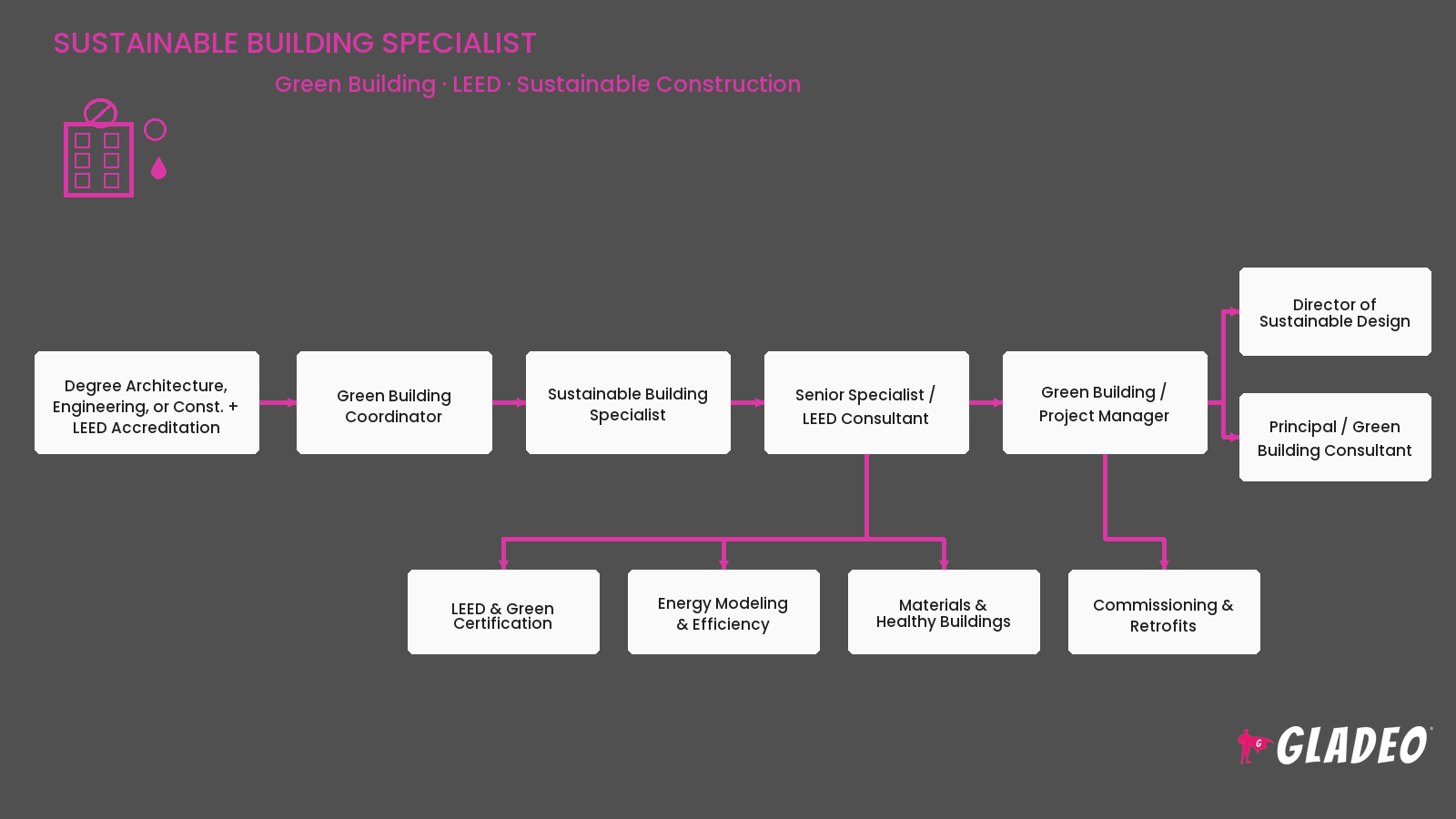
Click here to download the infographic
Newsfeed

Featured Jobs
Online Courses and Tools