






Spotlights
Sustainable Landscape Designer, Eco-Designer, Regenerative Agriculture Consultant, Permaculture Consultant, Agroecologist, Landscape Architect (Permaculture Focus), Ecological Designer, Environmental Designer, Sustainable Systems Designer, Green Infrastructure Designer, Organic Farm Planner, Natural Building Designer
Imagine walking through a thriving garden where every plant, pond, and pathway works in harmony to create a self-sustaining ecosystem that feeds people, restores the land, and supports wildlife—all designed with nature’s wisdom. That’s the impact a Permaculture Designer has on communities and the environment.
Permaculture Designers blend art, science, and ecology to create landscapes and systems that mimic natural processes. They spend their days assessing land, collaborating with farmers, architects, and community members, and sketching detailed designs that integrate water management, food production, and habitat restoration. Their work results in resilient, productive environments that reduce waste and energy use while promoting biodiversity.
These designers use tools like CAD software, GIS mapping, and soil analysis kits alongside permaculture principles such as zones, guilds, and succession planting. Their role is crucial for creating sustainable solutions that combat climate change, restore degraded land, and build healthier communities for future generations.
- Witnessing barren or damaged land transform into lush, life-giving ecosystems that support people and wildlife.
- Contributing directly to environmental sustainability and climate resilience in tangible ways.
- Collaborating with diverse teams — from farmers to architects — to solve complex ecological challenges creatively.
- Knowing your designs help reduce waste, save water, and promote food security in communities worldwide.
Working Schedule
Permaculture Designers often balance fieldwork with studio or office time, adapting their schedules to seasons and project deadlines. They may work for environmental organizations, design firms, or as independent consultants. Work hours can vary widely, sometimes including early mornings or weekends to observe natural patterns or meet client needs, and deadlines can be influenced by planting seasons or grant cycles.
Typical Duties
- Conduct site assessments including soil, water, and climate analysis to understand environmental conditions.
- Collaborate with clients, farmers, architects, and community members to identify goals and challenges.
- Develop detailed permaculture designs incorporating water management, planting schemes, and habitat creation.
- Create maps, sketches, and digital models using CAD and GIS software to communicate design plans.
- Select appropriate plant species and materials that support ecosystem health and productivity.
- Advise on renewable energy integration and natural building techniques when applicable.
- Prepare proposals and reports to secure funding or client approval.
- Monitor and adjust designs post-implementation to ensure ecosystem resilience and productivity.
- Educate clints and communities about permaculture principles and sustainable living practices.
- Stay updated on ecological research and sustainable agriculture trends to inform designs.
Additional Responsibilities
- Manage project budgets and timelines effectively.
- Train and supervise interns or volunteers during implementation phases.
- Coordinate with government agencies or NGOs for permits and environmental compliance.
- Organize workshops or community events to promote permaculture and sustainability.
- Write articles or case studies to share successful projects and lessons learned.
- Maintain a network of suppliers for sustainable materials and native plants.
- Participate in environmental advocacy or policy discussions related to land use.
- Maintain records of site conditions and project outcomes for future reference.
Mornings often begin with site visits to observe soil moisture, sunlight patterns, and plant health, gathering firsthand data to refine designs.
Midday is dedicated to drafting plans and models, using computer software to map zones, water flow, and planting guilds, while consulting with clients or team members to align goals.
Afternoons may involve meetings with contractors, community workshops, or revising proposals based on stakeholder feedback, followed by documentation and planning next steps before wrapping up the day.
Soft Skills
- Creative problem-solving
- Strong communication and collaboration
- Patience and adaptability
- Attention to detail
- Systems thinking
- Empathy towards people and nature
- Project management
- Critical observation
- Teaching and public speaking
- Networking and relationship building
- Resilience under changing conditions
- Open-mindedness to diverse ideas
Technical Skills
- Soil and water analysis
- GIS mapping and CAD software
- Plant identification and ecology
- Sustainable agriculture techniques
- Natural building methods
- Renewable energy basics
- Permaculre design principles
- Environmental impact assessment
- Data collection and monitoring
- Report writing and documentation
- Urban Permaculture Designer: Focuses on integrating sustainable systems into city environments like rooftop gardens and community farms.
- Agroforestry Specialist: Designs systems combining trees and crops for productivity and ecosystem health.
- Water Management Designer: Specializes in creating swales, ponds, and rainwater harvesting systems.
- Restoration Ecologist: Works on rehabilitating degraded landscapes to their natural state.
- Organic Farm Planner: Plans sustainable food production systems for organic farms using permaculture methods.
- Community Permaculture Educator: Focuses on teaching permaculture principles and engaging communities in sustainable practices.
- Green Infrastructure Designer: Integrates permaculture with urban infrastructure for stormwater management and green spaces.
- Permaculture Consultant: Provides expert advice and customized design solutions for clients across various sectors.
- Environmental consulting firms
- Sustainable agriculture NGOs
- Government environmental agencies
- Landscape architecture firms
- Community development organizations
- Educational institutions
- Renewable energy companies
- Organic farms and cooperatives
- Environmental advocacy groups
- Green building companies
- Research institutes
- Permaculture training centers
Permaculture Designers often face tight deadlines tied to planting seasons or grant requirements, demanding a balance of detailed planning and flexibility.
Work can be physically demanding, involving outdoor site visits, sometimes in challenging weather or terrain, alongside computer-based design work.
The career requires resilience due to iterative design processes, community engagement challenges, and the need to adapt solutions to complex ecological and social variables.
- Growing interest in regenerative agriculture and climate-smart design.
- Increased use of digital tools like GIS and drone mapping for site analysis.
- Integration of renewable energy and water-saving technologies into designs.
- Rising demand for urban permaculture solutions in cities worldwide.
- Collaboration across disciplines including architecture, ecology, and social sciences.
- Greater emphasis on community-led and participatory design processes.
- Expansion of permaculture education through online platforms and certifications.
- Focus on carbon sequestration and biodiversity enhancement in projects.
- Use of native plants and seed-saving to promote local ecosystems.
- Policy support and funding for sustainable land management increasing globally.
Many Permaculture Designers were curious about nature from a young age, enjoying activities like gardening, hiking, and observing wildlife.
They often showed an early passion for problem-solving and creativity, combining interests in science, art, and environmental stewardship to understand how natural systems work.
Becoming a Permaculture Designer usually involves studying environmental science, agriculture, landscape design, or related fields. Many professionals complement formal education with specialized permaculture training and hands-on experience in ecological design.
Students can take courses in relevant subjects such as:
- Environmental Science
- Ecology and Botany
- Soil Science
- Sustainable Agriculture
- Landscape Architecture
- Geographic Information Systems (GIS)
- Renewable Energy Systems
- Water Resource Management
- Natural Building Techniques
- Project Management
Hands-on experience through internships, apprenticeships, or permaculture design courses is essential to build practical skills. A strong portfolio showcasing design projects and community engagement can open doors to job opportunities in this field.
- Join environmental clubs or garden projects at school to gain early experience.
- Take science and art classes to build foundational knowledge and creativity.
- Volunteer with local farms, community gardens, or environmental groups.
- Explore summer programs focused on sustainability or agriculture.
- Build skills in computer design and mapping software.
- Attend workshops or webinars on permaculture principles.
- Network with professionals through internships or mentorship programs.
- Develop communication skills through presentations or writing about environmental topics.
- Create your own mini permaculture garden to practice design concepts.
- Research colleges offering environmental science or landscape architecture programs.
- Join environmental clubs or garden projects at school to gain early experience.
- Take science and art classes to build foundational knowledge and creativity.
- Volunteer with local farms, community gardens, or environmental groups.
- Explore summer programs focused on sustainability or agriculture.
- Build skills in computer design and mapping software.
- Attend workshops or webinars on permaculture principles.
- Network with professionals through internships or mentorship programs.
- Develop communication skills through presentations or writing about environmental topics.
- Create your own mini permaculture garden to practice design concepts.
- Research colleges offering environmental science or landscape architecture programs.
- Seek internships with permaculture farms or design firms to gain field experience.
- Volunteer for community garden projects to build practical skills.
- Create a portfolio of personal or volunteer design projects.
- Attend permaculture workshops and earn certifications.
- Network at sustainability conferences and environmental events.
- Apply for entry-level roles like ecological technician or assistant designer.
- Develop proficiency in CAD and GIS software through online courses.
- Offer to assist with local environmental restoration projects.
- Build relationships with mentors in the permaculture community.
- Learn grant writing and proposal development for sustainability projects.
- Document your experiences clearly to showcase your knowledge and enthusiasm.
- Stay informed on new permaculture practices and technologies.
- Master advanced design software and ecological modeling tools.
- Build a reputation through successful project completions and case studies.
- Expand your network by collaborating across disciplines and sectors.
- Develop leadership skills by managing teams and community initiatives.
- Pursue certifications such as Permaculture Design Certificate (PDC) or advanced ecological design credentials.
- Contribute to research or publications in sustainable design.
- Start your own consulting practice or design firm.
- Engage in public speaking and education to become a recognized expert.
Websites:
- Permaculture Institute (permaculture.org)
- Regenerative International (regenerationinternational.org)
- The Permaculture Research Institute (permaculturenews.org)
- American Society of Agricultural and Biological Engineers (asae.org)
- Ecological Landscape Alliance (ecolandscaping.org)
- Soil Science Society of America (soils.org)
- International Permaculture Convergence (ipc2021.org)
- Green Building Council (usgbc.org)
- Sustainable Agriculture Research and Education (sare.org)
- Land Trust Alliance (landtrustalliance.org)
- Association of Professional Landscape Designers (apld.org)
- Urban Agriculture Network (urbanagnetwork.org)
- Food and Agriculture Organization of the United Nations (fao.org)
- National Sustainable Agriculture Coalition (sustainableagriculture.net)
Books:
- Gaia's Garden by Toby Hemenway
- Permaculture: A Designers' Manual by Bill Mollison
- The One-Straw Revolution by Masanobu Fukuoka
- Designing Regenerative Cultures by Daniel Christian Wahl
- The Earth Care Manual by Patrick Whitefield
If permaculture design isn’t the right fit or you want to explore related paths, many careers share skills in sustainability, agriculture, and environmental design.
- Landscape Architect
- Environmental Scientist
- Agricultural Consultant
- Urban Planner
- Conservation Scientist
- Horticulturist
- Renewable Energy Technician
- Sustainability Coordinator
- Soil Scientist
- Ecological Restoration Specialist
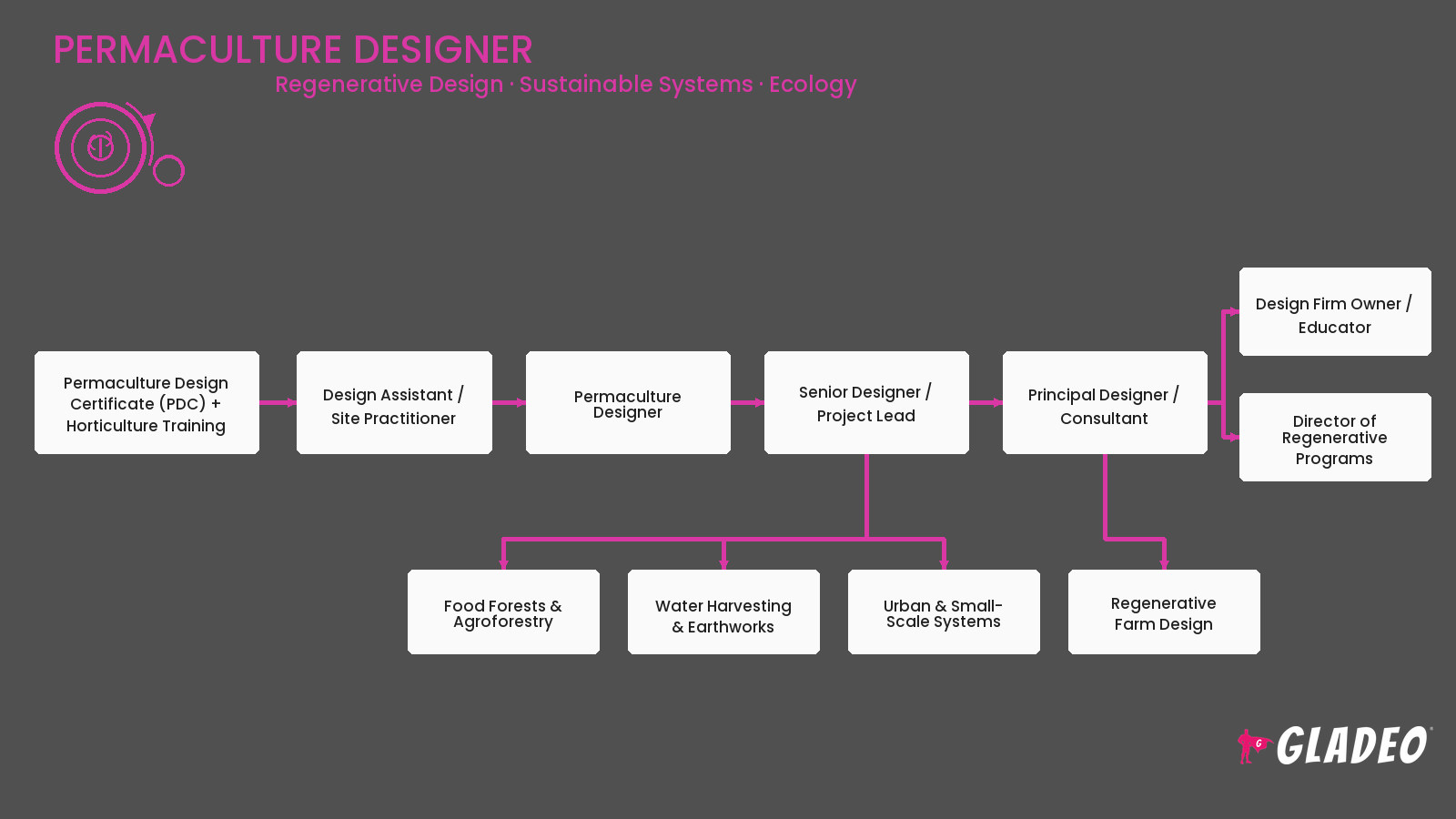
Click here to download the infographic
Newsfeed

Featured Jobs
Online Courses and Tools