





Spotlights
Certified Intraoperative Neurophysiology Technologist, Certified Neurodiagnostic Technologist, Electroneurodiagnostic Technologist (END Technologist), Intraoperative Neuromonitoring Technologist (IONM Tech), Neurodiagnostic Technologist (Neurodiagnostic Tech), Neurophysiology Technical Specialist, Registered Electroencephalogram Technologist (Registered EEG Tech), Registered Electroencephalography Technologist (R. EEG. T), Registered Electroneurodiagnostic Technologist (Registered END Tech)
When doctors need to see how the brain and nervous system are functioning, Neurodiagnostic Technologists run the tests that reveal the answers! From routine EEGs to complex operating-room monitoring, they help neurologists diagnose epilepsy, sleep disorders, and surgical nerve risk in real time.
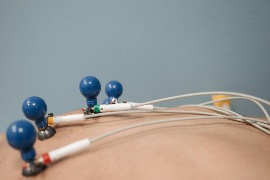
Neurodiagnostic Technologists apply electrodes, calibrate equipment, and record electrical activity from the brain, nerves, and muscles. Depending on their specialty and employer, they may perform electroencephalograms (EEG), evoked potentials, nerve conduction studies, or intraoperative neurophysiological monitoring (IONM). They work in hospitals, outpatient labs, sleep centers, and mobile services—collaborating with neurologists, epileptologists, surgeons, and technologist peers on each case.
They use digital EEG systems, amplifier boxes, electrode paste, and specialized montages while following strict patient safety and infection control protocols. Whether capturing a sleep study overnight or monitoring cranial nerves in the OR, skilled technologists combine patient care skills with precise technical setup.
- Direct contribution to neurological diagnosis and surgical safety
- High-demand allied health specialty with clear credential pathways
- Variety across EEG labs, epilepsy monitoring units, sleep, and OR settings
- Technical work that blends healthcare, electronics, and problem-solving
Working Schedule
Neurodiagnostic Technologists often work full-time with rotating shifts—days, evenings, nights, and weekends—because EEG and sleep labs run around the clock. Epilepsy monitoring units may require continuous patient observation. OR monitoring teams follow surgical schedules that can start early and run long. On-call rotation is common in IONM services.
Typical Duties
- Explain procedures and obtain consent from patients and families
- Measure head dimensions and apply EEG electrodes using 10–20 system
- Calibrate amplifiers, impedance-check electrodes, and start recordings
- Perform activation procedures—hyperventilation, photic stimulation, sleep
- Monitor patients during long-term epilepsy monitoring (LTEM) stays
- Document clinical observations, artifacts, and seizure events
- Assist physicians during intraoperative monitoring of neural pathways
- Conduct nerve conduction studies and evoked potential tests when cross-trained
- Troubleshoot electrical artifact from movement, equipment, or environment
- Remove electrodes, clean skin, and disinfect reusable supplies
- Maintain equipment logs and report malfunctions to biomedical engineering
- Follow HIPAA, infection control, and hospital safety policies
Additional Responsibilities
- Train students and new hires on electrode placement and montages
- Stock lab supplies—electrodes, paste, gauze, and disposable caps
- Participate in quality improvement and accreditation surveys
- Transport portable EEG machines to ICU and emergency departments
- Coordinate with sleep technologists on combined sleep-EEG protocols
- Update electronic medical records with technologist notes and study quality
- Respond to stat EEG requests for altered mental status or coma
A day shift may begin in the outpatient EEG lab—prepping three scheduled patients, applying electrodes, running 30-minute routine studies, and flagging abnormal sharp waves for the neurologist to review.
Midday could move to the epilepsy monitoring unit—observing a patient on continuous video-EEG, noting seizure semiology, and communicating with nursing when events occur. An urgent ICU consult adds a portable bedside recording.
Afternoon wrap-up includes uploading studies to PACS, cleaning rooms, restocking carts, and handing off to night staff with notes on in-progress LTEM cases. On OR days, the technologist scrubs in early and monitors until the last pedicle screw is confirmed safe.
Soft Skills
- Compassionate patient communication across ages and abilities
- Calm reassurance for anxious patients and caregivers
- Attention to detail on electrode placement and documentation
- Teamwork with nurses, neurologists, and surgeons
- Patience during long recordings and overnight monitoring
- Critical thinking to distinguish artifact from true abnormality
- Adaptability when schedules shift for emergencies or surgery
- Professionalism with confidential health information
- Stamina for standing, bending, and overnight shifts
- Continuous learning as neurodiagnostic standards evolve
Technical Skills
- International 10–20 electrode placement system
- Digital EEG system operation and montage selection
- Impedance testing and signal quality optimization
- Activation procedures and basic EEG pattern recognition
- Video-EEG synchronization and event marking
- Intraoperative monitoring modalities—SSEPs, MEPs, EMG, EEG
- Nerve conduction and evoked potential setup basics
- Infection control and electrode cleaning protocols
- Basic electronics troubleshooting for amplifiers and cables
- EMR documentation and PACS study management
- EEG Technologists: Outpatient and inpatient routine and ambulatory EEG
- LTEM Specialists: Epilepsy monitoring unit long-term recordings
- Intraoperative Monitoring Technologists: OR surgical nerve monitoring
- Sleep-EEG Technologists: Combined polysomnography and EEG roles
- Evoked Potential Technologists: Visual, auditory, and somatosensory testing
- Nerve Conduction Technologists: EMG lab support when cross-certified
- Mobile EEG Technologists: Portable services for homebound or SNF patients
- Academic medical centers and children's hospitals
- Community hospitals with neurology departments
- Independent neurodiagnostic and sleep laboratories
- Epilepsy centers and comprehensive seizure programs
- Surgical hospitals with IONM vendor partnerships
- Neurology private practice outpatient labs
- Veterans Affairs and military treatment facilities
- Rehabilitation hospitals and stroke centers
- Travel staffing agencies for END technologists
- Equipment manufacturers' clinical training divisions
Technologists work closely with ill or vulnerable patients—sometimes during seizures or before major surgery. Shifts can be overnight and emotionally demanding when cases are complex.
Certification exams and clinical practicums require dedication; CEUs maintain credentials. Entry pay is solid for allied health but OR and travel roles pay more with experience and on-call availability.
Professionals in the field value knowing their recordings help neurologists diagnose conditions that change treatment—and that OR monitoring may prevent paralysis during surgery.
- Growing demand for epilepsy monitoring and stroke EEG services
- Wireless and ambulatory EEG systems expanding outpatient monitoring
- IONM adoption in more spine and ENT surgical procedures
- Tele-EEG interpretation connecting rural hospitals to specialists
- Quantitative EEG and AI-assisted spike detection tools
- Cross-training between END, sleep, and EMG departments
- ABRET credentialing emphasis in hospital hiring requirements
- Aging population increasing neurology test volumes
- Travel technologist staffing filling regional workforce gaps
Many Neurodiagnostic Technologists liked biology and health classes—and volunteering or job-shadowing in hospitals sparked interest in patient care without years of medical school.
They often enjoyed hands-on labs, electronics kits, or anatomy models. A mix of caring for people and operating technical equipment drew them to allied health rather than nursing or physician tracks.
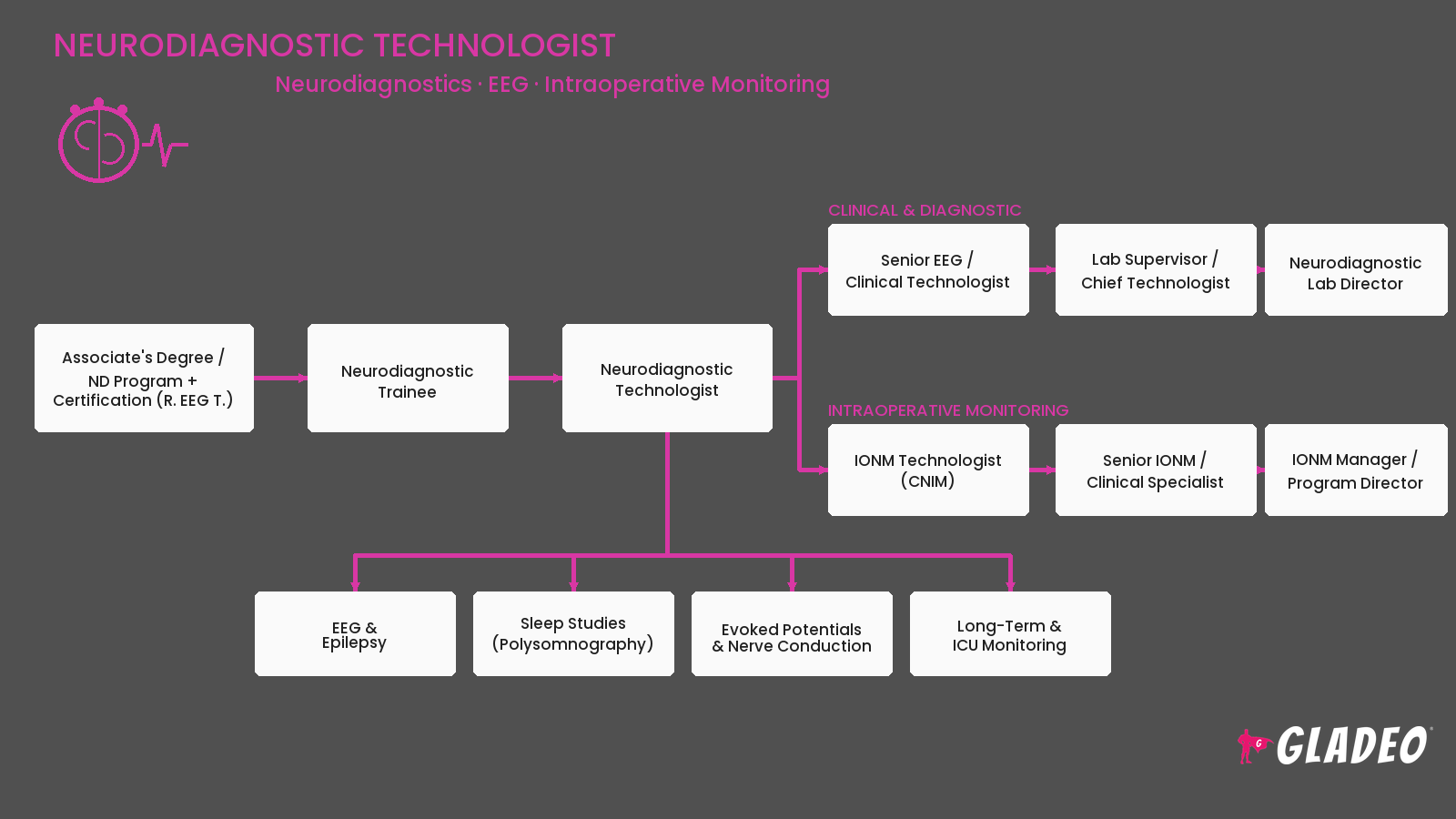
Neurodiagnostic Technologists typically complete a formal END program—certificate or associate degree—accredited by CAAHEP or approved by ABRET, including clinical practicum hours. High school diploma with science prerequisites is required for admission. Registered EEG Technologist (R. EEG T.) credential through ABRET is the industry standard employers expect after graduation.
Students can take courses in relevant subjects such as:
- Human anatomy and physiology with neurology focus
- Neuroanatomy and neurophysiology
- Electroencephalography principles and instrumentation
- Medical terminology and healthcare ethics
- Patient care and vital signs
- Pharmacology basics affecting EEG patterns
- Evoked potentials and nerve conduction fundamentals
- Healthcare informatics and EMR documentation
- Math and physics for biomedical signal understanding
Clinical practicum placements in hospital END labs are mandatory for graduation and ABRET exam eligibility. Students must log supervised electrode placements, recordings, and patient interactions before working independently.
ON-THE-JOB TRAINING
New hires receive department-specific orientation on equipment vendors, EMR workflows, and hospital codes. Mentorship continues for months as technologists advance from routine EEG to LTEM and optional IONM training.
OPTIONAL CERTIFICATIONS
- ABRET Registered EEG Technologist (R. EEG T.)
- ABRET Registered Evoked Potential Technologist (R. EP T.)
- CNIM — Certification in Neurophysiologic Intraoperative Monitoring
- CLTM — Certification in Long-Term Monitoring
- BLS/CPR Healthcare Provider Certification
- Take biology, chemistry, anatomy, and algebra in high school
- Volunteer or work as a hospital greeter or patient transporter
- Job-shadow an EEG technologist during an outpatient lab shift
- Research CAAHEP-accredited neurodiagnostic programs early—seats are limited
- Maintain strong GPA for competitive program admission
- Earn CPR certification before clinical practicum
- Practice patient communication through HOSA or health occupation clubs
- Visit program open houses and speak with current END students
- Complete prerequisite immunizations and background checks for clinical placement
- Study medical terminology online before first college term
- Avoid academic dishonesty—clinical trust depends on integrity
- Save for certification exam fees and travel clinical rotations if required
- Choose CAAHEP-accredited or ABRET-recognized END programs only
- Confirm clinical site partnerships with hospitals hiring graduates
- Look for IONM and LTEM exposure—not just routine EEG labs
- Ask about first-time ABRET board pass rates
- Prefer programs with modern digital EEG equipment in labs
- Compare associate degree vs. certificate length and transfer options
- Seek financial aid and workforce grant eligibility in your state
- Verify distance options if you must relocate for clinical practicum
- Talk to alumni about travel, sleep, and OR career paths
- Ensure anatomy and neurophysiology courses are rigorous prerequisites
- Apply to hospital neurodiagnostic departments and outpatient EEG labs
- Search Indeed, Health eCareers, and ASSET job boards for END technologists
- Target titles: EEG Technologist, Neurodiagnostic Technologist I, END Tech
- Highlight clinical practicum hours and electrode placement competency
- Register for ABRET exam promptly after graduation
- Be flexible on nights and weekends for first hospital roles
- Consider travel staffing agencies for rapid experience and pay
- Network through ASET conferences and local neurodiagnostic societies
- Emphasize calm patient care examples from clinical rotations
- Apply to sleep centers if cross-training polysomnography interests you
- Earn CLTM and CNIM credentials for LTEM and OR specialty pay
- Become lead technologist or END lab supervisor
- Train into IONM team lead or regional monitoring manager roles
- Teach in END programs or vendor clinical education departments
- Move into neurodiagnostic equipment sales or application specialist roles
- Pursue healthcare administration with END department director paths
Websites:
- ASET — The Neurodiagnostic Society
- ABRET (American Board of Registration of EEG and EP Technologists)
- Coalition for Accreditation of Allied Health Education Programs (CAAHEP)
- American Clinical Neurophysiology Society (ACNS)
- Foundation for Neurodiagnostic Technologists
- Health eCareers allied health job board
- Indeed hospital technologist listings
- Epilepsy Foundation professional resources
- Neurodiagnostic program directory — ASET
- Travel END staffing agency career pages
Books:
- Introduction to Neurogenic Communication Disorders by Brookshire
- Fisch and Spehlmann's EEG Primer by Bruce J. Fisch
- Neurodiagnostic Technology by ASET curriculum texts
- Clinical Neurophysiology by Daube and Rubin
- The EEG in Clinical Practice by Ebersole and Pedley
Related careers that use overlapping skills include:
- Polysomnographic Technologist
- Radiologic Technologist
- Surgical Technologist
- EMG/Nerve Conduction Technician
- Cardiovascular Technologist
- Registered Nurse
- Biomedical Equipment Technician
- Medical Laboratory Technician
- Patient Care Technician
- Clinical Research Coordinator
Newsfeed

Featured Jobs
Online Courses and Tools