







Spotlights
AI Experience Designer, Human-AI Interaction (HAX) Designer, AI Trust and Transparency Designer, Human-Centered AI Designer, AI Interaction Designer, Explainable AI Designer, AI Product Designer, Responsible AI Designer, AI Interface Designer, Human-AI Collaboration Designer, AI UX Researcher, AI Oversight Designer
When a navigation app suggests a route, a hiring tool flags a resume, or a photo editor auto-enhances a picture, someone had to decide how much to tell you about what the AI just did, how confident it really is, and how easy it should be for you to override it. Human-AI Interaction Designers design that entire relationship between people and AI, making sure the systems we increasingly rely on are understandable, trustworthy, and correctable rather than confusing black boxes.
This role goes far beyond any single chat window or app screen. Human-AI Interaction Designers study how AI recommendations, predictions, and decisions show up across an entire product, from a subtle confidence score next to a suggestion to a full review dashboard where a doctor double-checks an AI's diagnosis. They work with machine learning engineers to understand what a model can and cannot reliably do, with UX researchers to test how real people interpret AI behavior, and with ethics, legal, and policy teams to make sure AI systems are used responsibly and fairly.
Using research methods, prototyping tools, and emerging design frameworks for explainability and transparency, Human-AI Interaction Designers shape whether people trust AI appropriately, neither blindly following bad suggestions nor ignoring genuinely helpful ones. Their decisions about how AI uncertainty, errors, and limitations get communicated can be the difference between a system that empowers human judgment and one that quietly erodes it.
- Shaping how millions of people understand and trust the AI systems in their daily lives
- Tackling genuinely new design problems that did not exist a few years ago
- Working at the frontier where technology, ethics, and human psychology all meet
- Helping build AI systems that respect human judgment instead of replacing it carelessly
Working Schedule
Human-AI Interaction Designers typically work full-time, standard business hours, as part of a design, research, or responsible AI team within a technology company. The role blends independent research and design time with heavy collaboration, including workshops with engineers, researchers, and policy teams. Most work directly for technology companies building AI products, though some work at research labs, consultancies, or nonprofit organizations focused on responsible AI.
Typical Duties
- Researching how different user groups interpret and react to AI-generated suggestions or decisions
- Designing interfaces that clearly communicate an AI system's confidence, limitations, and uncertainty
- Creating controls that let users easily review, correct, or override AI decisions
- Developing guidelines for when and how a system should explain its reasoning to users
- Collaborating with machine learning engineers to understand model behavior and failure modes
- Running usability studies to see whether people over-trust or under-trust an AI feature
- Designing onboarding experiences that set accurate expectations about what an AI can do
- Auditing existing products for confusing, misleading, or unsafe AI interactions
- Partnering with ethics, legal, and policy teams on responsible AI guidelines
- Presenting research findings and design recommendations to product leadership
- Prototyping and testing multiple ways of surfacing AI-driven recommendations or alerts
- Documenting design patterns for AI transparency and human oversight across a product
Additional Responsibilities
- Contributing to a company's broader responsible AI or AI ethics guidelines
- Training other designers and product teams on human-AI interaction principles
- Reviewing new AI features before launch for trust and transparency issues
- Studying accessibility implications of AI features for users with disabilities
- Tracking emerging research and regulation around AI transparency and explainability
- Advocating for user testing before AI features ship, even under tight deadlines
A Human-AI Interaction Designer's morning might start by reviewing findings from a recent usability study, looking at whether test participants understood why an AI tool flagged a certain result or ignored it entirely because the explanation was buried too deep in the interface. They might sketch out a few new ways to present that explanation more clearly.
Midday often includes meetings with a machine learning engineer to understand exactly how confident a new model really is in different situations, followed by a working session with a product designer to figure out how to represent that confidence visually without overwhelming users with technical detail. They might also join a review with the legal or policy team about a new AI feature that touches sensitive decisions, like credit approvals or medical recommendations.
Afternoons are often spent prototyping, building a few different versions of an "AI explanation" panel or an override button, then planning a study to see which version actually helps people make better decisions. Before the day ends, they typically document what they learned, update design guidelines, and flag any patterns that suggest people are trusting the AI too much or too little.
Soft Skills
- Deep curiosity about how people think, decide, and build trust
- Strong research and analytical thinking skills
- Clear communication across technical, design, and policy teams
- Ethical reasoning and comfort raising hard questions about AI risk
- Empathy for how different users, including vulnerable ones, experience AI systems
- Patience with ambiguity, since best practices in this field are still forming
- Collaboration and consensus-building across disciplines
- Attention to detail in how small wording or design choices shape trust
- Adaptability as AI capabilities and regulations change quickly
- Critical thinking about when an AI system should not be trusted
- Strong storytelling to translate research findings into design decisions
- Advocacy skills to push for user testing under deadline pressure
Technical Skills
- User research and usability testing methods
- Interaction design and prototyping tools such as Figma
- Basic understanding of how machine learning models work and where they fail
- Familiarity with explainability and interpretability concepts in AI
- Data visualization for communicating confidence, probability, and uncertainty
- Accessibility standards for AI-driven interfaces
- Knowledge of AI ethics, fairness, and bias evaluation frameworks
- Systems thinking to design consistent AI behavior across an entire product
- Familiarity with relevant AI regulations and transparency requirements
- Analytics tools for studying how users interact with AI features over time
- AI Transparency Designer: Focuses on explaining how and why an AI reached a decision
- AI Trust Researcher: Studies how much people trust AI systems and why that trust shifts
- Human Oversight Designer: Designs controls that let people review, correct, or override AI
- Responsible AI Designer: Focuses on fairness, safety, and ethical guidelines across AI products
- AI Onboarding Designer: Designs how new users are introduced to an AI feature's capabilities and limits
- Explainable AI (XAI) Designer: Specializes in visualizing and simplifying complex model reasoning
- Enterprise AI Interaction Designer: Designs human oversight tools for professional settings like healthcare or finance
- Technology and software companies
- AI research labs and think tanks
- Healthcare and health technology companies
- Financial services and insurance companies
- Government agencies regulating or deploying AI systems
- Consulting firms specializing in responsible or ethical AI
- Universities and academic research centers
- Nonprofit organizations focused on AI policy and safety
- Automotive and autonomous vehicle companies
- Enterprise software companies building AI tools for other businesses
- Media and content platforms using AI-driven recommendations
- Standards bodies and industry consortiums focused on AI guidelines
Human-AI Interaction Designers work in a field where the "right answer" is often still unknown, since AI capabilities and public understanding of them keep shifting. This means constantly researching, testing, and revising design approaches rather than relying on settled best practices, which can be intellectually demanding and sometimes frustrating.
The stakes can be high. Poor design choices around AI transparency or oversight have real consequences, from people blindly trusting a flawed medical recommendation to ignoring a genuinely helpful safety alert. Designers carry real responsibility for getting these decisions right, and that weight can be heavy, especially when working on AI systems used in healthcare, finance, or other sensitive areas.
The role also requires navigating tension between business pressure to ship AI features quickly and the slower, more careful work of testing whether people actually understand and can control those features. Advocating for that careful work, sometimes against tight deadlines, requires confidence, patience, and a willingness to push back respectfully.
- Growing regulation requiring AI systems to be explainable and transparent to users
- Increased research into how much people over-trust or under-trust AI recommendations
- Rising demand for human oversight controls in high-stakes AI applications like healthcare and hiring
- Greater focus on designing for AI errors and failure states, not just success cases
- Expansion of AI literacy efforts to help everyday users understand AI limitations
- Growing use of confidence scores and uncertainty visualization in consumer products
- Increased collaboration between designers, ethicists, and policy teams on AI products
- Rise of academic and industry research communities dedicated to human-AI interaction
- More companies establishing formal responsible AI or AI ethics design teams
- Growing attention to how AI interaction design affects vulnerable or underserved users
Many Human-AI Interaction Designers were the kids who asked a lot of "but why" questions, curious not just about how something worked but about whether it was fair or trustworthy. They often enjoyed debate, philosophy discussions, or ethics-focused classes alongside a genuine interest in technology and how things were built.
Many also gravitated toward psychology, sociology, or design classes, drawn to understanding how people think and make decisions. A combination of technical curiosity and a strong sense of fairness or justice often pointed toward this emerging and still-forming career path.
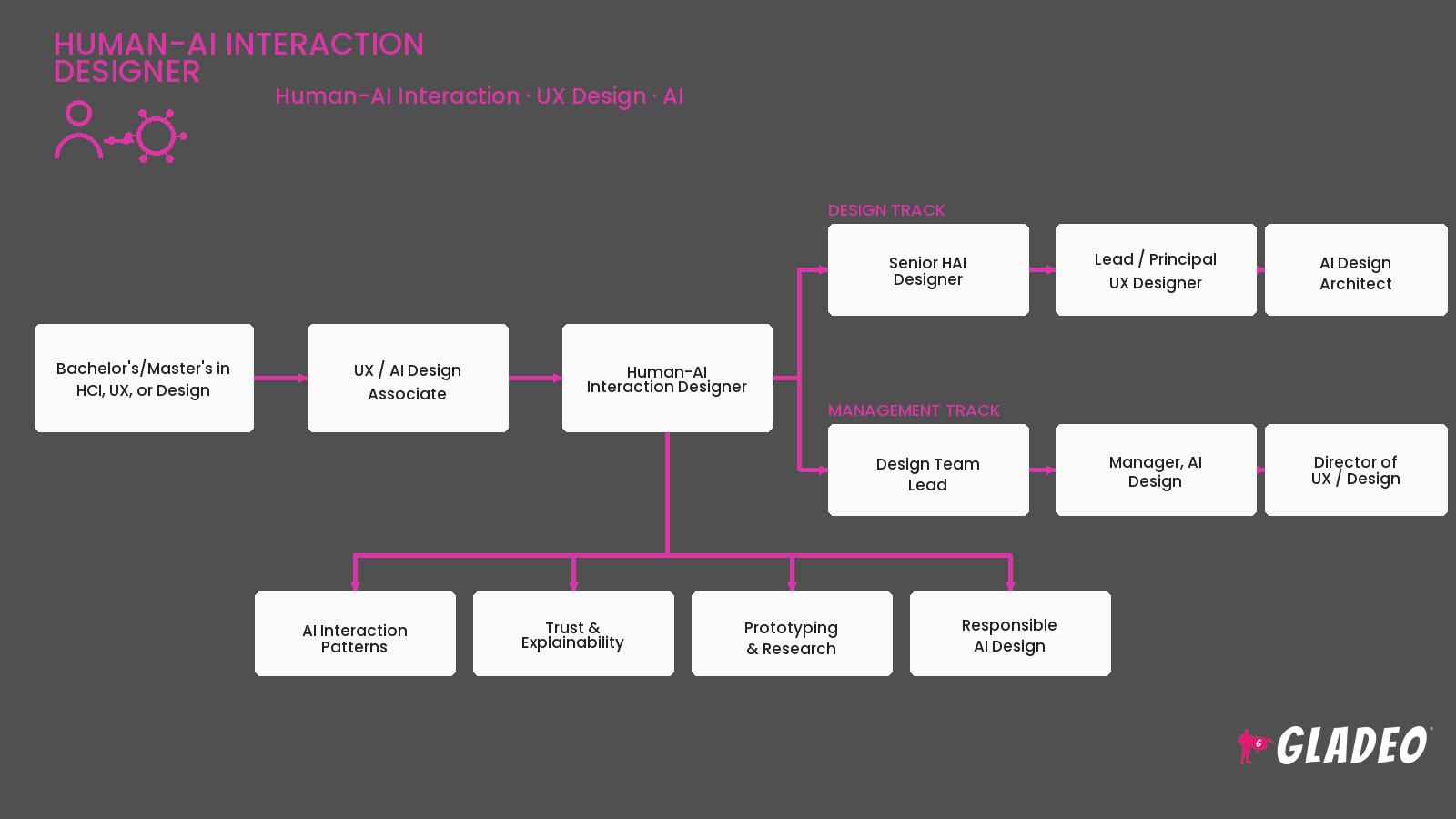
Most Human-AI Interaction Designers hold a bachelor's degree in human-computer interaction, UX design, cognitive science, psychology, or a related field, and many pursue a master's degree, since this role often requires research skills beyond typical design training. Because the field is so new, many professionals also come from backgrounds in AI ethics, policy, or academic human-computer interaction research.
Students can take courses in relevant subjects such as:
- Human-Computer Interaction
- Cognitive Psychology and Decision-Making
- Introduction to Artificial Intelligence and Machine Learning
- User Experience (UX) Research Methods
- Ethics of Technology and Artificial Intelligence
- Data Visualization and Information Design
- Statistics and Research Methods
- Interaction Design and Prototyping
- Philosophy of Mind or Philosophy of Ethics
- Public Policy and Technology Regulation
Because this field is still forming its best practices, staying current through research papers, conferences, and hands-on projects matters as much as formal coursework. Building a portfolio that shows research into how people understand and trust AI systems, even through class projects or personal research, helps demonstrate readiness for the role. Many designers also gain experience through UX research internships or academic research assistant positions before moving into industry roles.
- Take psychology, sociology, and philosophy classes to understand human decision-making
- Study computer science or take an introductory AI course to understand how models work
- Join a debate team or ethics bowl to practice reasoning through complex tradeoffs
- Take a UX design or human-computer interaction course, in school or online
- Read about real cases where AI systems confused, misled, or harmed users
- Practice basic user research skills, like conducting simple interviews or surveys
- Study data visualization to learn how to communicate uncertainty and probability clearly
- Explore coding or prototyping tools to understand what is technically possible to design
- Follow researchers and organizations working on responsible and human-centered AI
- Volunteer or intern with organizations focused on technology policy or AI ethics
- Practice explaining complex technical or ethical ideas in simple language
- Seek out research opportunities, even informal ones, studying how people use technology
- Programs offering coursework in both human-computer interaction and AI or machine learning
- Faculty actively researching human-AI interaction, trust, or explainable AI
- Opportunities to conduct real user research as part of coursework
- Access to interdisciplinary coursework blending psychology, ethics, and computer science
- Strong emphasis on research methods, not just visual design skills
- Capstone or thesis projects focused on emerging AI design challenges
- Connections to AI labs, research centers, or responsible AI teams
- Coursework covering accessibility and inclusive design for AI systems
- Opportunities to publish or present research at student or academic conferences
- Career services familiar with UX research and AI-focused design roles
- Flexible programs for students pursuing graduate research in this new field
- Active alumni network working in AI ethics, UX research, or design roles
- Build a portfolio showing research or design work related to AI trust, transparency, or oversight
- Apply for entry-level titles like UX Researcher, AI Product Designer, or Associate Interaction Designer
- Look for internships at AI labs, research centers, or responsible AI teams
- Search job boards such as LinkedIn and Indeed using terms like human-AI interaction or AI UX research
- Publish or present any academic research on human-AI interaction, even informal projects
- Join communities and mailing lists focused on human-centered AI and AI ethics
- Practice presenting research findings clearly to both technical and non-technical audiences
- Highlight coursework or projects in psychology, ethics, or research methods on your resume
- Reach out to researchers or designers in the field for informational interviews
- Contribute to open discussions or writing about responsible AI design
- Be ready to discuss real examples of confusing or misleading AI interfaces you have noticed
- Stay flexible about entering through adjacent roles like UX research or product design first
- Build a track record of research that measurably improved trust or usability of AI features
- Take on increasingly high-stakes projects, such as AI used in healthcare or finance
- Develop deeper technical fluency in machine learning to collaborate more effectively with engineers
- Contribute to or help shape a company's responsible AI guidelines
- Mentor other designers and researchers new to human-AI interaction work
- Publish research or speak at conferences to build a reputation in this emerging field
- Build relationships with policy, legal, and executive teams shaping AI strategy
- Move into roles like Lead AI Interaction Designer, Responsible AI Design Lead, or Head of Human-AI Research
Websites:
- ACM SIGCHI - sigchi.org
- Nielsen Norman Group (NN/g) - nngroup.com
- Interaction Design Foundation (IxDF) - interaction-design.org
- Partnership on AI - partnershiponai.org
- Association for the Advancement of Artificial Intelligence (AAAI) - aaai.org
- Microsoft HAX Toolkit (Human-AI eXperience) - microsoft.com/haxtoolkit
- Stanford Human-Centered Artificial Intelligence (HAI) - hai.stanford.edu
- MIT Media Lab - media.mit.edu
- AI Now Institute - ainowinstitute.org
- UX Collective - uxdesign.cc
- Fast.ai Community - fast.ai
- DesignLab - designlab.com
- Interaction Design Association (IxDA) - ixda.org
- Center for Human-Compatible AI - humancompatible.ai
Books:
- Human-Centered AI by Ben Shneiderman
- The Design of Everyday Things by Don Norman
- Weapons of Math Destruction by Cathy O'Neil
- Atlas of AI by Kate Crawford
- You Look Like a Thing and I Love You by Janelle Shane
If you find that being a Human-AI Interaction Designer isn't the right fit, your skills in research, ethics, and human-centered design transfer well to many related careers.
- UX Researcher
- Product Designer
- AI Ethics Consultant
- User Experience (UX) Designer
- Technology Policy Analyst
- Human Factors Engineer
- Data Ethics Specialist
- Interaction Designer
- Cognitive Scientist
- AI Product Manager
Click here to download the infographic
Newsfeed

Featured Jobs
Online Courses and Tools