






Spotlights
Botanical Curator, Plant Collection Manager, Herbarium Manager, Botanical Archivist, Plant Taxonomist, Botanical Researcher, Botanical Specimen Specialist, Plant Conservator, Botanical Data Manager, Botanical Collection Specialist, Botanical Historian
Herbarium Curators play a vital role in preserving the botanical legacy of our planet. Their work allows scientists, students, and the public to explore plant diversity through carefully maintained collections that document species from around the world and across centuries.
On a daily basis, Herbarium Curators manage and expand plant specimen collections, ensuring each leaf, flower, and seed is properly preserved and cataloged. They collaborate with botanists, researchers, educators, and museum staff to facilitate plant research, exhibitions, and educational programs. Their meticulous care safeguards plant samples that support scientific discoveries, environmental conservation, and climate change studies.
Using specialized preservation techniques, digital databases, and taxonomic tools, Herbarium Curators combine science and organization to maintain collections that serve as invaluable resources. Their expertise ensures plant specimens remain accessible and scientifically relevant, making this role essential for biodiversity research and education.
- Contributing to global plant conservation efforts by preserving rare and endangered species.
- Supporting scientific research that uncovers plant evolution, ecology, and climate change impacts.
- Engaging with educators and the public to share the wonders of plant biodiversity through exhibits and programs.
- Working hands-on with unique and historic plant specimens that tell stories of ecosystems around the world.
Working Schedule
Herbarium Curators typically work full-time during regular business hours in museum or botanical garden environments. Their work involves a mix of desk time for documentation and computer work, plus hands-on specimen care in labs or storage facilities. While generally steady, workloads can increase around exhibit openings, research deadlines, or grant reporting. Many curators enjoy a balance of routine and variety, with some positions requiring occasional travel for fieldwork or conferences.
Typical Duties
- Cataloging and identifying plant specimens with accurate scientific names and classification.
- Preserving specimens using drying, mounting, and storage techniques to prevent decay.
- Digitizing collections by photographing specimens and entering data into searchable databases.
- Conducting research on plant taxonomy, distribution, and historical collection data.
- Collaborating with botanists and researchers to support scientific studies and publications.
- Designing and preparing exhibits that showcase botanical diversity and conservation themes.
- Managing loans and exchanges of specimens with other herbaria and research institutions.
- Training and supervising interns, volunteers, or staff involved in collection care.
- Monitoring environmental conditions in storage areas to protect specimens from damage.
- Applying for grants and managing budgets related to collection maintenance and research.
- Maintaining accurate records of specimen provenance, condition, and usage.
- Engaging with educators to develop outreach materials and educational programs.
Additional Responsibilities
- Developing policies and procedures for collection management and access.
- Ensuring compliance with legal and ethical standards
regarding plant specimens, including permits and international agreements. - Participating in professional conferences and botanical networks to stay current with research and best practices.
- Advising on acquisitions of new specimens or collections from field expeditions or donations.
- Supporting conservation projects through data sharing and expertise.
- Promoting public awareness of plant biodiversity and the importance of herbaria.
- Maintaining safety protocols in labs and storage facilities handling preserved specimens.
- Contributing to publications, reports, and grant proposals to advance botanical knowledge.
Mornings often start with reviewing emails and planning daily tasks, such as prioritizing specimen processing and coordinating with researchers needing access to collections.
Midday is usually spent in the herbarium’s workroom, where the curator prepares new specimens, updates digital databases, or examines plants under microscopes to verify identifications.
Afternoons might involve meetings with museum staff to plan upcoming exhibits or collaborating with educators to develop workshop content, followed by monitoring storage conditions and documenting specimen loans before wrapping up the day.
Soft Skills
- Attention to detail
- Organizational skills
- Patience and perseverance
- Curiosity and love of learning
- Communication skills
- Collaboration and teamwork
- Problem-solving abilities
- Critical thinking
- Time management
- Adaptability
- Public speaking
- Ethical judgment
Technical Skills
- Botanical taxonomy knowledge
- Specimen preservation techniques
- Database management
- Microscopy
- Digital imaging and photography
- Scientific research methods
- Grant writing basics
- Environmental monitoring
- Collection management software
- Data analysis
- Academic Herbarium Curator: Works primarily in universities supporting research and teaching.
- Museum Herbarium Curator: Focuses on public exhibitions and educational outreach.
- Botanical Garden Curator: Manages living plant collections alongside preserved specimens.
- Research Herbarium Curator: Engages heavily in scientific studies and publishing.
- Government Herbarium Curator: Supports conservation policy and biodiversity monitoring.
- Private Collection Curator: Maintains specialized or rare plant collections for private institutions or individuals.
- Field Herbarium Curator: Participates in collection expeditions and specimen acquisition.
- Digital Herbarium Curator: Specializes in digitizing collections and managing online databases.
- Botanical gardens
- Natural history museums
- Universities and research institutions
- Government environmental agencies
- Conservation organizations
- Private research foundations
- Arboretums
- Agricultural research centers
- Environmental nonprofits
- Science museums
- Public parks and nature centers
- International botanical networks
Herbarium Curators work under the pressure of preserving delicate, often irreplaceable plant specimens while meeting research and exhibition deadlines. They must be precise and methodical, as errors in labeling or storage can compromise scientific value.
While the typical schedule is during regular business hours, curators may face busy periods when preparing exhibits, processing new collections, or assisting researchers. This can require longer days or weekend work.
The job demands physical care of specimens, including handling fragile materials and maintaining controlled environments, which requires vigilance and sometimes repetitive tasks. Curators must balance behind-the-scenes work with public-facing roles, often needing to communicate complex botanical information clearly.
- Increasing digitization of herbarium collections for global access.
- Integration of DNA barcoding in specimen identification.
- Growing emphasis on plant conservation and climate change research.
- Use of AI and machine learning to analyze large botanical datasets.
- Collaborations between herbaria worldwide to share data and specimens.
- Development of interactive and virtual exhibits for broader public engagement.
- Adoption of sustainable and eco-friendly preservation methods.
- Expansion of citizen science projects involving plant documentation.
- Enhanced use of GIS mapping for plant distribution studies.
- Increased funding and interest in biodiversity informatics.
Many Herbarium Curators developed a fascination with plants, nature, and science during childhood, often enjoying activities like gardening, hiking, or collecting leaves and flowers. These early experiences sparked curiosity about the natural world and how plants grow and interact.
Young curators often showed an interest in organizing collections or understanding how living things are classified. They might have enjoyed science fairs, nature clubs, or museum visits, laying the foundation for a career that blends science, history, and preservation.
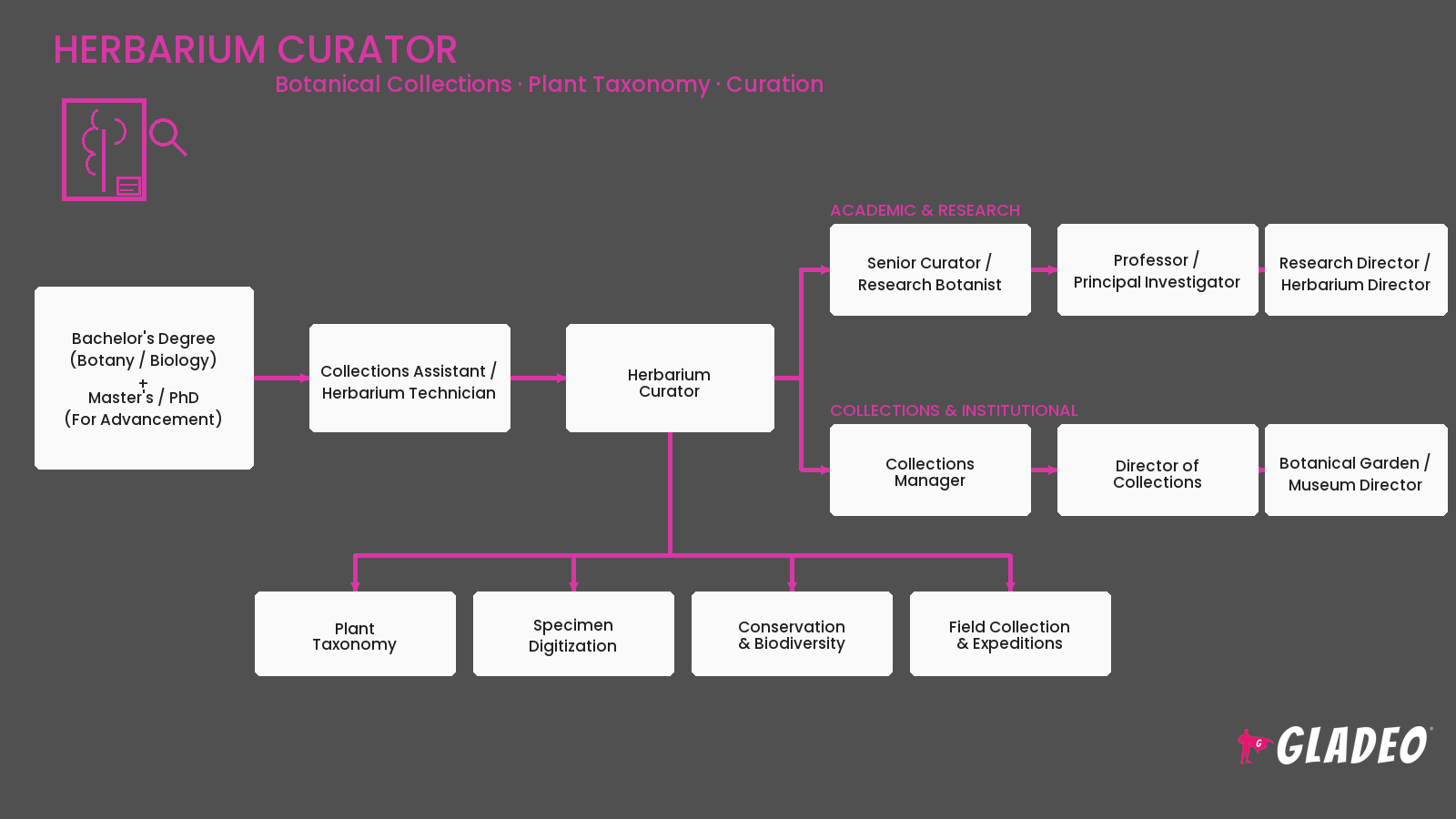
Becoming a Herbarium Curator usually requires a bachelor's degree in botany, biology, environmental science, or a related field. Advanced degrees can open doors to research positions and leadership roles. Practical experience with plant identification, taxonomy, and specimen preservation is essential.
Students can take courses in relevant subjects such as:
- Botany and Plant Biology
- Plant Taxonomy and Systematics
- Herbarium Techniques and Preservation
- Plant Ecology and Conservation
- Museum Studies
- Data Management and Database Systems
- Scientific Writing and Communication
- Environmental Science
- GIS and Mapping Technology
- Research Methods in Biology
Hands-on experience such as internships, volunteering at herbaria or botanical gardens, and building a portfolio of specimen work are invaluable. On-the-job training helps curators master collection management software and develop expertise in specific plant groups.
- Take biology, environmental science, and chemistry classes.
- Join science clubs or environmental organizations.
- Volunteer at local botanical gardens or museums.
- Learn computer skills focused on databases and digital imaging.
- Participate in science fairs with plant-related projects.
- Attend workshops or camps related to botany or horticulture.
- Explore internships or summer jobs in natural history or science institutions.
- Develop strong research and writing skills.
- Practice public speaking and presentation abilities.
- Study foreign languages that can aid in international research collaborations.
- Choose programs with strong botany or plant science departments.
- Look for schools offering hands-on herbarium or museum internships.
- Consider programs with courses in taxonomy, conservation, and museum studies.
- Find opportunities for research assistantships or fieldwork.
- Evaluate faculty expertise and their research interests.
- Seek programs with digital collection management training.
- Check for collaborations with botanical gardens or conservation organizations.
- Prioritize schools with access to diverse plant collections.
- Look for programs offering grant writing and project management courses.
- Consider graduate programs for advanced research and leadership roles.
- Ensure availability of modern lab facilities and technology.
- Look for programs that support networking through conferences and professional societies.
- Volunteer or intern at a local herbarium, botanical garden, or museum to gain hands-on experience.
- Assist with specimen processing, labeling, and preservation tasks.
- Help digitize collections by photographing and entering data.
- Shadow experienced curators to learn collection management techniques.
- Participate in public outreach or educational programs.
- Take part in plant identification and taxonomy projects.
- Support research by gathering historical data or preparing specimens.
- Attend botanical conferences or workshops to build knowledge and networks.
- Apply for entry-level roles such as herbarium technician or collection assistant.
- Build a portfolio documenting your contributions to collections and research.
- Seek mentorship from professionals in the field.
- Develop proficiency with herbarium database software and imaging tools.
- Gain expertise in specialized plant groups or taxonomic areas.
- Pursue a master's or doctoral degree focused on botany or herbarium science.
- Build a strong network with researchers and institutions worldwide.
- Publish research papers and present at botanical conferences.
- Take on leadership roles managing collections or teams.
- Lead grant writing efforts to fund research and collection projects.
- Develop skills in digital curation and biodiversity informatics.
- Expand public outreach by designing innovative education programs.
Websites:
- American Society of Plant Taxonomists (https://www.aspt.net)
- Botanical Society of America (https://www.botany.org)
- Index Herbariorum (http://sweetgum.nybg.org/science/ih)
- Society for the Preservation of Natural History Collections (https://spnhc.org)
- Global Biodiversity Information Facility (https://www.gbif.org)
- International Association for Plant Taxonomy (https://www.iaptglobal.org)
- The New York Botanical Garden (https://www.nybg.org)
- Kew Royal Botanic Gardens (https://www.kew.org)
- Missouri Botanical Garden (https://www.missouribotanicalgarden.org)
- National Science Foundation (https://www.nsf.gov)
- NatureServe (https://www.natureserve.org)
- Biodiversity Heritage Library (https://www.biodiversitylibrary.org)
- Plant Conservation Alliance (https://www.plantconservation.org)
- Herbarium Digitization Program (https://herbariums.si.edu)
Books:
- Herbarium Handbook by Barbara M. Thiers
- Plant Systematics: A Phylogenetic Approach by Walter S. Judd
- Curating Natural History Collections: A Handbook by Caroline L. Stearns
- Botany for Gardeners by Brian Capon
- The Herbarium as a Tool for Plant Conservation by Vicki A. Funk
If becoming a Herbarium Curator isn’t the right fit, many related careers offer opportunities to work with plants, science, and collections in different ways.
- Botanist
- Museum Collections Manager
- Environmental Scientist
- Plant Ecologist
- Conservation Biologist
- Horticulturist
- Taxonomist
- Science Educator
- Agricultural Scientist
- Plant Pathologist
Newsfeed

Featured Jobs
Online Courses and Tools