






Spotlights
Agricultural Engineer, Controlled Environment Agriculture Engineer, Greenhouse Systems Engineer, Horticultural Engineer, Environmental Control Engineer, Plant Growth Engineer, Greenhouse Automation Specialist, Climate Control Engineer, Sustainable Agriculture Engineer, Crop Production Engineer, Agritech Engineer, Greenhouse Design Engineer
Imagine walking into a greenhouse where every plant thrives in perfect conditions—balanced temperature, ideal humidity, and optimized light—all year round. This environment means fresher produce, enhanced food security, and reduced environmental impact, made possible by the expertise of Greenhouse Engineers!
Greenhouse Engineers design, develop, and maintain advanced greenhouse systems that create controlled environments for growing plants. They collaborate closely with horticulturists, agricultural scientists, architects, and technicians to build efficient structures that regulate temperature, ventilation, light, and irrigation. Their daily work involves planning layouts, analyzing environmental data, and integrating technology to improve plant growth and energy efficiency.
Using tools like CAD software for design, environmental sensors for monitoring, and automation systems for climate control, Greenhouse Engineers blend engineering principles with biological knowledge. Their role is vital to modern agriculture—helping farms grow more food sustainably, reduce waste, and adapt to changing climates. Their innovations help feed communities and protect natural resources.
- Transforming challenging environments into thriving plant habitats through engineering creativity.
- Knowing your work supports sustainable food production and environmental stewardship.
- Collaborating with scientists and tech experts to innovate green solutions.
- Seeing tangible results in healthier plants and increased crop yields.
Working Schedule
Greenhouse Engineers typically work full-time, often in office and greenhouse settings. Their schedule may involve standard 40-hour weeks but can include overtime during project deadlines or system installations. Work environments can vary from comfortable indoor offices to on-site greenhouse locations, sometimes requiring travel to farms or research centers. Many Greenhouse Engineers are employed by agricultural companies, research institutions, or government agencies, while some work as consultants or contractors, leading to flexible but deadline-driven hours.
Typical Duties
- Designing greenhouse structures and environmental control systems.
- Analyzing climate data to optimize temperature, humidity, and lighting.
- Integrating automated systems for irrigation and ventilation.
- Collaborating with horticulturists to meet plant growth requirements.
- Conducting feasibility studies and cost analyses for new projects.
- Maintaining and upgrading existing greenhouse technology.
- Ensuring compliance with environmental and safety regulations.
- Managing energy efficiency and sustainability initiatives.
- Troubleshooting system malfunctions and performance issues.
- Preparing technical reports and documentation.
- Overseeing installation and testing of greenhouse equipment.
- Training staff on system operation and maintenance.
Additional Responsibilities
- Researching emerging technologies in controlled environment agriculture.
- Advising clients or management on best practices for greenhouse operations.
- Participating in grant writing or funding proposals for projects.
- Coordinating with suppliers and contractors for materials and services.
- Monitoring environmental impact and suggesting improvements.
- Developing emergency response plans for system failures.
- Contributing to academic or industry publications and conferences.
- Supporting educational outreach or community programs related to sustainable agriculture.
Morning often starts with reviewing environmental data collected overnight from greenhouse sensors and monitoring system performance to identify any issues needing immediate attention.
Midday involves hands-on work such as meeting with architects or horticulturists to discuss design modifications, running simulations on climate control software, or visiting greenhouse sites to inspect installations.
Afternoons may include preparing detailed reports, collaborating with project teams via video calls, planning maintenance schedules, and coordinating with vendors to procure new equipment or parts. Deadlines often require prioritizing problem-solving and adjustments to ensure optimal plant growth conditions.
Soft Skills
- Analytical thinking
- Problem solving
- Attention to detail
- Collaboration and teamwork
- Communication skills
- Adaptability
- Creativity
- Time management
- Project management
- Critical thinking
- Patience
- Environmental awareness
Technical Skills
- Computer-Aided Design (CAD)
- Environmental monitoring systems
- Automation and control systems
- Data analysis and interpretation
- HVAC system knowledge
- Sustainable design principles
- Irrigation system design
- Energy efficiency technologies
- Programming for environmental controls
- Technical writing
- Research Engineer: Focuses on developing new greenhouse technologies and sustainable practices.
- Design Engineer: Specializes in creating greenhouse blueprints and structural plans.
- Systems Engineer: Integrates climate control, irrigation, and lighting systems within greenhouses.
- Automation Engineer: Develops automated systems to monitor and adjust environmental factors.
- Sustainability Engineer: Works on reducing energy use and environmental impact of greenhouses.
- Maintenance Engineer: Oversees repair and upkeep of greenhouse equipment and systems.
- Agronomy Engineer: Combines plant science with engineering to optimize crop production.
- Consulting Engineer: Advises farms and companies on greenhouse design and operation.
- Agricultural technology companies
- Commercial greenhouse growers
- Agricultural research institutes
- Universities with agriculture programs
- Government agricultural agencies
- Environmental consulting firms
- Renewable energy companies
- Horticultural societies
- Construction firms specializing in greenhouses
- Agritech startups
- Food production companies
- Nonprofit organizations focused on sustainable agriculture
Greenhouse Engineers often face pressure to develop cost-effective and energy-efficient solutions while meeting strict agricultural and environmental standards. They must balance technical challenges with the biological needs of plants, requiring persistent problem solving and innovation.
Work hours are generally full-time but can extend during critical project phases or system emergencies. The role may involve time in both office settings and greenhouses, with occasional exposure to outdoor conditions. Travel to client sites or research facilities is common.
Sacrifices include managing complex, multidisciplinary projects that require strong attention to detail and adaptability. Engineers must stay current with rapidly evolving technologies and may face tight deadlines, requiring dedication and continuous learning.
- Rising use of smart sensors and IoT devices for real-time environmental monitoring.
- Increased automation and robotics in greenhouse management.
- Advances in energy-efficient climate control systems.
- Growing emphasis on sustainable and organic farming practices.
- Integration of AI and machine learning for crop and environment optimization.
- Development of vertical farming and urban greenhouse solutions.
- Use of renewable energy sources like solar and geothermal in greenhouses.
- Focus on reducing water usage through precision irrigation.
- Collaboration between engineers and biologists for plant-specific environments.
- Implementation of modular and scalable greenhouse designs.
Many Greenhouse Engineers were fascinated by plants, gardening, or how things work from a young age. They often enjoyed building projects, experimenting with growing plants, or tinkering with technology to solve problems.
They tended to be curious about the natural world and passionate about sustainability, combining interests in science, math, and the environment. Early hobbies might include science fairs, robotics clubs, or volunteering in community gardens.
Becoming a Greenhouse Engineer typically requires a bachelor's degree in agricultural engineering, environmental engineering, biological engineering, or a related field. Students learn a mix of engineering principles and plant sciences, preparing them to design and manage controlled environment agriculture systems.
Students can take courses in relevant subjects such as:
- Biology and Plant Physiology
- Environmental Science
- Thermodynamics
- Fluid Mechanics
- Agricultural Systems Design
- Control Systems Engineering
- Soil Science
- Computer-Aided Design (CAD)
- Data Analysis and Statistics
- Sustainable Agriculture Practices
Hands-on experience through internships or cooperative education programs is crucial to gain practical skills. Building a portfolio of design projects and familiarity with the latest greenhouse technologies will help students stand out. Many employers also value certifications in project management or environmental technologies.
- • Take advanced math courses like algebra, geometry, and calculus.
- • Enroll in biology and environmental science classes.
- • Join science clubs or robotics teams to develop problem-solving skills.
- • Participate in agricultural or horticultural programs if available.
- • Learn computer skills, including CAD and data analysis software.
- • Volunteer or intern at local farms or greenhouses.
- • Attend workshops or camps focused on sustainability or engineering.
- • Develop strong communication and teamwork abilities.
- • Explore summer programs in agriculture or engineering.
- • Research colleges offering agricultural or environmental engineering degrees.
- • Connect with professionals through internships or mentorships.
- • Prepare a portfolio showcasing relevant projects or experiments.
- Choose programs accredited by recognized engineering organizations.
- Look for curricula combining engineering with plant sciences.
- Seek schools offering hands-on labs and internship opportunities.
- Check if the program includes training in automation and control systems.
- Consider programs with research facilities for controlled environment agriculture.
- Evaluate faculty expertise in greenhouse technology and sustainable agriculture.
- Find schools with strong industry partnerships for job placement.
- Assess availability of scholarships or financial aid for agriculture engineering.
- Look for opportunities to participate in design competitions or clubs.
- Ensure access to modern CAD and environmental monitoring software.
- Verify program's emphasis on sustainability and energy efficiency.
- Prioritize programs with career services supporting agriculture engineering fields.
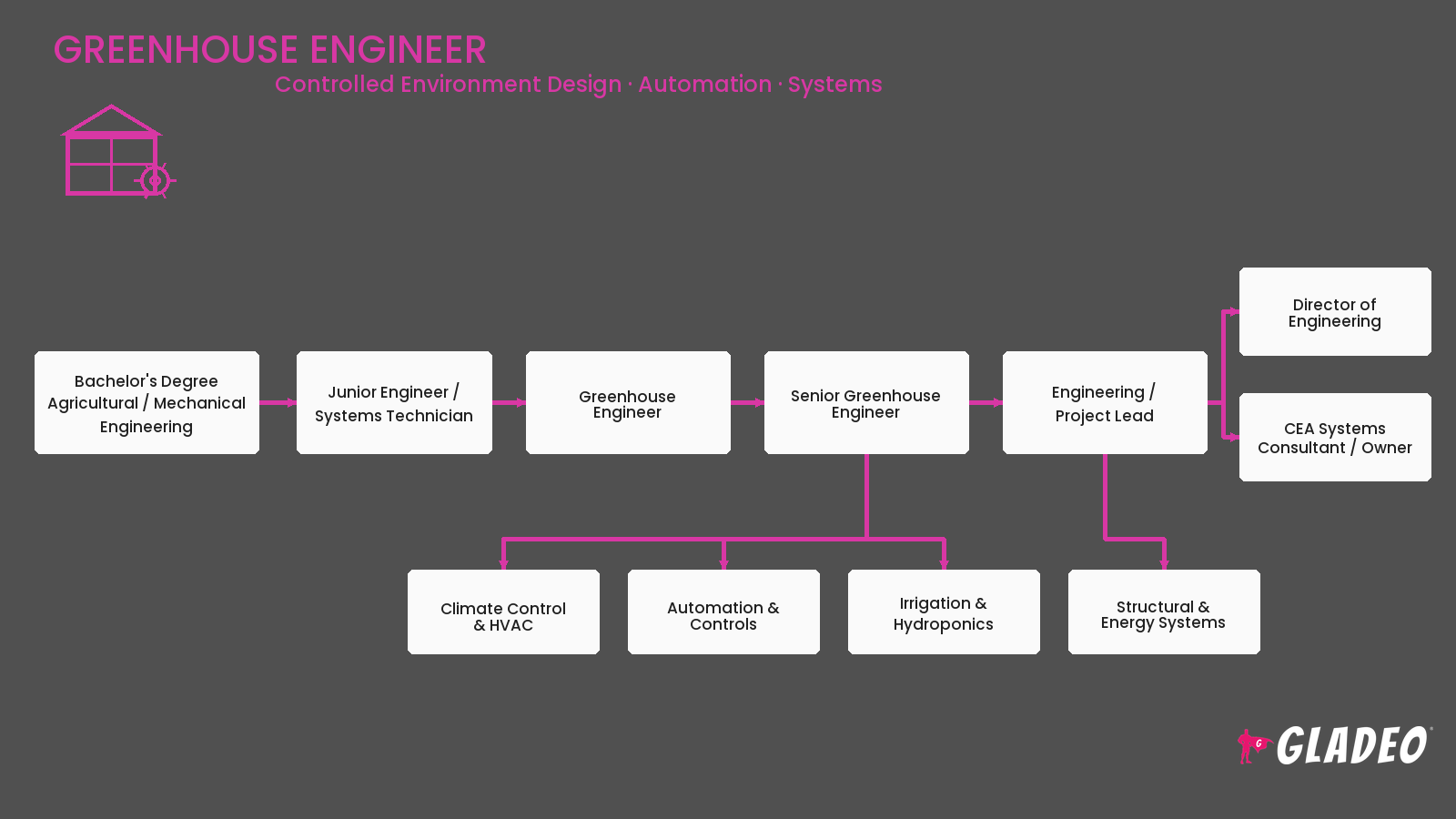
- Apply for internships or entry-level roles at agricultural technology firms or commercial greenhouses.
- Build a portfolio of design and technical projects related to greenhouse systems.
- Network with professionals at agriculture and engineering conferences or local chapters.
- Develop proficiency in CAD and environmental control software.
- Seek mentorship from experienced Greenhouse Engineers or agricultural scientists.
- Volunteer for projects that involve greenhouse maintenance or monitoring.
- Prepare for interviews by understanding current greenhouse technologies and challenges.
- Join professional organizations related to agricultural or environmental engineering.
- Stay updated on industry trends and emerging technologies.
- Consider certifications in project management or automation systems.
- Demonstrate problem-solving skills through practical examples.
- Gain experience in both technical design and fieldwork aspects.
- Pursue advanced certifications or a master's degree in agricultural or environmental engineering.
- Specialize in emerging technologies like AI-driven climate control or renewable energy integration.
- Lead complex projects to build management and leadership experience.
- Develop strong professional networks through industry events and associations.
- Stay current with research and innovations by publishing or attending workshops.
- Seek roles with increasing responsibility such as project manager or senior engineer.
- Expand skills into related areas like data analytics or sustainable design.
- Mentor junior engineers and participate in community outreach.
Websites:
- American Society of Agricultural and Biological Engineers (ASABE) - https://www.asabe.org
- Controlled Environment Agriculture Association - https://ceaa.org
- International Society for Horticultural Science - https://www.ishs.org
- Greenhouse Grower - https://www.greenhousegrower.com
- Agricultural Research Service - https://www.ars.usda.gov
- Farm Energy - https://farm-energy.extension.org
- Association for Vertical Farming - https://vertical-farming.net
- Society of Environmental Engineers - https://www.environmental.org.uk
- National Sustainable Agriculture Coalition - https://sustainableagriculture.net
- Engineering360 - https://www.globalspec.com
- Renewable Energy World - https://www.renewableenergyworld.com
- Environmental Protection Agency (EPA) Agriculture - https://www.epa.gov/agriculture
- AgFunderNews - https://agfundernews.com
- Agri-Tech East - https://www.agritech-east.co.uk
Books:
- Controlled Environment Agriculture: The Basics of Protected Agriculture by Paul V. Nelson
- Greenhouse Engineering by Robert A. Aldrich and John W. Bartok Jr.
- Sustainable Greenhouse Systems by Paolo Barberi and Claudio Bonazzi
- Introduction to Agricultural Engineering Technology by Harry L. Field and Raymond A. Culp
- Environmental Control in Plant Production by Peter Goldsmith
If a career as a Greenhouse Engineer doesn’t work out or you want a backup plan, there are many related paths that use your skills in engineering, biology, and technology.
- Agricultural Technician
- Environmental Engineer
- Horticulturist
- Renewable Energy Engineer
- Irrigation Specialist
- Landscape Architect
- Food Scientist
- Building Systems Engineer
- Sustainability Consultant
- Plant Scientist
Newsfeed

Featured Jobs
Online Courses and Tools