







Spotlights
Data Pipeline Engineer, Big Data Engineer, ETL Developer, Data Infrastructure Engineer, Database Architect, Analytics Engineer, Data Platform Engineer, Data Warehouse Engineer, Cloud Data Engineer, Data Systems Engineer, Business Intelligence Engineer, Data Integration Engineer
Every time a streaming app recommends your next favorite show, a delivery app predicts exactly when your food will arrive, or a hospital's AI tool flags a pattern doctors should look at, there is a hidden layer of work that made it possible. Long before any data scientist or AI model can find insight in the data, someone had to build the pipes that carry that data from thousands of scattered sources into one clean, trustworthy place. That someone is a Data Engineer, and without them, even the smartest algorithm has nothing reliable to learn from.
Data Engineers design, build, and maintain the systems that collect, move, clean, and store massive amounts of data so it is ready for other people to use. They work closely with data scientists, machine learning engineers, and business analysts to understand what data those teams need and how fast they need it, then build the pipelines and databases that deliver it accurately and on time. When a company's app logs millions of user clicks a day, a retailer tracks inventory across hundreds of stores, or a hospital system needs patient data flowing securely between departments, a Data Engineer is the one who architects how all of that information moves and where it lives.
Using tools like SQL, Python, cloud platforms such as AWS, Azure, and Google Cloud, and specialized systems for streaming and batch data processing, Data Engineers turn scattered, messy information into dependable data that businesses and AI systems can actually trust. Their work rarely makes headlines, but it is the invisible foundation underneath nearly every modern data-driven decision and every AI product you have ever used. Without accurate, well-organized data flowing in the background, even the most brilliant analysis or model would be working with nothing but noise.
- Building the invisible infrastructure that powers apps, AI models, and decisions used by millions
- Solving intricate technical puzzles about how to move and organize data efficiently and reliably
- Working at the foundation of the AI and data revolution, one of the fastest-growing fields in tech
- Seeing the direct, measurable impact of your work when dashboards, models, and products finally run smoothly
Working Schedule
Most Data Engineers work full-time, typically around 40 hours a week, though deadlines around major product launches or data migrations can mean longer stretches or occasional after-hours work when a pipeline breaks unexpectedly. The role is almost entirely computer-based, working from an office or remotely, often across time zones on distributed teams. Some Data Engineers are on call in rotation to respond if a critical data pipeline fails overnight, since many pipelines run continuously to keep dashboards and AI systems fed with fresh data. Most work as full-time employees at tech companies, but a growing number work as consultants or contractors helping multiple companies modernize their data systems.
Typical Duties
- Designing and building data pipelines that move data from sources into storage systems
- Writing and maintaining ETL (extract, transform, load) processes to clean and reshape raw data
- Building and managing data warehouses and data lakes that store information at scale
- Writing complex SQL queries and optimizing databases for speed and reliability
- Automating data workflows so pipelines run on schedule without manual intervention
- Monitoring pipelines for failures, delays, or data quality issues and fixing them quickly
- Collaborating with data scientists and analysts to understand what data they need and how
- Ensuring data security, privacy, and compliance with regulations like GDPR or HIPAA
- Documenting data sources, definitions, and pipeline architecture for other teams to use
- Testing new data sources and integrating third-party APIs into existing systems
- Optimizing infrastructure costs on cloud platforms as data volume grows
- Troubleshooting data discrepancies and tracing errors back to their source
Additional Responsibilities
- Evaluating and adopting new data tools, frameworks, and cloud services
- Setting up data governance policies so data stays consistent and well-labeled across teams
- Mentoring junior engineers and analysts on best practices for working with data
- Participating in code reviews to keep pipeline code clean and maintainable
- Coordinating with IT and security teams on access controls and data protection
- Estimating the cost and timeline of new data infrastructure projects
- Staying current on new database technologies and distributed computing frameworks
- Supporting on-call rotations to respond to urgent data outages
A Data Engineer's morning often starts by checking dashboards and alerts to make sure overnight data pipelines ran successfully. If something failed, that becomes the first priority, tracing the error back through logs to figure out whether a source system changed, a server ran out of space, or the data itself came in malformed. Once everything looks healthy, they might join a stand-up meeting with data scientists or analysts to hear what new data they need for an upcoming project.
Midday is often spent writing and testing code, building a new pipeline to bring in data from a freshly added source, rewriting a slow SQL query so a dashboard loads faster, or restructuring a database table so it is easier for other teams to use. Data Engineers frequently switch between coding, reviewing a teammate's pull request, and researching how a new tool or cloud service might solve a tricky problem more efficiently.
Afternoons often bring collaboration and planning. A Data Engineer might meet with a machine learning engineer to make sure training data is arriving in the right format, discuss a new data source with a business team, or document how a pipeline works so it does not become a mystery to whoever maintains it next. Before wrapping up, they check that scheduled jobs are set to run correctly overnight and note anything that needs follow-up the next day.
Soft Skills
- Strong problem-solving and analytical thinking
- Attention to detail, since small errors in data can cause big downstream problems
- Clear communication with both technical and non-technical teams
- Organization and the ability to manage multiple pipelines and projects at once
- Patience and persistence when debugging complex, hard-to-trace issues
- Collaboration and teamwork across data science, engineering, and business teams
- Adaptability to fast-changing tools and technologies
- Time management and prioritization under competing deadlines
- Curiosity about how systems fit together end to end
- Ownership and accountability for the reliability of your pipelines
- Willingness to document work clearly for others to understand
- Comfort working independently as well as within a larger engineering team
Technical Skills
- SQL and relational database design
- Programming languages such as Python, Java, or Scala
- ETL and data pipeline tools like Apache Airflow, dbt, or Informatica
- Big data frameworks such as Apache Spark, Hadoop, or Kafka
- Cloud platforms including AWS, Google Cloud Platform, and Microsoft Azure
- Data warehousing solutions such as Snowflake, BigQuery, or Redshift
- Data modeling and schema design for structured and unstructured data
- Version control systems like Git for managing pipeline code
- Understanding of data governance, privacy regulations, and security best practices
- Basic knowledge of machine learning workflows and how models consume data
- Pipeline Engineer: Focuses on building and maintaining the systems that move data from one place to another
- Analytics Engineer: Bridges data engineering and analytics, shaping data specifically for dashboards and reporting
- Big Data Engineer: Specializes in handling extremely large or fast-moving datasets using distributed systems
- Cloud Data Engineer: Builds and manages data infrastructure on cloud platforms like AWS or Azure
- Streaming Data Engineer: Focuses on real-time data flows, such as live tracking or fraud detection systems
- Machine Learning Data Engineer: Builds pipelines specifically designed to feed data into AI and ML models
- Data Platform Engineer: Builds the broader infrastructure and tools that other data engineers rely on
- Database Architect: Designs the overall structure and strategy for how an organization's data is stored
- Technology and software companies
- E-commerce and retail companies
- Financial services and banking firms
- Healthcare systems and health tech companies
- Streaming media and entertainment companies
- Ride-share, delivery, and logistics companies
- Government agencies and public sector data teams
- Consulting firms specializing in data and analytics
- Cloud computing providers such as AWS, Google Cloud, and Microsoft
- Universities and research institutions
- Nonprofit organizations tracking impact data
- Startups building new AI and data products
Data Engineers carry real responsibility, because when pipelines fail, everything downstream fails with them: dashboards go blank, AI models train on stale or wrong data, and business decisions can be made on bad information. That pressure to build reliable, accurate systems means the work demands careful testing and a willingness to take failures seriously rather than just patch around them.
Because so many pipelines run continuously and other teams depend on fresh data every day, Data Engineers are sometimes on call outside normal hours to fix urgent issues, especially at companies where data feeds live products or financial systems. The work can also become highly technical and detail-oriented, requiring long stretches of focused debugging that some find satisfying and others find draining.
The field changes quickly, with new cloud tools, frameworks, and best practices arriving constantly as data volumes keep growing and AI adoption accelerates. Data Engineers who want to stay valuable need to keep learning throughout their careers, since a tool that is standard today may be replaced within a few years, and companies increasingly expect engineers to understand how their pipelines connect to machine learning systems.
- Explosive growth in demand for clean, reliable data to train AI and machine learning models
- Rise of cloud-native data platforms replacing traditional on-premises databases
- Growing use of real-time streaming data for fraud detection, personalization, and logistics
- Increased adoption of data mesh and decentralized data ownership models
- Expansion of automated data quality monitoring and observability tools
- Rising importance of data privacy regulations shaping how pipelines are built
- Growth of low-code and no-code tools that let more people build simple pipelines
- Convergence of data engineering and machine learning engineering roles
- Increased use of open table formats like Apache Iceberg and Delta Lake
- Greater emphasis on cost optimization as cloud data storage and processing scale up
Many Data Engineers grew up enjoying puzzles, logic games, and anything that involved organizing information, whether that meant color-coding a bookshelf, building elaborate spreadsheets for a hobby, or figuring out the most efficient way to sort a huge collection of trading cards. They often gravitated toward math, computer classes, and video games that rewarded systems thinking and optimization.
Others discovered an early love of building things, whether with construction sets, computer programs, or simple websites, and enjoyed the specific satisfaction of taking something messy and making it work smoothly and efficiently. Many were the friend who ended up fixing everyone's tech problems, quietly enjoying the process of tracing a glitch back to its root cause.
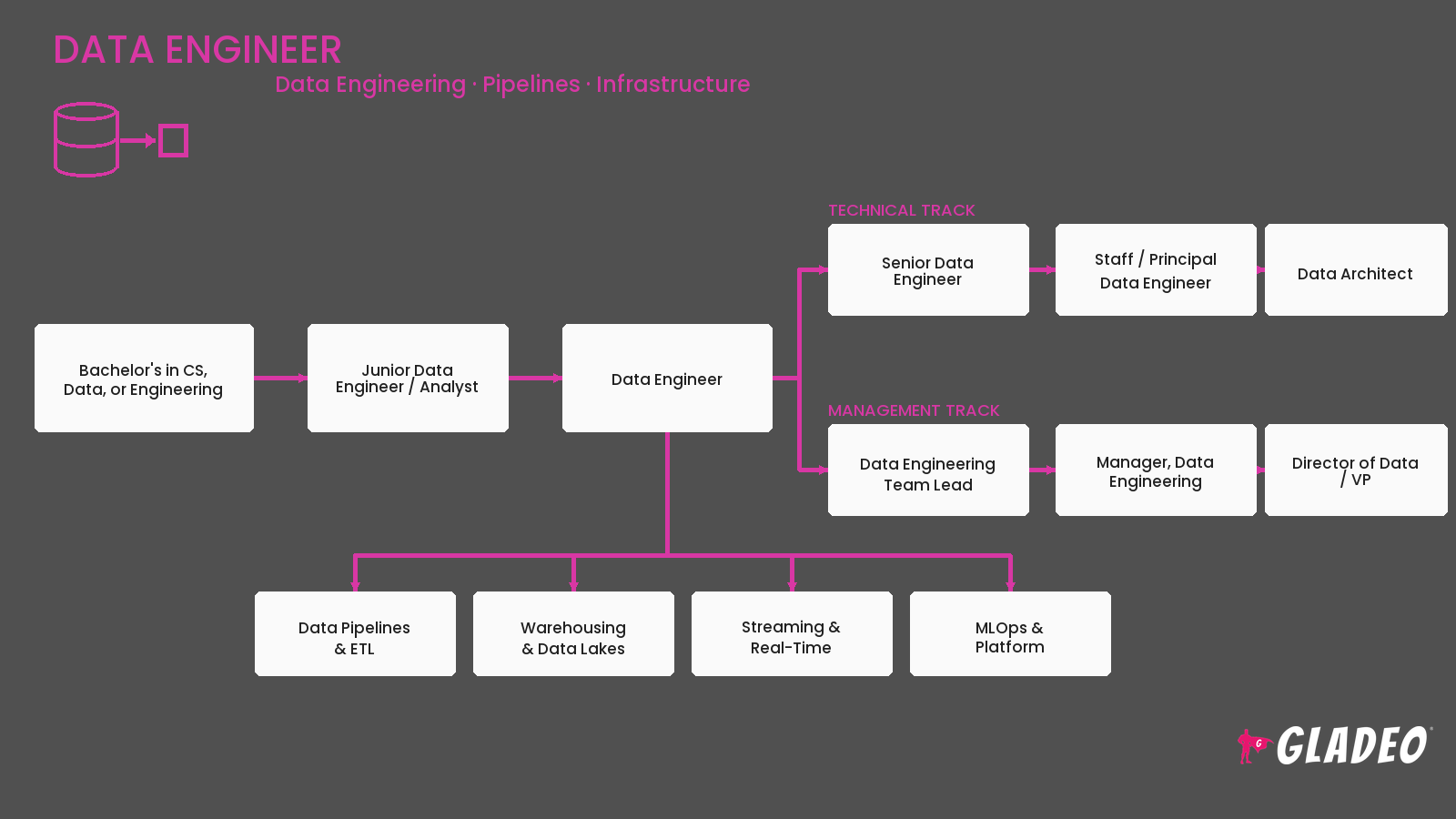
Most Data Engineers hold a bachelor's degree in computer science, information technology, data science, software engineering, or a related field, typically a four-year program covering programming, databases, and systems design. Some enter the field through coding bootcamps or self-directed learning paired with strong project portfolios, especially if they already have experience in software development or data analysis. Employers care most about demonstrated skill with real data tools and systems, so hands-on projects often matter as much as the degree itself.
Students can take courses in relevant subjects such as:
- Data Structures and Algorithms
- Database Systems and SQL
- Cloud Computing Fundamentals
- Distributed Systems
- Python or Java Programming
- Data Warehousing and ETL Design
- Statistics and Data Analysis
- Systems Design and Software Architecture
- Big Data Technologies
- Data Privacy, Security, and Ethics
Hands-on experience is essential, since employers want to see that you can actually build a working pipeline, not just describe one in theory. Internships, personal projects using public datasets, and contributions to open-source data tools all help build a portfolio that demonstrates real skill. Many Data Engineers continue learning throughout their careers through cloud certifications and hands-on courses as new tools and platforms emerge.
- Take computer science, statistics, and as much math as your school offers
- Learn a programming language like Python on your own through free online resources
- Take a free introductory SQL course to understand how databases work
- Build a personal project using a public dataset, such as sports stats or weather data
- Join a coding club, computer science honor society, or hackathon team
- Experiment with a free-tier cloud platform like AWS, Google Cloud, or Azure
- Enter a data or coding competition such as a school hackathon or Kaggle beginner challenge
- Create a GitHub account and start posting your coding projects publicly
- Look for a summer program or camp focused on computer science or data
- Reach out to a data engineer or software developer for an informational interview
- Practice explaining a technical project clearly to someone who is not technical
- Take on a leadership or organizing role in any club, since organizing information is core to the job
- Strong computer science or data engineering curriculum with real coding requirements
- Courses that cover both databases and distributed or cloud computing systems
- Opportunities for internships with tech companies or data-heavy organizations
- Instructors or mentors with real industry experience in data engineering
- Access to modern tools like cloud platforms, not just theoretical coursework
- Capstone projects where you build an actual data pipeline or system
- Strong career services and job placement support in tech roles
- Active student clubs or competitions related to coding, data, or AI
- Flexible or online options if you plan to work while studying
- Opportunities to earn cloud certifications alongside your degree
- A curriculum that keeps pace with current industry tools and practices
- Alumni networks connected to tech companies and data teams
- Build a portfolio of real data pipeline projects you can show and explain in detail
- Complete at least one internship in software engineering, data, or analytics before graduating
- Apply for entry-level titles like Junior Data Engineer, ETL Developer, or Data Analyst with growth potential
- Earn a foundational cloud certification, such as AWS or Google Cloud's data engineering credential
- Post your projects on GitHub and keep your code clean and well-documented
- Search job boards like LinkedIn and Indeed along with tech-specific sites and company career pages
- Attend tech meetups, hackathons, and career fairs focused on data and software careers
- Practice technical interview questions involving SQL, coding, and system design
- Be ready to explain a project from your portfolio in detail, including problems you ran into
- Consider starting as a data analyst or software engineer to build experience before specializing
- Network with alumni, professors, and professionals through LinkedIn and local tech communities
- Show curiosity and a genuine interest in how data systems work during interviews
- Deepen your expertise in distributed systems, cloud architecture, and large-scale data processing
- Take ownership of increasingly complex or business-critical pipelines
- Earn advanced certifications in specific cloud platforms or big data tools
- Build a track record of designing systems that are both reliable and cost-efficient
- Move into senior data engineer, staff engineer, or data architect roles
- Develop mentoring skills by helping junior engineers grow their technical abilities
- Learn how machine learning systems consume data to work more closely with AI teams
- Stay active in data engineering communities to learn about emerging tools and best practices
Websites:
- Data Engineering Weekly - dataengineeringweekly.com
- dbt Community - getdbt.com/community
- Apache Airflow - airflow.apache.org
- Apache Spark - spark.apache.org
- Google Cloud Skills Boost - cloudskillsboost.google
- AWS Training and Certification - aws.amazon.com/training
- Microsoft Learn (Azure Data Engineering) - learn.microsoft.com
- DataCamp - datacamp.com
- Towards Data Science - towardsdatascience.com
- Kaggle - kaggle.com
- freeCodeCamp - freecodecamp.org
- GitHub - github.com
- The Data Engineering Podcast - dataengineeringpodcast.com
- Locally Optimistic (data community) - locallyoptimistic.com
Books:
- Designing Data-Intensive Applications by Martin Kleppmann
- Fundamentals of Data Engineering by Joe Reis and Matt Housley
- The Data Warehouse Toolkit by Ralph Kimball and Margy Ross
- Streaming Systems by Tyler Akidau, Slava Chernyak, and Reuven Lax
- Designing Distributed Systems by Brendan Burns
If you find that being a Data Engineer isn't the right fit, your skills in coding, systems thinking, and working with large datasets transfer to many related careers.
- Data Scientist
- Machine Learning Engineer
- Database Administrator
- Software Engineer
- Business Intelligence Analyst
- Cloud Engineer
- Data Analyst
- DevOps Engineer
- Solutions Architect
- Systems Analyst
Click here to download the infographic
Newsfeed

Featured Jobs
Online Courses and Tools