






Spotlights
Agronomic Consultant, Crop Advisor, Agricultural Consultant, Field Crop Specialist, Soil and Crop Scientist, Precision Agriculture Consultant, Plant Health Specialist, Agronomy Specialist, Agricultural Extension Agent, Crop Production Consultant
Imagine vast fields of crops growing healthy and strong, feeding communities and supporting economies around the world. Behind this success are Crop Consultants, the experts who guide farmers on how to optimize yields and protect plants from pests and diseases.
Crop Consultants spend their days visiting farms, analyzing soil and plant health, and advising farmers on the best crop varieties, fertilizers, irrigation methods, and pest control strategies. They collaborate closely with farmers, agricultural researchers, equipment suppliers, and sometimes government agencies to ensure crops thrive and resources are used efficiently.
Using tools like soil testing kits, GPS mapping, satellite imagery, and advanced software for data analysis, Crop Consultants combine science and technology to develop tailored plans. Their work is vital to sustainable farming, helping produce more food with fewer inputs while protecting the environment.
- Helping farmers achieve better harvests and improve their livelihoods
- Applying science and technology to solve real-world agricultural challenges
- Contributing to sustainable food production and environmental stewardship
- Building strong relationships with farming communities and seeing the direct impact of your advice
Working Schedule
Crop Consultants often work full-time and can expect a mix of office time and field visits. Their schedule tends to be busiest during planting and growing seasons, which may include early mornings and weekends. Weather and crop cycles influence their routine, and some consultants operate as independent contractors while others work for agricultural companies or government agencies.
Typical Duties
- Conduct soil and tissue sampling to assess nutrient levels and plant health
- Analyze data from tests and field observations to diagnose crop problems
- Recommend appropriate fertilizers, pesticides, and herbicides
- Develop crop management plans tailored to specific farm conditions
- Use GPS and mapping technology to monitor fields and optimize inputs
- Advise on irrigation methods and water management
- Monitor pest and disease outbreaks and suggest control measures
- Train farmers and farm workers on best practices and new technologies
- Keep detailed records of field visits, recommendations, and outcomes
- Stay updated on agricultural research, policies, and market trends
- Collaborate with agronomists, researchers, and suppliers
- Prepare reports and presentations for clients or stakeholders
Additional Responsibilities
- Participate in agricultural workshops and extension programs
- Assist in the evaluation and testing of new crop varieties or products
- Help farms comply with environmental regulations and certifications
- Support data collection for research projects or government programs
- Promote sustainable farming practices and soil conservation
- Advise on risk management related to climate and market changes
- Coordinate with laboratories for advanced testing
- Contribute to community education about agriculture and food security
A Crop Consultant’s day often starts early with reviewing recent soil test results and planning farm visits. They prepare equipment like GPS devices and sampling tools while checking weather forecasts to ensure optimal field conditions.
Midday is spent visiting farms, walking through fields, collecting samples, and observing plant conditions. They engage directly with farmers, discussing challenges and explaining recommendations. Data collected is input into software for analysis and mapping.
In the afternoon and evening, consultants analyze gathered data, prepare reports, and communicate findings to clients. They may attend meetings with agricultural suppliers or participate in training sessions to stay current with new farming techniques and technology.
Soft Skills
- Strong communication and interpersonal skills to work effectively with farmers and teams
- Problem-solving mindset to diagnose and solve crop issues
- Attention to detail for accurate data collection and analysis
- Patience and adaptability to work in varying field conditions and with diverse clients
- Critical thinking for interpreting scientific data and making recommendations
- Time management to balance fieldwork and administrative duties
- Collaboration and teamwork with agricultural professionals
- Customer service orientation to build trust and long-term relationships
- Curiosity and eagerness to learn about new agricultural developments
- Physical stamina for fieldwork and outdoor activities
- Organizational skills for managing multiple farms and reports
- Respect for environmental and cultural factors in farming communities
Technical Skills
- Soil and plant tissue sampling techniques
- Use of GPS mapping and geographic information systems (GIS)
- Data analysis software for agronomy and crop management
- Familiarity with agricultural chemistry and pest control methods
- Proficiency in using digital record-keeping and reporting tools
- Understanding of irrigation systems and water management technology
- Knowledge of crop genetics and breeding basics
- Competence with precision agriculture equipment and sensors
- Ability to interpret satellite imagery and drone data
- Use of mobile technology and apps for farm monitoring
- Precision Agriculture Consultant: specializes in using advanced technology and data analytics to optimize crop production
- Soil Scientist Consultant: focuses on soil health, nutrient management, and soil conservation practices
- Pest Management Consultant: expert in identifying and controlling crop pests and diseases
- Sustainable Agriculture Consultant: advises on eco-friendly and resource-efficient farming methods
- Crop Nutrition Specialist: provides detailed guidance on fertilization and plant nutrient requirements
- Extension Agent: works with government or university programs to educate farmers and promote best practices
- Crop Production Consultant: offers broad advice on all aspects of crop growing processes
- Biotechnology Consultant: integrates genetic and biotech solutions into crop management
- Agricultural input companies (seeds, fertilizers, pesticides)
- Farm cooperatives and agribusiness firms
- Government agricultural extension services
- Environmental and conservation organizations
- Research institutions and universities
- Precision agriculture technology companies
- Agrochemical manufacturers
- Nonprofit organizations focused on food security
- Agricultural consulting firms
- Large farming operations and agribusinesses
- Equipment suppliers and distributors
- Biotechnology firms
Crop Consultants face pressure to provide timely, accurate advice because farmers’ livelihoods depend on their guidance. Weather and crop health can change rapidly, requiring quick response and adaptability.
Work hours can be irregular, especially during planting and harvest seasons, with long days spent outdoors in all weather conditions. Travel between farms adds to the physical demands.
The role requires balancing scientific knowledge with practical farming realities, and consultants often manage multiple clients at once, which can be stressful. Patience and strong communication help navigate challenging situations and diverse farmer needs.
- Growing use of drone and satellite imagery for crop monitoring
- Increasing adoption of precision agriculture technologies
- Emphasis on sustainable and regenerative farming practices
- Integration of big data and AI in crop management decisions
- Development of digital platforms for farmer communication
- Stricter environmental regulations impacting fertilizer and pesticide use
- Climate change influencing crop choices and growing seasons
- Rising demand for organic and non-GMO crop consulting
- Expansion of remote sensing and sensor technologies
- Collaboration between tech companies and agricultural scientists
Many future Crop Consultants enjoy spending time outdoors, exploring nature and gardening as kids. They are curious about how plants grow and show early interest in science and biology.
They often like solving puzzles and experimenting with plants or soils, demonstrating a natural problem-solving attitude and a desire to help others succeed, especially in community or family garden settings.
Most Crop Consultants have a bachelor’s degree in agronomy, crop science, soil science, agricultural science, or a related field. Some also pursue specialized certifications or advanced training in precision agriculture or pest management.
Students can take courses in relevant subjects such as:
- Plant Biology
- Soil Science
- Agricultural Chemistry
- Entomology
- Plant Pathology
- Crop Management
- Precision Agriculture Technology
- Data Analysis and Statistics
- Environmental Science
- Agricultural Economics
Hands-on experience is critical, so internships, cooperative education, and working on farms or research projects help build practical skills. Developing a strong portfolio of case studies and recommendations can impress future employers.
- Take science courses like biology, chemistry, and environmental science
- Participate in agriculture-related clubs such as FFA or 4-H
- Gain experience with gardening or farming projects
- Learn computer skills including data analysis and mapping software
- Explore internships or summer jobs on farms or agricultural businesses
- Attend agricultural fairs and workshops
- Develop communication skills through presentations and writing
- Study math courses to support data analysis
- Volunteer with community gardening or conservation groups
- Research colleges with strong agricultural programs
- Choose programs with hands-on fieldwork opportunities
- Look for schools offering precision agriculture technology courses
- Seek programs with internships or industry partnerships
- Prioritize programs with strong faculty in agronomy and crop science
- Check for access to modern lab and field equipment
- Consider certifications in pest management or soil analysis
- Evaluate schools with active agricultural research centers
- Ensure curriculum covers sustainability and environmental topics
- Look for programs teaching data analysis and GIS
- Select schools that encourage participation in agricultural organizations
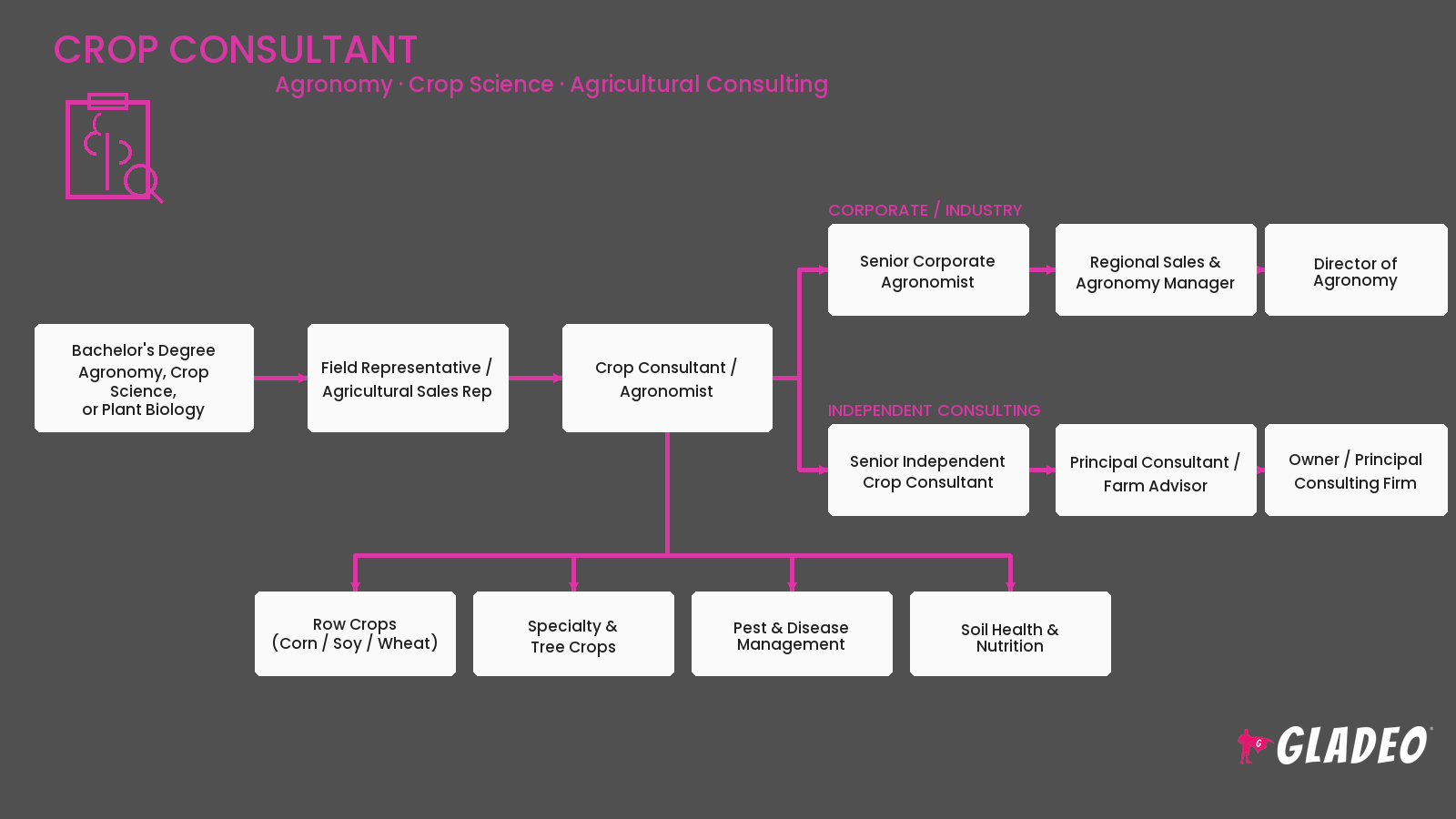
- Apply for internships or assistant roles with agricultural consultants
- Volunteer at local farms or research stations
- Build a portfolio documenting your fieldwork and recommendations
- Network with professionals through agricultural associations
- Attend industry conferences and workshops
- Seek entry-level roles with agribusiness or extension services
- Develop skills in soil testing and sample collection
- Practice using crop management software
- Gain experience with GPS and mapping tools
- Work under experienced consultants to learn client interaction
- Obtain relevant certifications such as Certified Crop Adviser
- Participate in continuing education to stay current
- Master advanced crop management and data analysis techniques
- Build strong relationships with farmers and agricultural companies
- Pursue certifications like Certified Crop Adviser or precision ag credentials
- Expand expertise in specialized areas like pest management or sustainability
- Develop leadership skills to manage consulting teams
- Stay informed on industry trends and emerging technologies
- Seek opportunities to work on larger or more diverse farms
- Consider further education such as a master’s degree in agronomy or related fields
Websites:
- Certified Crop Adviser (cca-national.org)
- American Society of Agronomy (agronomy.org)
- International Society of Precision Agriculture (ispag.org)
- Agricultural Consultants Association (agconsultants.org)
- National Association of County Agricultural Agents
(nacaa.com) - USDA Natural Resources Conservation Service (nrcs.usda.gov)
- Extension Foundation (extension.org)
- CropLife International (croplife.org)
- AgWeb (agweb.com)
- Successful Farming (successfulfarming.com)
- PrecisionAg Alliance (precisionag.org)
- AgriBusiness Global (agribusinessglobal.com)
- Farm Journal (farmjournal.com)
Books:
- The Nature and Properties of Soils by Nyle C. Brady and Ray R. Weil
- Principles of Agronomy for Sustainable Agriculture by Francisco J. Villalobos and Elias Fereres
- Crop Production and Management by C. N. Pandey
- Precision Agriculture Technology for Crop Farming by Qin Zhang
- The Science of Agriculture: A Biological Approach by Ray V. Herren and David L. Kerns
If consulting isn’t the right fit or you want to explore related fields, many careers use similar skills in agriculture and environmental science.
- Agronomist
- Soil Scientist
- Environmental Consultant
- Farm Manager
- Pest Control Specialist
- Agricultural Research Technician
- Irrigation Specialist
- Extension Agent
- Biotechnologist
- Sustainable Agriculture Specialist
Newsfeed

Featured Jobs
Online Courses and Tools