





Spotlights
Computer Repair Technician, ATM Service Technician, Office Equipment Repair Specialist, Hardware Repair Technician, Technical Support Technician, Vending Machine Repairer, Electronic Equipment Repairer, IT Support Technician, Field Service Technician, Office Machine Technician, Computer Support Specialist, Equipment Maintenance Technician
Imagine stepping into a bustling bank, grocery store, or office where every machine — from ATMs to office printers — hums smoothly, helping people access cash, print documents, or complete transactions without a hiccup. It’s the behind-the-scenes skill of Computer, ATM, and Office Machine Repairers that keeps these essential devices running and the world moving forward.
Every day, these repairers diagnose, troubleshoot, and fix a wide array of electronic and mechanical equipment. They work closely with customers, vendors, and technical teams to ensure devices like computers, ATMs, copiers, and fax machines function flawlessly. Whether responding to urgent repair calls or performing routine maintenance, they focus on restoring efficiency and preventing downtime.
Using specialized tools, diagnostic software, and technical manuals, repairers identify issues ranging from hardware malfunctions to software glitches. Their expertise ensures that businesses can rely on their technology, saving time and money while keeping customers satisfied. This role is crucial because it connects technology’s promise with real-world reliability and productivity.
- Solving complex mechanical and electronic problems to restore critical machines.
- Working hands-on with cutting-edge technology and tools every day.
- Helping businesses and customers by minimizing downtime and improving efficiency.
- Constantly learning new skills as technology evolves and new devices emerge.
Working Schedule
Computer, ATM, and Office Machine Repairers often work full-time, with shifts that can include evenings or weekends depending on client needs and emergency repairs. Many work in fast-paced environments like banks, office buildings, or retail stores, sometimes traveling to various sites. The role can be a mix of scheduled maintenance and urgent troubleshooting, requiring flexibility and readiness to respond to unexpected equipment failures.
Typical Duties
- Diagnose hardware and software issues in computers, ATMs, and office equipment.
- Perform routine maintenance and inspections to prevent equipment breakdowns.
- Replace or repair faulty components such as circuit boards, wiring, and mechanical parts.
- Install and configure new machines or upgrades to existing equipment.
- Test repaired machines to ensure they meet performance standards.
- Document repairs, service histories, and parts used for each job.
- Communicate with customers to explain problems and the repair process.
- Order necessary parts and maintain inventory of repair supplies.
- Collaborate with manufacturers or technical support for complex issues.
- Train customers or staff on proper equipment use and basic troubleshooting.
- Follow safety protocols to prevent electrical hazards or equipment damage.
- Manage emergency repairs to minimize business disruption.
Additional Responsibilities
- Maintain tools and diagnostic equipment in good working order.
- Stay updated on new technologies and repair methods through training.
- Assist in developing maintenance schedules to extend equipment life.
- Provide feedback to manufacturers on recurring equipment issues.
- Support installation teams with technical expertise during new equipment setups.
- Manage service contracts and warranties related to equipment repairs.
- Ensure compliance with industry safety and quality standards.
Mornings often start by reviewing repair requests, checking schedules, and gathering tools and parts needed for the day’s jobs. Repairers might prioritize urgent calls for broken ATMs or office machines to minimize customer impact.
Midday involves traveling to client sites or working in a shop to diagnose problems using electronic testers and software diagnostics. They dismantle machines carefully, replace or fix faulty components, and reassemble equipment while ensuring everything functions correctly.
Afternoons might include documenting completed repairs, ordering parts for upcoming jobs, and communicating with clients or team members about maintenance plans or complex repairs. They may also spend time learning about new equipment models or software updates to stay current in the field.
Soft Skills
- Problem-solving mindset
- Good communication skills
- Patience and persistence
- Attention to detail
- Customer service orientation
- Time management
- Adaptability and flexibility
- Manual dexterity
- Critical thinking
- Teamwork
- Reliability
- Stress management
Technical Skills
- Electronic diagnostics
- Hardware repair and replacement
- Software troubleshooting
- Use of multimeters and oscilloscopes
- Mechanical repair skills
- Computer networking basics
- Reading technical manuals and schematics
- Equipment installation and configuration
- Inventory management
- Safety procedures for electrical equipment
- Computer Repair Technician: Focuses on diagnosing and fixing desktop and laptop computers and peripherals.
- ATM Service Technician: Specializes in maintaining and repairing automated teller machines used in banks and retail.
- Office Equipment Repair Specialist: Repairs copiers, fax machines, printers, and multifunction devices.
- Vending Machine Repairer: Maintains and fixes vending machines, including electronic payment systems.
- Field Service Technician: Travels to various client locations to perform equipment repairs and installations.
- Technical Support Technician: Provides remote and on-site assistance for hardware and software issues.
- Hardware Repair Technician: Concentrates on repairing physical components of electronic devices.
- Equipment Maintenance Technician: Focuses on preventive maintenance to avoid equipment failure.
- Banks and financial institutions
- Retail stores and supermarkets
- Office equipment manufacturers and service providers
- IT service and repair companies
- Vending machine operators and suppliers
- Government agencies and public service offices
- Healthcare facilities and hospitals
- Educational institutions
- Telecommunications companies
- Computer hardware manufacturers
- Business equipment leasing companies
- Municipal service providers
This career demands patience and a steady hand, especially when working with delicate electronic parts. Repairers often face pressure to fix machines quickly to avoid disrupting business operations, which means the job can be stressful during peak times or emergencies.
Work hours typically follow a standard full-time schedule but can extend into evenings or weekends for urgent repairs or scheduled maintenance. Field technicians may travel frequently, requiring flexibility and good time management.
The role requires continuous learning to keep up with rapidly changing technology, which means investing personal time in training or certification. Physical demands include standing, bending, and handling small parts, sometimes in cramped or awkward spaces.
- Increased use of remote diagnostic tools and IoT technology for proactive maintenance.
- Growing reliance on automated teller machines and self-service kiosks across industries.
- Shift toward more compact and multifunctional office machines requiring specialized repair skills.
- Use of AI-powered software to assist in troubleshooting and repair processes.
- Emphasis on eco-friendly practices and recycling of electronic components.
- Integration of mobile payment and wireless connectivity in vending and ATM machines.
- Demand for faster repair turnaround times to minimize customer disruption.
- Expansion of service contracts and subscription-based maintenance models.
- Rise of cloud-based software affecting repair diagnostics and updates.
- Development of augmented reality tools for remote repair guidance and training.
Kids interested in how gadgets work, who enjoy taking apart toys, computers, or other electronics to see their components, often find this career appealing. Early hobbies like building model kits, experimenting with basic coding, or fixing household devices can be a strong sign of future interest.
Those who enjoy solving puzzles, troubleshooting problems, and working with their hands often find satisfaction in this field. Being curious about technology and enjoying hands-on projects during school or at home can set the stage for a successful career repairing machines.
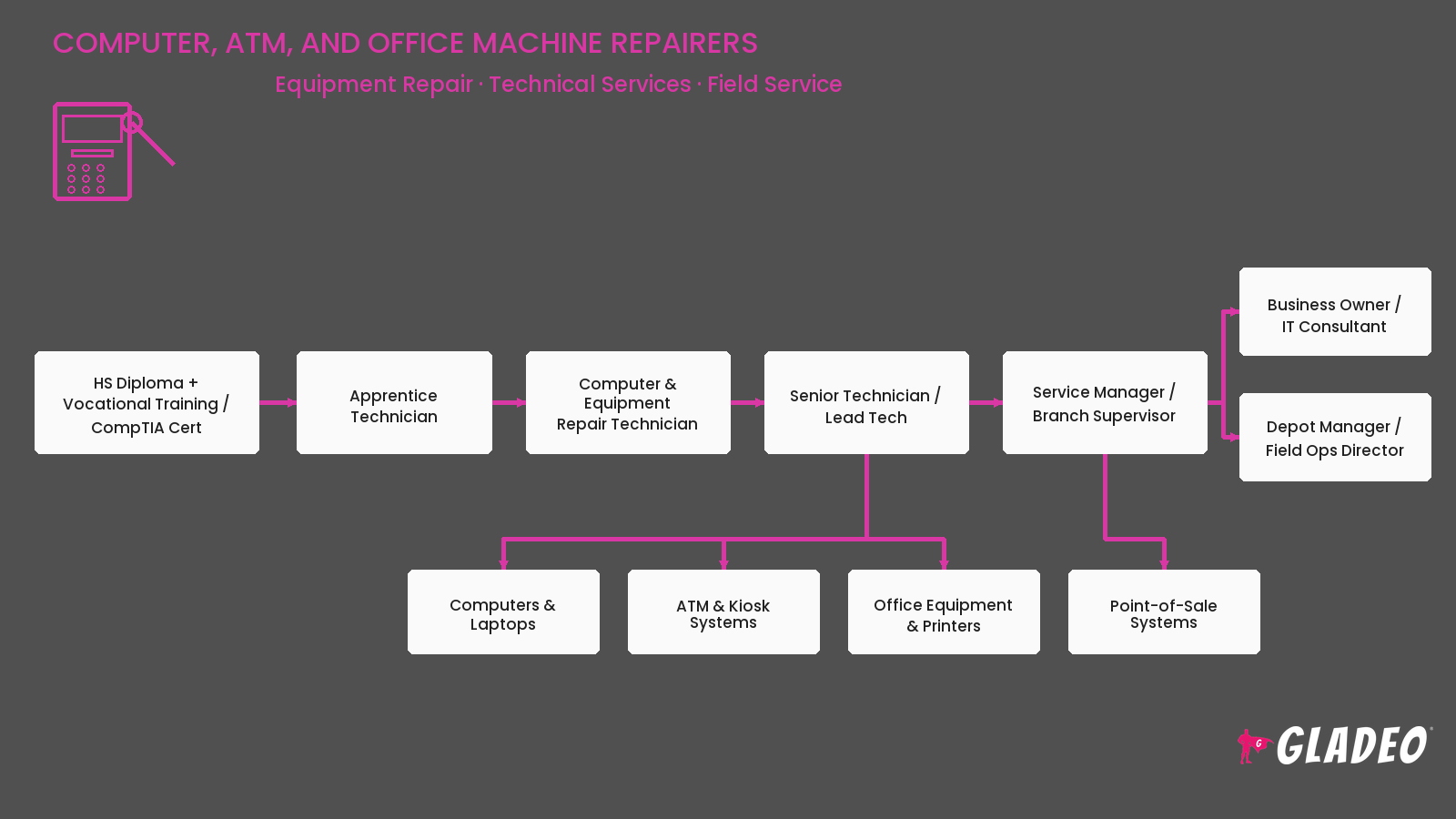
Most Computer, ATM, and Office Machine Repairers start with a high school diploma or equivalent, combined with technical training in electronics, computer hardware, or office equipment repair. Many pursue vocational programs, associate degrees, or certifications that focus on electronic repair, computer technology, or mechatronics.
Students can take courses in relevant subjects such as:
- Basic Electronics
- Computer Hardware Fundamentals
- Introduction to Networking
- Mechanical Systems and Repair
- Digital Logic and Circuitry
- Customer Service Skills
- Troubleshooting Techniques
- Safety Practices in Electronics
- Software Installation and Configuration
- Technical Drawing and Schematics
Hands-on experience through internships, apprenticeships, or on-the-job training is essential to develop the practical skills needed. Building a portfolio of repaired equipment and gaining certifications from manufacturers or industry organizations enhances job prospects and career growth.
- Take math courses focusing on algebra and geometry to understand technical concepts.
- Enroll in computer science or information technology classes.
- Participate in electronics or robotics clubs and competitions.
- Seek internships or summer jobs in IT or repair shops.
- Practice building and repairing small electronics at home.
- Develop communication skills through group projects and presentations.
- Attend career fairs to learn about technical training programs.
- Explore vocational schools or community colleges offering repair certifications.
- Complete courses in customer service and business communication.
- Consider dual enrollment programs for college credit while in high school.
- Look for programs with hands-on labs and real-world equipment.
- Choose schools with strong partnerships with local businesses for internships.
- Verify instructor experience and industry credentials.
- Ensure curriculum covers both hardware and software repair.
- Check for certifications offered, such as CompTIA A+ or manufacturer-specific credentials.
- Seek programs that teach diagnostic tools and software usage.
- Confirm availability of career services and job placement support.
- Look for small class sizes for personalized instruction.
- Check program accreditation and reputation in the industry.
- Choose programs that include safety training and professional ethics.
- Apply for entry-level technician roles at local computer or office machine repair shops.
- Volunteer to assist IT departments in schools or community centers.
- Build a personal portfolio by repairing friends’ and family’s devices.
- Attend job fairs targeting technical careers.
- Seek apprenticeships or internships with established service companies.
- Join online forums or groups related to electronics repair to network and learn.
- Obtain basic certifications like CompTIA A+ to strengthen your resume.
- Practice creating clear documentation of repairs and customer communications.
- Develop a professional online presence showcasing your skills.
- Prepare for interviews by practicing technical questions and problem-solving scenarios.
- Get familiar with common diagnostic software and tools.
- Offer to support IT help desks to gain customer service experience.
- Gain advanced certifications in specialized equipment or software.
- Develop expertise in networked and cloud-connected devices.
- Build strong relationships with clients and vendors for referrals.
- Take on supervisory or training roles within service teams.
- Stay updated with industry trends and emerging technologies.
- Consider branching into sales or technical consulting roles.
- Pursue higher education in electronics or computer engineering.
- Start your own repair business or franchise service operations.
Websites:
- Electronics Technicians Association International (eta-i.org)
- Association of Support Professionals (asp-co.org)
- CompTIA (comptia.org)
- International Society of Certified Electronics Technicians (iscet.org)
- National Institute for Certification in Engineering Technologies (nicet.org)
- TechRepublic (techrepublic.com)
- Repair.org (repair.org)
- iFixit (ifixit.com)
- Electronics Repair Weekly (electronicsrepairweekly.com)
- Service Council (servicecouncil.com)
- International Association of Electronics Technicians (iaet.org)
- Vending Times (vendingtimes.com)
- ATM Industry Association (atmia.com)
- Office Technology Magazine (officetechnology.com)
Books:
- Troubleshooting and Repairing Major Appliances by Eric Kleinert
- Upgrading and Repairing PCs by Scott Mueller
- The Electronics Handbook by Jerry C. Whitaker
- Practical Electronics for Inventors by Paul Scherz and Simon Monk
- Networking All-in-One For Dummies by Doug Lowe
If repairing computers, ATMs, and office machines doesn’t feel like the perfect fit, there are many related careers where your technical skills and problem-solving abilities can shine.
- IT Support Specialist
- Network Technician
- Electronics Assembler
- Field Service Engineer
- Technical Sales Representative
- Manufacturing Technician
- Quality Control Inspector
- Help Desk Analyst
- Telecommunications Technician
- Computer Systems Analyst
Newsfeed

Featured Jobs
Online Courses and Tools