







Spotlights
Climate Analyst, Environmental Policy Analyst, Climate Risk Analyst, Sustainability Analyst, Climate Researcher, Environmental Consultant, Climate Data Scientist, Climate Strategist, Environmental Impact Analyst, Climate Adaptation Specialist, Climate Modeling Analyst, Greenhouse Gas Analyst
Imagine a future where communities, businesses, and governments can predict and prepare for extreme weather, rising sea levels, and shifting climate patterns. Climate Change Analysts make this future possible by turning complex climate data into clear insights that help protect our planet and people.
Climate Change Analysts gather and examine vast amounts of environmental data to understand how climate is changing and what consequences may unfold. They collaborate with scientists, policymakers, environmental organizations, and businesses to develop strategies that reduce carbon footprints, adapt infrastructure, and guide sustainable growth. Their daily work involves analyzing climate models, assessing risks to ecosystems and economies, and producing reports that influence real-world decisions.
Using advanced software for data modeling, geographic information systems (GIS), and statistical analysis, these analysts translate raw climate information into actionable recommendations. Their role is vital because they bridge the gap between scientific research and practical solutions, helping society respond effectively to one of the greatest challenges of our time.
- Helping communities prepare for and reduce the impact of climate change.
- Influencing policies and business practices toward sustainability and environmental health.
- Working at the forefront of science and social change with real-world impact.
- Collaborating with diverse teams to create innovative solutions for the planet’s future.
Working Schedule
Climate Change Analysts typically work full-time in office environments but may have flexible schedules to accommodate project deadlines or collaboration with international teams. Some roles involve travel to field sites or conferences. Many work for government agencies, nonprofits, consulting firms, or research institutions. While most have standard hours, urgent climate events or policy windows can lead to busy, intense periods.
Typical Duties
- Collect and analyze climate and environmental data from various sources.
- Develop models to predict future climate scenarios and impacts.
- Assess risks related to climate change for communities, economies, and ecosystems.
- Prepare detailed reports and presentations for policymakers, businesses, and the public.
- Collaborate with scientists, engineers, and policy experts to design mitigation and adaptation strategies.
- Monitor and evaluate the effectiveness of climate policies and programs.
- Interpret scientific literature and keep up-to-date with climate research.
- Communicate complex climate information in accessible language to diverse audiences.
- Use GIS and statistical software to visualize climate trends and risks.
- Advise organizations on reducing greenhouse gas emissions and improving sustainability.
- Participate in stakeholder meetings, workshops, and public forums.
- Support grant writing and funding proposals for climate initiatives.
Additional Responsibilities
- Advocate for climate awareness and education.
- Contribute to climate change impact assessments for environmental reviews.
- Help develop community outreach programs related to climate resilience.
- Assist in creating training materials for climate policy implementation.
- Participate in interdisciplinary research projects.
- Support data quality control and validation processes.
- Engage with media or public inquiries about climate issues.
- Stay informed on international climate agreements and regulations.
A Climate Change Analyst starts the day reviewing the latest climate data updates and research publications to stay informed on new developments. They may check in with team members or attend a morning briefing to align objectives for ongoing projects.
Midday involves deep analytical work: running climate models, interpreting data sets, or preparing detailed reports that summarize findings on climate risks or mitigation opportunities. They often use specialized software tools and collaborate remotely with scientists or policymakers to refine strategies.
By afternoon or evening, the analyst might participate in meetings with stakeholders, present findings to community groups, or draft policy briefs. They also allocate time to communicate complex scientific concepts in clear language to non-experts, ensuring their work drives informed action.
Soft Skills
- Critical thinking and problem solving
- Clear and persuasive communication
- Collaboration and teamwork
- Adaptability and flexibility
- Attention to detail
- Curiosity and eagerness to learn
- Project management
- Public speaking and presentation
- Empathy for affected communities
- Time management
- Strategic thinking
- Ethical judgment
Technical Skills
- Climate data analysis
- Statistical modeling
- Geographic Information Systems (GIS)
- Climate simulation software
- Environmental impact assessment
- Data visualization
- Report writing
- Policy analysis
- Remote sensing
- Programming languages like Python or R
- Policy Analyst: Focuses on evaluating and recommending climate-related government policies.
- Research Scientist: Conducts scientific studies to understand climate processes and impacts.
- Risk Analyst: Assesses financial and physical risks related to climate change for organizations.
- Sustainability Consultant: Advises businesses on reducing environmental footprints and implementing green practices.
- Adaptation Specialist: Develops strategies to help communities adjust to climate impacts.
- Mitigation Analyst: Designs plans to reduce greenhouse gas emissions.
- Data Scientist: Uses big data techniques to analyze climate patterns and trends.
- Environmental Economist: Studies economic impacts of climate change and cost-benefit of interventions.
- Government environmental agencies
- Environmental nonprofits and advocacy groups
- Climate research institutes
- Consulting firms specializing in sustainability
- Energy companies
- Urban planning departments
- International organizations (e.g., UN, World Bank)
- Universities and academic centers
- Think tanks and policy organizations
- Agriculture and forestry organizations
- Renewable energy companies
- Insurance and risk assessment firms
Climate Change Analysts face pressure to provide accurate, timely analyses that can influence major policy and business decisions. Deadlines can be tight, especially when responding to emerging climate events or legislative sessions. The work demands a high level of intellectual rigor and accountability.
The job typically requires full-time hours, but analysts often work extra hours to meet project goals or collaborate with global partners across time zones. Some travel may be involved for conferences, field assessments, or stakeholder meetings, which can add to time away from home.
Due to the complex and evolving nature of climate science, analysts must continuously update their knowledge and skills. They may face emotional challenges when confronting the severity of climate impacts but find motivation in contributing solutions that protect people and ecosystems.
- Growing use of artificial intelligence and machine learning in climate modeling.
- Increased integration of climate data with economic and social indicators.
- Expansion of climate risk disclosure requirements for businesses.
- Rising demand for climate adaptation and resilience planning.
- Greater emphasis on equity and environmental justice in climate policies.
- Development of more precise regional and local climate projections.
- Use of satellite and remote sensing technologies for real-time monitoring.
- Collaboration across disciplines to create holistic climate solutions.
- Increased funding and political attention to climate initiatives.
- Shift toward renewable energy and decarbonization strategies.
Kids interested in becoming Climate Change Analysts often loved exploring nature, tracking weather patterns, or conducting simple science experiments about the environment. They might have been drawn to documentaries or books about animals, ecosystems, and how the planet works.
Early signs include curiosity about science, especially earth sciences, eagerness to understand big problems, and a passion for helping others and the planet. They often enjoyed math and data puzzles and were motivated by a desire to make a difference in the world.
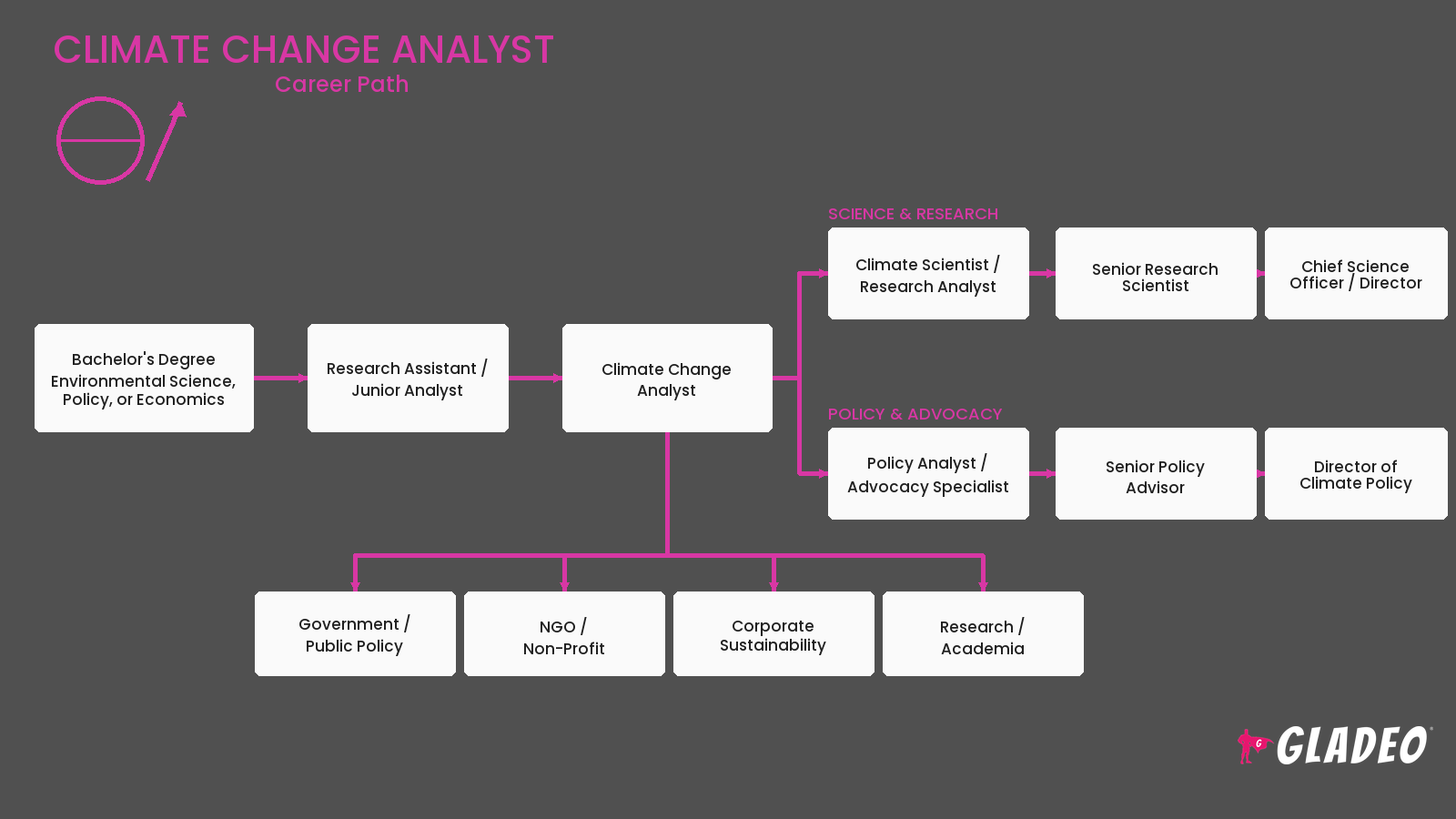
Climate Change Analysts usually start with a bachelor’s degree in environmental science, climatology, geography, or a related field. Many pursue advanced degrees to deepen their expertise and improve career prospects. Hands-on experience through internships and research projects is highly valuable.
Students can take courses in relevant subjects such as:
- Environmental Science
- Climatology
- Meteorology
- Geography and GIS
- Statistics and Data Analysis
- Climate Policy and Law
- Sustainability Studies
- Remote Sensing
- Computer Programming (Python, R)
- Environmental Economics
Building a strong portfolio of research, reports, and data projects can set candidates apart. Internships with environmental agencies or nonprofits offer practical experience. On-the-job training continues as climate science evolves and new technologies emerge.
- Take advanced science and math classes like biology, chemistry, physics, and calculus.
- Participate in environmental clubs or science fairs focused on climate topics.
- Learn computer skills, especially data analysis and programming basics.
- Volunteer with local environmental organizations or community projects.
- Develop strong writing and communication skills through essays and presentations.
- Take geography and earth science electives if available.
- Attend summer camps or workshops on climate and sustainability.
- Seek mentorship from professionals in environmental fields.
- Explore online courses or certifications in climate science.
- Build a portfolio of environmental projects or research papers.
- Choose programs offering strong courses in environmental science and data analysis.
- Look for opportunities to participate in research or internships.
- Select schools with connections to government agencies or environmental organizations.
- Consider programs that teach GIS and climate modeling software.
- Check for faculty expertise in climate science and policy.
- Seek interdisciplinary programs combining science, policy, and economics.
- Evaluate availability of resources like labs and computing facilities.
- Prioritize programs with active sustainability initiatives and student groups.
- Review alumni success in environmental careers.
- Ensure curriculum includes communication and policy training.
- Apply for internships at environmental agencies, research institutes, or nonprofits.
- Build a portfolio showcasing data analysis and climate-related projects.
- Network with professionals through events and online platforms like LinkedIn.
- Volunteer for local climate action groups to gain experience.
- Develop skills in GIS, statistical software, and programming languages.
- Prepare clear, concise writing samples explaining complex topics simply.
- Seek entry-level roles such as research assistant, data analyst, or policy intern.
- Attend climate conferences or workshops to learn and connect.
- Ask for informational interviews with climate professionals.
- Create a personal website or blog to share climate insights and projects.
- Stay updated on climate news and emerging research.
- Practice public speaking and presentation skills.
- Gain specialized expertise in climate modeling or policy analysis.
- Pursue certifications or advanced degrees in climate science or sustainability.
- Build a strong network of mentors and collaborators in climate fields.
- Lead projects or teams to develop management experience.
- Publish research or policy papers to establish authority.
- Develop skills in grant writing and fundraising.
- Transition into leadership roles within organizations.
- Expand influence by engaging with media and public education.
Websites:
- Intergovernmental Panel on Climate Change (IPCC)
- National Aeronautics and Space Administration (NASA) Climate Division
- Environmental Protection Agency (EPA) Climate Change Website
- United Nations Framework Convention on Climate Change (UNFCCC)
- American Geophysical Union (AGU)
- Climate Central
- World Resources Institute (WRI)
- Climate Reality Project
- Society for Conservation Biology
- The Climate Group
- Union of Concerned Scientists
- National Oceanic and Atmospheric Administration (NOAA)
- Climate Program Office
- Environmental Defense Fund (EDF)
- Sierra Club
Books:
- The Uninhabitable Earth by David Wallace-Wells
- This Changes Everything by Naomi Klein
- Climate Change: What Everyone Needs to Know by Joseph Romm
- The Sixth Extinction by Elizabeth Kolbert
- Drawdown: The Most Comprehensive Plan Ever Proposed to Reverse Global Warming by Paul Hawken
If becoming a Climate Change Analyst feels too specialized or competitive, there are many related careers that still make a difference for the environment and society.
- Environmental Scientist
- Meteorologist
- Sustainability Coordinator
- Energy Analyst
- Urban Planner
- Environmental Educator
- Wildlife Biologist
- Renewable Energy Technician
- Policy Analyst
- Data Scientist
Newsfeed

Featured Jobs
Online Courses and Tools