






Spotlights
Building Automation Specialist, Controls Technician, Building Systems Technician, HVAC Automation Technician, Energy Management Technician, Facility Automation Technician, Building Controls Engineer, Building Automation Engineer, DDC Technician (Direct Digital Controls Technician, Automation Systems Technician
Smart thermostats, automated lighting, and energy dashboards in modern offices and hospitals do not run themselves—Building Automation Technicians make connected buildings work! These specialists install, program, and maintain the systems that keep indoor environments comfortable, safe, and efficient.
Building Automation Technicians work with Building Automation Systems (BAS) and Direct Digital Control (DDC) networks that link HVAC equipment, sensors, valves, and controllers across a facility. They read control diagrams and sequences, configure controllers, troubleshoot communication faults, and tune systems so heating, cooling, ventilation, and lighting respond to occupancy and weather. They collaborate with HVAC mechanics, electricians, IT staff, and facility managers in commercial buildings, campuses, hospitals, and data centers.
They use BACnet, LonWorks, and proprietary BAS software alongside multimeters, network tools, and laptop programming interfaces. Whether commissioning a new smart building or retrofitting legacy equipment with modern controls, skilled technicians blend mechanical HVAC knowledge with networking and IT fundamentals to deliver reliable, energy-smart performance.
- Working at the intersection of HVAC, electronics, and IT—skills in high demand
- Seeing immediate results when systems run efficiently and occupants stay comfortable
- Strong career paths in energy management, smart buildings, and facility operations
- Problem-solving variety—every building and controls issue is a new puzzle
Working Schedule
Building Automation Technicians typically work full-time, often on day shifts with on-call rotation for after-hours emergencies. Service and retrofit projects may require early starts or weekend work when buildings are unoccupied. Employers include mechanical contractors, controls manufacturers, facility management firms, and in-house building engineering teams at hospitals, universities, and corporate campuses.
Typical Duties
- Install and wire DDC controllers, sensors, actuators, and network devices
- Program and configure BAS sequences for HVAC, lighting, and energy optimization
- Test and commission new control systems to verify proper operation
- Troubleshoot communication faults on BACnet, MS/TP, IP, and LonWorks networks
- Calibrate temperature, humidity, pressure, and flow sensors
- Download and analyze trend logs to diagnose equipment performance issues
- Update controller firmware and maintain accurate as-built control documentation
- Coordinate with HVAC technicians on valve, damper, and equipment repairs
- Perform preventive maintenance on controllers, panels, and field devices
- Respond to hot/cold calls and alarm notifications from building operators
- Verify graphics, alarms, and schedules display correctly in the BAS front end
- Document work orders, setpoint changes, and code-compliant control modifications
Additional Responsibilities
- Train facility staff on BAS navigation and basic override procedures
- Support energy audits and retro-commissioning projects
- Assist IT teams with cybersecurity policies for networked building devices
- Specify replacement controllers and sensors for obsolete equipment
- Participate in LEED and energy benchmarking reporting where required
- Travel between multiple sites for service contract accounts
- Present system status and recommendations to engineers and property managers
Morning often starts with reviewing overnight alarms and work orders from facility managers. A technician might remote into a hospital BAS to check why an air-handling unit failed to start, then drive to site to inspect the controller, wiring, and safeties.
Midday could involve programming a new VAV box sequence, verifying sensor readings against handheld instruments, and coordinating with an HVAC mechanic to replace a stuck damper actuator. Lunch might be at a jobsite trailer between two commercial retrofit projects.
Afternoon tasks include commissioning a rooftop unit, uploading revised graphics to the front end, and documenting as-built changes. Before heading out, they confirm alarms are cleared, leave notes for the night operator, and prep tomorrow's tools and laptop for the next building on the route.
Soft Skills
- Logical troubleshooting under time pressure
- Clear communication with mechanics, engineers, and building operators
- Attention to detail when reading control diagrams and wiring schematics
- Customer service when occupants report comfort issues
- Patience during repetitive commissioning and point-to-point checkout
- Teamwork across trades—HVAC, electrical, plumbing, and IT
- Adaptability when legacy systems behave differently than new platforms
- Safety awareness around rooftops, mechanical rooms, and live circuits
- Self-direction when working alone on service routes
- Continuous learning as BAS software and protocols evolve
Technical Skills
- HVAC fundamentals—chillers, boilers, AHUs, VAV, and hydronic systems
- DDC controller programming (Trane, Johnson Controls, Siemens, Honeywell, etc.)
- BACnet and LonWorks network configuration and troubleshooting
- Reading electrical schematics and control ladder diagrams
- Multimeter, clamp meter, and temperature/humidity measurement tools
- BAS front-end navigation, trend analysis, and alarm management
- Low-voltage wiring terminations and conduit practices
- IP networking basics—switches, subnets, and firewall coordination
- Pneumatic-to-DDC retrofit techniques where older buildings remain
- Energy management strategies—schedules, resets, and demand limiting
- BAS Service Technicians: Maintain and repair existing building control systems
- Controls Installers: Wire and mount controllers during new construction
- Commissioning Technicians: Test and verify systems meet design intent
- Energy Management Specialists: Optimize sequences for efficiency and cost savings
- Manufacturer Field Reps: Support specific control product lines regionally
- Facility Controls Operators: In-house staff running campus-wide BAS networks
- Smart Building Integrators: Connect HVAC, lighting, access, and IoT platforms
- Mechanical and HVAC contracting firms with controls divisions
- Building automation and controls manufacturers
- Commercial property management and facility services companies
- Hospitals and healthcare systems with complex environmental requirements
- Universities and K-12 districts with multi-building campuses
- Data centers requiring precision cooling and monitoring
- Government and municipal facility engineering departments
- Energy services companies (ESCOs) performing retrofits
- Industrial and manufacturing plants with process HVAC
- Controls integrators specializing in BACnet and open-protocol systems
The work is hands-on and sometimes physically demanding—climbing ladders to rooftops, working in hot mechanical rooms, and carrying tools between equipment areas. Technicians must follow lockout/tagout and electrical safety rules every day.
When a building loses heat or cooling, response time matters. On-call shifts and urgent callbacks are common, especially for healthcare and data center accounts. Entry roles may start with helper tasks before leading programming work.
Despite the pressure, many technicians enjoy bridging trades—combining HVAC craft with computer networking—and knowing their work directly affects comfort, energy bills, and equipment life across entire campuses.
- Smart building and IoT integration across HVAC, lighting, and security
- Cybersecurity requirements for networked BAS devices
- Cloud-based analytics and fault detection diagnostics (FDD)
- Electrification and heat pump controls in commercial retrofits
- Open-protocol BACnet adoption reducing proprietary lock-in
- Remote monitoring and mobile apps for facility operators
- Integration with utility demand response and grid-interactive programs
- Indoor air quality monitoring tied to ventilation control sequences
- Workforce demand as aging controls technicians retire nationwide
Many Building Automation Technicians grew up taking things apart to see how they worked—thermostats, computers, RC cars, or home Wi-Fi networks. They often liked math, physics, or shop classes and felt satisfied when a fix made something run better.
HVAC explorer programs, robotics clubs, coding hobbies, or helping family members with home improvement projects sparked interest in skilled trades that also use technology. A curiosity about how buildings stay comfortable led them toward controls work.
Building Automation Technicians typically need a high school diploma plus postsecondary training in HVAC, electrical technology, or building automation. Many enter through HVAC apprenticeships and add controls certifications on the job. Associate degrees in HVAC/R, energy management, or industrial controls technology strengthen hiring prospects and speed advancement into programming roles.
Students can take courses in relevant subjects such as:
- HVAC fundamentals and refrigeration principles
- Electrical circuits, wiring, and motor controls
- Programmable logic controllers (PLC) and DDC basics
- Building automation systems and BACnet protocols
- Blueprint and control diagram reading
- Computer networking and IT fundamentals
- Energy management and building science
- Physics, algebra, and technical math
- OSHA safety and lockout/tagout procedures
Hands-on lab work, internships with mechanical contractors, and helper experience on controls install crews are essential. Employers value candidates who can demonstrate wiring terminations, sensor calibration, and basic BAS navigation before hiring into technician roles.
ON-THE-JOB TRAINING
Most technicians learn manufacturer-specific BAS software and site standards on the job. New hires often start as controls helpers—pulling wire, labeling devices, and assisting checkout—before advancing to programming and commissioning. Training may last several months to two years depending on platform complexity and employer mentorship.
OPTIONAL CERTIFICATIONS
- EPA Section 608 Certification (for refrigerant-handling roles)
- NATE or HVAC Excellence certifications in controls or commercial HVAC
- BACnet International or vendor-specific BAS operator credentials
- OSHA 10- or 30-Hour Construction Safety Certification
- Manufacturer certifications (Trane, JCI, Siemens, Honeywell, etc.)
- Take algebra, physics, and computer science or ICT courses
- Enroll in HVAC/R or electrical CTE programs if offered
- Join SkillsUSA or HVAC competitions to build hands-on experience
- Earn OSHA 10 and EPA 608 credentials when eligible
- Job-shadow a controls technician on a commissioning project
- Learn basic IP networking and Python or scripting fundamentals
- Work summers as an HVAC helper or electrical apprentice assistant
- Research community college programs in building automation technology
- Practice reading ladder diagrams and control schematics
- Obtain a driver's license—service routes require reliable transportation
- Visit ASHRAE student chapters or local trade association meetings
- Build a small home lab with a trainer board or Raspberry Pi BACnet project
- Choose programs with live BAS lab stations—not lecture-only courses
- Look for partnerships with mechanical contractors offering internships
- Confirm curriculum covers BACnet, DDC programming, and HVAC systems
- Prefer instructors with field commissioning experience
- Ask about job placement rates with local controls employers
- Seek programs that include electrical wiring and motor control labs
- Compare associate degree vs. certificate timelines and cost
- Verify access to vendor software training or simulation tools
- Select schools near major metro areas with smart-building demand
- Ensure coursework includes energy codes and building automation standards
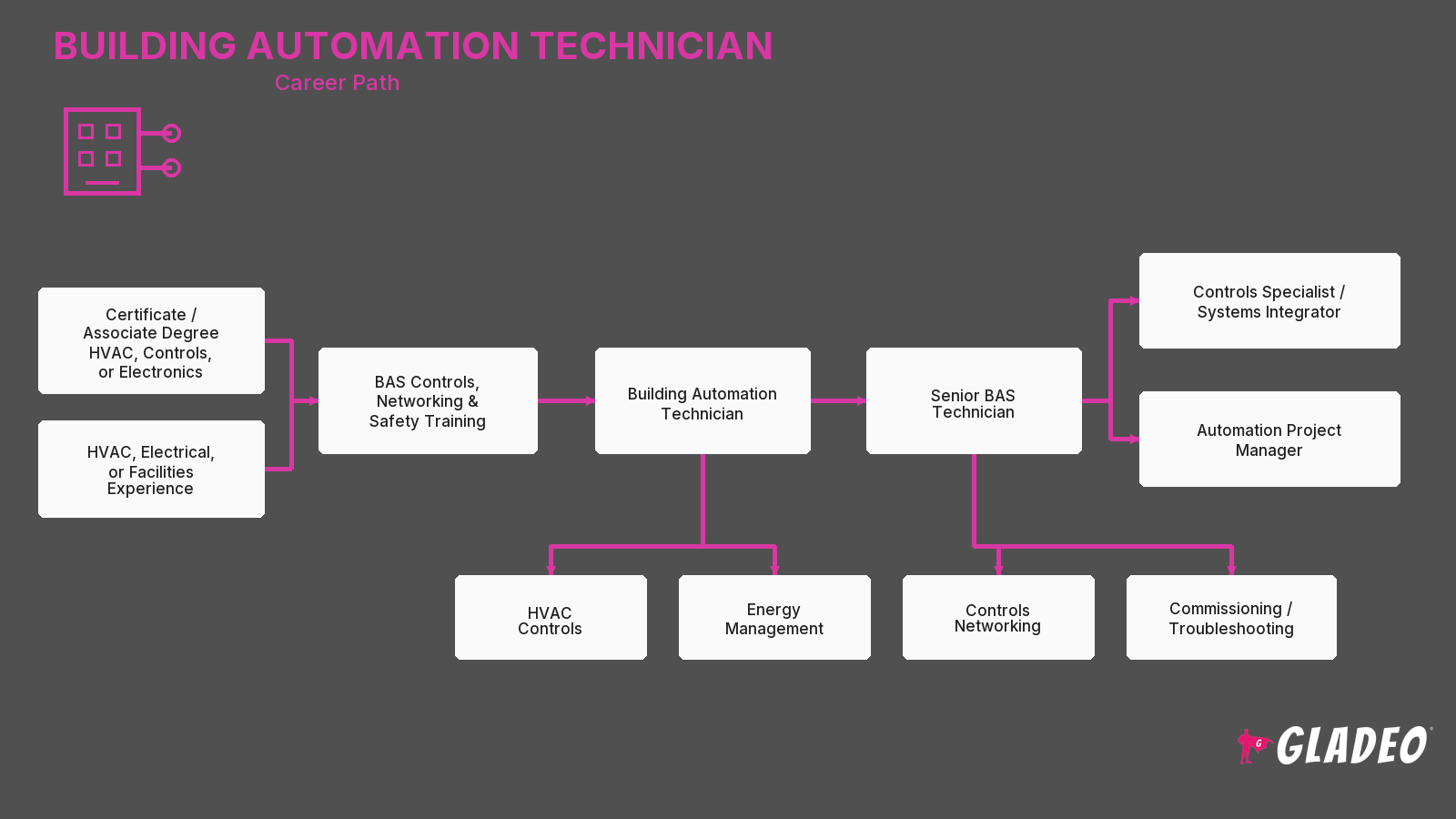
- Apply to mechanical contractors with dedicated controls departments
- Target entry titles: Controls Helper, BAS Installer, HVAC Controls Apprentice
- Search Indeed, LinkedIn, and manufacturer dealer career pages
- Highlight HVAC coursework, electrical labs, and any BAS exposure on resumes
- Be willing to start with wire pulling, device mounting, and checkout assistance
- Obtain EPA 608 and OSHA 10 before applying when possible
- Network through ASHRAE, local PHCC, or HVAC trade association events
- Ask instructors for referrals to alumni working in building automation
- Emphasize troubleshooting examples from labs or part-time HVAC work
- Relocate to regions with strong commercial construction and retrofit markets
- Master one major BAS platform, then cross-train on additional manufacturers
- Pursue commissioning and energy management project lead roles
- Become a senior controls programmer or application engineer
- Move into BAS project management or sales engineering
- Earn LEED or CEM credentials to lead sustainability-focused retrofits
- Supervise install crews or start an independent controls service business
Websites:
- ASHRAE (American Society of Heating, Refrigerating and Air-Conditioning Engineers)
- BACnet International
- Building Efficiency for a Sustainable Tomorrow (BEST) Center
- North American Technician Excellence (NATE)
- HVAC Excellence
- U.S. Department of Energy — Building Technologies Office
- Air Conditioning Contractors of America (ACCA)
- International Facility Management Association (IFMA)
- Smart Buildings Center
- LinkedIn and Indeed skilled-trades job boards
- Manufacturer training portals (Trane, Johnson Controls, Siemens, Honeywell)
Books:
- Control Systems for Heating, Ventilating, and Air Conditioning by Haines and Hittle
- Building Automation: Communication Systems with EIB/KNX, LON, and BACnet by Kastner
- HVAC Control Systems by Ronnie J. Auvil
- Electricity for Refrigeration, Heating, and Air Conditioning by Russell Smith
- Building Commissioning Handbook by K. Reed
Related careers that use overlapping skills include:
- HVAC Mechanic or Installer
- Electrician
- Facilities Manager
- Energy Auditor
- Solar Photovoltaic Installer
- Industrial Maintenance Technician
- Fire Alarm and Security Systems Technician
- Network Technician
- Stationary Engineer or Boiler Operator
- Commissioning Agent
Newsfeed

Featured Jobs
Online Courses and Tools