





Spotlights
Autonomy Engineer, Self-Driving Systems Engineer, Autonomous Vehicle Engineer, Robotics Perception Engineer, Guidance and Navigation Engineer, Unmanned Systems Engineer, Drone Systems Engineer, Autonomous Robotics Engineer, Sensor Fusion Engineer, Autonomy Software Engineer, Autonomous Mobility Engineer, Field Robotics Engineer
A self-driving car threads through city traffic without a hand on the wheel. A delivery drone navigates around trees and power lines to drop a package on a doorstep. A warehouse robot weaves between shelves and coworkers without ever colliding. A submarine drone explores the ocean floor for hours with no signal to the surface. None of these machines are simply remote-controlled; they are making their own moment-to-moment decisions about the world around them. Making that possible, safely and reliably, is the work of an Autonomous Systems Engineer.
Autonomous Systems Engineers design the sensing, decision-making, and control systems that let vehicles, drones, and robots operate on their own, without a person directly driving or piloting them. They work at the intersection of robotics, software, and safety engineering, combining cameras, lidar, radar, and other sensors with algorithms that let a machine understand where it is, what is around it, and what to do next. This work goes far beyond building a single robot: it means designing entire systems for navigation, sensor fusion, and fail-safe behavior, then teaming up with mechanical engineers, software developers, safety specialists, and test pilots or drivers to prove those systems work in the real world, not just in simulation.
Using tools like machine learning frameworks, simulation environments, sensor data pipelines, and rigorous testing protocols, Autonomous Systems Engineers turn raw sensor data into split-second decisions a machine can trust. Their work matters enormously, because when autonomy fails, the consequences can be serious, from a stalled delivery to a life-threatening accident. Every safe autonomous vehicle test, every drone that avoids an obstacle, and every warehouse robot that works alongside people without incident is the result of an engineer who obsessed over every edge case until the system could be trusted.
- Working at the cutting edge of robotics, AI, and engineering all at once
- Watching a machine make its own safe, correct decisions in the real world after months of testing
- Solving genuinely hard problems that combine software, hardware, and safety in equal measure
- Helping build technology that could transform transportation, delivery, agriculture, and exploration
Working Schedule
Most Autonomous Systems Engineers work full-time, often more than a standard 40 hours during intense testing periods or ahead of major product milestones. The work is split between time at a computer designing algorithms and analyzing sensor data, and time in labs, test tracks, or the field running real-world trials of vehicles, drones, or robots. Fieldwork can mean early mornings, travel to test sites, or work in varied weather conditions, since autonomous systems have to be tested in the same messy, unpredictable environments they will eventually operate in. Most engineers are employed full-time by automotive companies, robotics firms, aerospace companies, or tech startups, though some work as contractors or consultants on specific projects.
Typical Duties
- Designing algorithms for navigation, path planning, and obstacle avoidance
- Building sensor fusion systems that combine cameras, lidar, radar, and GPS data
- Developing and testing perception systems that let a machine identify objects and hazards
- Writing and refining control software that translates decisions into physical movement
- Running simulations to test how a system responds to thousands of possible scenarios
- Conducting real-world field tests of vehicles, drones, or robots and analyzing the results
- Identifying edge cases and failure modes, then redesigning systems to handle them safely
- Collaborating with mechanical and electrical engineers on hardware that supports autonomy
- Working with safety and regulatory teams to meet legal and industry safety standards
- Analyzing large volumes of sensor and test data to improve system performance
- Debugging unexpected behavior discovered during simulation or field testing
- Documenting system architecture, test results, and safety cases for review
Additional Responsibilities
- Staying current on advances in machine learning, robotics, and sensor technology
- Presenting test results and technical findings to engineering leadership or clients
- Mentoring junior engineers on autonomy software and testing practices
- Supporting regulatory submissions and safety certification processes
- Managing relationships with sensor and hardware suppliers
- Contributing to research papers, patents, or technical publications
- Participating in incident investigations when a test does not go as planned
- Helping estimate timelines and technical risk for new autonomy projects
An Autonomous Systems Engineer's morning often starts with reviewing data from the previous day's tests, whether that is a simulated run of a self-driving algorithm or footage from a drone's obstacle course flight. They look for anything unexpected, a moment where the system hesitated, misread an object, or reacted a fraction of a second too slowly, and start tracing the cause.
Midday is frequently spent writing and refining code, tuning a perception algorithm to better recognize pedestrians in low light, adjusting a path-planning system to handle a tricky intersection, or building a new simulation scenario to stress-test the system before it ever touches the real world. Engineers move fluidly between coding, running simulations, and analyzing results, often collaborating closely with teammates who specialize in hardware, sensors, or safety.
Afternoons might involve heading to a test track or lab to run a live trial, watching closely as a vehicle or robot navigates a course while sensors log every detail. Afterward, the team reviews what happened, debates what needs to change, and plans the next test. Engineers also spend time in meetings with safety engineers or regulators, since proving a system is safe enough for the real world is just as important as building it in the first place.
Soft Skills
- Rigorous, safety-first thinking about every possible failure mode
- Strong problem-solving and analytical reasoning
- Patience and persistence through repeated testing and debugging cycles
- Clear communication across engineering, safety, and business teams
- Comfort with ambiguity, since autonomy problems rarely have one clean answer
- Collaboration across mechanical, electrical, and software disciplines
- Attention to detail when reviewing data and test results
- Adaptability as tools, regulations, and technology evolve quickly
- Composure under pressure during high-stakes field tests
- Curiosity and a drive to understand exactly why something failed
- Ethical awareness about the real-world impact of autonomous decisions
- Willingness to keep learning as the field advances rapidly
Technical Skills
- Programming in Python, C++, or similar languages used in robotics and autonomy
- Machine learning and computer vision for perception and object recognition
- Sensor fusion techniques combining lidar, radar, cameras, and GPS
- Path planning, control theory, and navigation algorithms
- Simulation tools for testing autonomous systems before real-world deployment
- Robot Operating System (ROS) or similar robotics software frameworks
- Data analysis and visualization for interpreting sensor and test data
- Understanding of safety standards and regulatory requirements for autonomous systems
- Familiarity with hardware such as embedded systems, microcontrollers, and actuators
- Testing and validation methodologies for safety-critical systems
- Perception Engineer: Focuses on how a system sees and interprets its surroundings using cameras, lidar, and radar
- Controls Engineer: Designs the systems that translate decisions into precise physical movement
- Planning and Navigation Engineer: Builds the algorithms that decide where a system should go and how
- Simulation Engineer: Creates virtual environments to test autonomy systems safely before real-world trials
- Autonomous Vehicle Engineer: Specializes in self-driving cars and trucks
- Drone Autonomy Engineer: Focuses on autonomous flight, navigation, and obstacle avoidance for aerial vehicles
- Marine and Underwater Autonomy Engineer: Builds systems for autonomous boats and underwater vehicles
- Warehouse and Industrial Robotics Engineer: Designs autonomy for robots operating in factories and warehouses
- Automotive and self-driving vehicle companies
- Drone and aerospace manufacturers
- Robotics and warehouse automation companies
- Defense and government research agencies
- Logistics and delivery companies
- Agricultural technology companies building autonomous farm equipment
- Maritime and underwater exploration companies
- University and government research labs
- Technology startups developing new autonomy platforms
- Ride-share and mobility companies
- Mining and heavy equipment manufacturers
- Space exploration organizations building autonomous rovers and spacecraft
Autonomous Systems Engineers work in a field where mistakes can have serious, sometimes life-threatening consequences, so the pressure to test thoroughly and think through every possible failure mode is intense. Unlike many software bugs that can simply be patched later, a flaw in an autonomous system's decision-making can cause real-world harm before anyone notices it, which means engineers cannot cut corners on safety no matter how tight the deadline.
The pace of the field is demanding. Long hours are common, especially around major test milestones, product launches, or regulatory reviews, and fieldwork can mean early mornings, travel, or work in uncomfortable weather conditions. The work is also emotionally weighty at times, since engineers must openly confront and document every way a system could fail, including scenarios involving real risk to people.
Because the technology and regulations around autonomy are still evolving quickly, engineers must commit to continuous learning throughout their careers. What counts as best practice today may be replaced by better methods within a few years, and engineers who want to stay at the forefront need to keep up with fast-moving research in machine learning, sensors, and safety engineering.
- Rapid advances in machine learning improving perception and decision-making in real time
- Growing deployment of robotaxis and autonomous delivery vehicles in select cities
- Expansion of autonomous drones for delivery, agriculture, and infrastructure inspection
- Increasing use of simulation and synthetic data to test rare, dangerous scenarios safely
- Rising regulatory scrutiny and new safety standards for autonomous vehicles and robots
- Growth of autonomous systems in warehouses, ports, and mining operations
- Advances in sensor technology making lidar and radar smaller, cheaper, and more accurate
- Increasing collaboration between autonomy engineers and AI research teams
- Expansion of autonomous systems into underwater and space exploration
- Greater public and industry focus on explain ability and trust in autonomous decision-making
Many Autonomous Systems Engineers grew up fascinated by how machines make decisions, whether that meant programming a simple robot to navigate a maze, building remote-control vehicles and then trying to automate them, or getting hooked on video games and simulations involving physics and navigation. Robotics competitions, coding clubs, and science fairs were common places where their curiosity about intelligent machines first took shape.
Others were drawn to space, aviation, or ocean exploration from an early age, dreaming about vehicles that could go where humans could not easily follow. They tended to enjoy math, physics, and computer science when it connected to something moving and tangible, and they liked the challenge of figuring out not just how to build a machine, but how to make it smart enough to handle the unexpected.
Most Autonomous Systems Engineers hold a bachelor's degree in robotics engineering, computer science, electrical engineering, mechanical engineering, or aerospace engineering, and many roles, especially research-focused ones, prefer or require a master's degree or PhD. These programs combine coursework in programming, control systems, and machine learning with substantial hands-on project work building and testing real robotic or autonomous systems. Because the field draws from so many disciplines, some engineers enter through computer science with a robotics focus, while others come from mechanical or electrical engineering backgrounds and specialize later.
Students can take courses in relevant subjects such as:
- Robotics and Control Systems
- Machine Learning and Computer Vision
- Linear Algebra and Differential Equations
- Programming in Python and C++
- Sensor Systems and Signal Processing
- Artificial Intelligence
- Embedded Systems and Microcontrollers
- Systems Engineering and Safety Analysis
- Probability and Statistics
- Robot Operating System (ROS) and Simulation Tools
Hands-on project experience is critical in this field, since employers want to see that you have actually built and tested autonomous or robotic systems, not just studied the theory. Research labs, robotics competitions, internships at autonomy companies, and personal projects using open-source robotics platforms all help build a strong portfolio. Many engineers continue learning throughout their careers as machine learning techniques and safety standards keep advancing rapidly.
- Take physics, calculus, and computer science courses, aiming as high as your school offers
- Join a robotics team such as FIRST Robotics, VEX Robotics, or a similar competition program
- Learn to program in Python, and later explore C++ once you are comfortable coding
- Experiment with hobby robotics kits, drones, or simple autonomous car projects at home
- Try free online courses in machine learning or robotics to see if the field excites you
- Enter science fairs or robotics competitions involving navigation, sensors, or autonomy
- Look for a summer program in robotics, AI, or engineering at a university
- Reach out to a robotics or autonomy engineer for an informational interview or job shadow
- Build a small project involving sensors, like a robot that avoids obstacles using ultrasonic sensors
- Practice explaining a technical project clearly to people without a technical background
- Explore research opportunities or clubs at your college focused on robotics or AI
- Apply for internships at robotics, automotive, drone, or aerospace companies as early as possible
- Strong robotics, mechanical, electrical, or computer science program with hands-on labs
- Access to real robotics hardware, sensors, and simulation software, not just theory
- Faculty actively doing research in robotics, autonomy, or machine learning
- Opportunities to join a robotics club, competition team, or research lab as an undergraduate
- Strong internship pipelines with autonomy, automotive, aerospace, or robotics companies
- Coursework that blends software, hardware, and control systems rather than just one area
- A capstone or senior design project involving a real autonomous or robotic system
- Access to modern tools like ROS, simulation environments, and current sensor technology
- Strong career services with placement rates in robotics and autonomy-related roles
- Opportunities to pursue a graduate degree if you want to move into research roles
- Active industry partnerships or advisory boards connected to the program
- A curriculum that keeps pace with fast-moving developments in AI and autonomy
- Build a portfolio of robotics or autonomy projects you can demonstrate and explain in depth
- Complete at least one internship or research position in robotics, autonomy, or AI before graduating
- Apply for entry-level titles like Associate Autonomy Engineer, Robotics Software Engineer, or Test Engineer
- Contribute to open-source robotics projects to build a public, verifiable track record
- Search job boards like LinkedIn, along with career pages of autonomy, automotive, and robotics companies
- Attend robotics conferences, competitions, and career fairs such as those hosted by IEEE or ICRA
- Practice technical interviews involving coding, algorithms, and robotics or control systems concepts
- Be ready to walk through a project in detail, including what failed and how you fixed it
- Consider starting in a related software or robotics engineering role to build experience before specializing
- Network with professors, research mentors, and alumni working in autonomy or robotics
- Be open to relocating toward hubs for autonomous vehicles, aerospace, or robotics companies
- Show genuine passion for safety and rigor, since employers value careful engineers in this field
- Deepen your expertise in a specialty like perception, controls, or planning algorithms
- Take ownership of increasingly complex test campaigns and safety-critical systems
- Publish research, patents, or technical talks to build a reputation in the field
- Pursue a graduate degree if you want to move into research or highly specialized roles
- Build a track record of systems that perform reliably across many real-world conditions
- Move into senior engineer, technical lead, or autonomy program manager roles
- Mentor junior engineers on testing rigor and safety-first thinking
- Stay active in robotics and AI research communities to keep pace with the field's rapid growth
Websites:
- IEEE Robotics and Automation Society - ieee-ras.org
- Association for the Advancement of Artificial Intelligence (AAAI) - aaai.org
- The Robot Report - therobotreport.com
- Association for Unmanned Vehicle Systems International (AUVSI) - auvsi.org
- Robot Operating System (ROS) - ros.org
- OpenAI Research - openai.com/research
- NVIDIA Developer (Autonomous Machines) - developer.nvidia.com
- Society of Automotive Engineers (SAE International) - sae.org
- arXiv Robotics Papers - arxiv.org/list/cs.RO/recent
- RoboticsTomorrow - roboticstomorrow.com
- IEEE Spectrum Robotics - spectrum.ieee.org/robotics
- FIRST Robotics - firstinspires.org
- Udacity Self-Driving Car Engineer Program - udacity.com
- MIT OpenCourseWare (Robotics) - ocw.mit.edu
Books:
- Probabilistic Robotics by Sebastian Thrun, Wolfram Burgard, and Dieter Fox
- Introduction to Autonomous Robots by Nikolaus Correll, Bradley Hayes, and Christoffer Heckman
- Robotics, Vision and Control by Peter Corke
- Artificial Intelligence: A Modern Approach by Stuart Russell and Peter Norvig
- Self-Driving Cars: A Fast, Fun Guide to Anticipating and Adapting to the Automotive Revolution by Jurgen Reers
If you find that being an Autonomous Systems Engineer isn't the right fit, your skills in robotics, software, and complex systems thinking transfer to many related careers.
- Robotics Engineer
- Machine Learning Engineer
- Aerospace Engineer
- Controls Engineer
- Embedded Systems Engineer
- Robotics Technician
- Systems Safety Engineer
- Mechanical Engineer
- Computer Vision Engineer
- Test and Validation Engineer
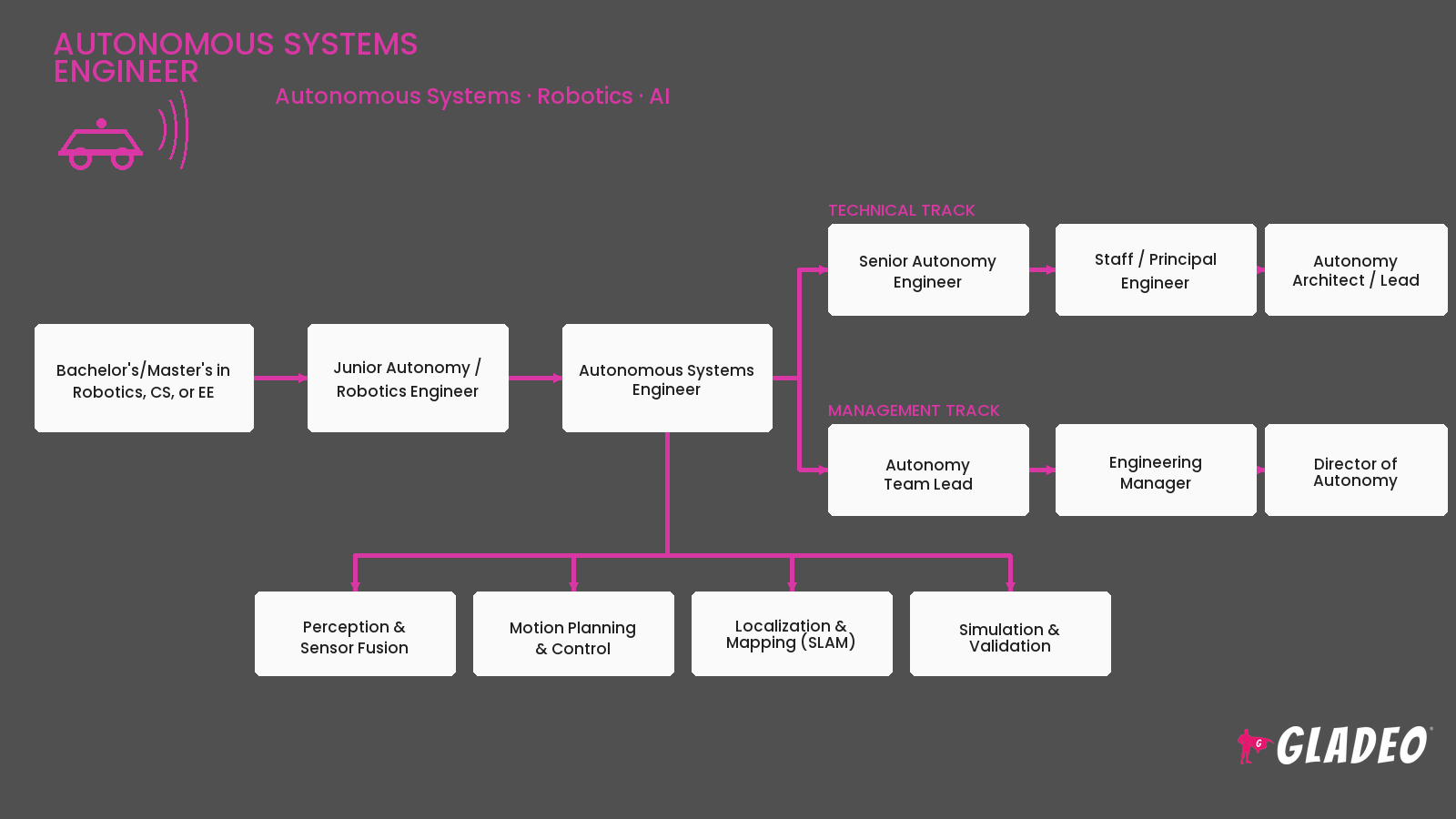
Click here to download the infographic
Newsfeed

Featured Jobs
Online Courses and Tools